Advertisements
Advertisements
प्रश्न
Two long straight parallel current-carrying conductors are kept ‘a’ distant apart in the air. The direction of current in both the conductors is the same. Find the magnitude of force per unit length and the direction of the force between them. Hence define one ampere.
Advertisements
उत्तर
The magnetic induction B1 set up by the current I1 flowing in the first conductor at a point somewhere in the middle of the second conductor is
`B_1 = (mu_0I_1)/(2pia)` ...(1)

The magnetic force acting on the portion P2Q2 of length ℓ2 of the second conductor is
F2 = l2 ℓ2 B1 sin 90° ...(2)
From equation (1) and (2),
F2 = `(mu_0I_1I_2ℓ_2)/(2pia)`, towards first conductor
`F_2/ℓ_2 = (mu_0I_1I_2)/(2pia)` ...(3)
The magnetic induction B2 set up by the current I2 flowing in the second conductor at a point somewhere in the middle of the first conductor is
`B_2 = (mu_0I_2)/(2pia)` ...(4)
The magnetic force acting on the portion P1Q1 of length ℓ1 of the first conductor is
F1 = I1ℓ1B2 sin 90° ...(5)
From equation (3) and (5)
`F_1 = (mu_0I_1I_2ℓ_1)/(2pia)`, towards second conductor
`F_1/ℓ_1 = (mu_0I_1I_2)/(2pia)` ...(6)
The standard definition of 1A
If I1 = I2 = 1A
ℓ1 = ℓ2 = 1m
a = 1m in V/A then `F_1/ℓ_1 = F_2/ℓ_2 = (mu_0 xx 1 xx 1)/(2pi xx 1) = 2 xx 10^-7` N/m
∴ One ampere is that electric current which when flows in each one of the two infinitely long straight parallel conductors placed 1m apart in vacuum causes each one of them to experience a force of 2 × 10⁻⁷ N/m.
APPEARS IN
संबंधित प्रश्न
A long, straight wire of radius r carries a current i and is placed horizontally in a uniform magnetic field B pointing vertically upward. The current is uniformly distributed over its cross section. (a) At what points will the resultant magnetic field have maximum magnitude? What will be the maximum magnitude? (b) What will be the minimum magnitude of the resultant magnetic field?
Consider a 10-cm long piece of a wire which carries a current of 10 A. Find the magnitude of the magnetic field due to the piece at a point which makes an equilateral triangle with the ends of the piece.
Two parallel wires separated by a distance of 10 cm carry currents of 10 A and 40 A along the same direction. Where should a third current by placed so that it experiences no magnetic force?
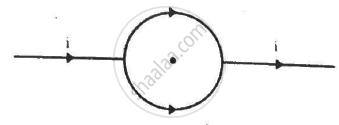
A conducting circular loop of radius a is connected to two long, straight wires. The straight wires carry a current i as shown in figure. Find the magnetic field B at the centre of the loop.
Five long wires A, B, C, D and E, each carrying current I are arranged to form edges of a pentagonal prism as shown in figure. Each carries current out of the plane of paper.

- What will be magnetic induction at a point on the axis O? AxisE is at a distance R from each wire.
- What will be the field if current in one of the wires (say A) is switched off?
- What if current in one of the wire (say) A is reversed?
Two long parallel wires kept 2 m apart carry 3A current each, in the same direction. The force per unit length on one wire due to the other is ______.
When two long, straight, current-carrying conductors are placed parallel to each other and the currents flow in the same direction, the conductors:
If the current Ia in conductor a is doubled while Ib and the distance d remain unchanged, the force per unit length F/L between the conductors:
