Please select a subject first
Advertisements
Advertisements
Obtain the expression for the energy stored per unit volume in a charged parallel plate capacitor.
Concept: Energy Stored in a Charged Capacitor
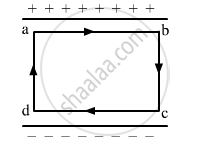
The electric field inside a parallel plate capacitor is E. Find the amount of work done in moving a charge q over a closed loop a b c d a.
Concept: Combination of Capacitors
Considering the case of a parallel plate capacitor being charged, show how one is required to generalize Ampere's circuital law to include the term due to displacement current.
Concept: The Parallel Plate Capacitor
A parallel plate capacitor of capacitance C is charged to a potential V. It is then connected to another uncharged capacitor having the same capacitance. Find out the ratio of the energy stored in the combined system to that stored initially in the single capacitor.
Concept: Capacitors and Capacitance
Find out the amount of the work done to separate the charges at infinite distance.
Concept: Potential Energy of a System of Charges
What is the geometrical shape of equipotential surfaces due to a single isolated charge?
Concept: Equipotential Surfaces
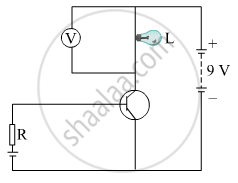
In the given circuit diagram a voltmeter ‘V’ is connected across a lamp ‘L’. Ho would (i) the brightness of the lamp and (ii) voltmeter reading ‘V’ be affected, if the value of resistance ‘R’ is decreased? Justify your answer.
Concept: Effect of Dielectric on Capacitance
Draw the equipotential surfaces due to an electric dipole. Locate the points where the potential due to the dipole is zero.
Concept: Equipotential Surfaces
- Assertion (A): Work done in moving a charge around a closed path, in an electric field is always zero.
- Reason (R): Electrostatic force is a conservative force.
Concept: Potential Energy of a System of Charges
Justify your answers for each case.
State the significance of the negative value of electrostatic potential energy of a system of charges.
Three charges are placed at the corners of an equilateral triangle ABC of side 2.0 m as shown in the figure. Calculate the electric potential energy of the system of three charges.

Concept: Potential Energy of a System of Charges
The capacitors, each of 4 µF are to be connected in such a way that the effective capacitance of the combination is 6 µF. This can be achieved by connecting ______.
Concept: Combination of Capacitors
Read the following paragraph and answer the questions.
| A capacitor is a system of two conductors separated by an insulator. The two conductors have equal and opposite charges with a potential difference between them. The capacitance of a capacitor depends on the geometrical configuration (shape, size and separation) of the system and also on the nature of the insulator separating the two conductors. They are used to store charges. Like resistors, capacitors can be arranged in series or parallel or a combination of both to obtain the desired value of capacitance. |
- Find the equivalent capacitance between points A and B in the given diagram.

- A dielectric slab is inserted between the plates of the parallel plate capacitor. The electric field between the plates decreases. Explain.
- A capacitor A of capacitance C, having charge Q is connected across another uncharged capacitor B of capacitance 2C. Find an expression for (a) the potential difference across the combination and (b) the charge lost by capacitor A.
OR
Two slabs of dielectric constants 2K and K fill the space between the plates of a parallel plate capacitor of plate area A and plate separation d as shown in the figure. Find an expression for the capacitance of the system.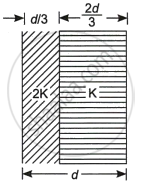
Concept: Capacitors and Capacitance
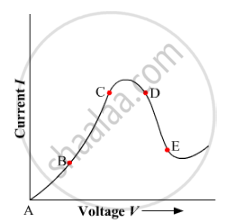
Graph showing the variation of current versus voltage for a material Ga As is shown in the figure. Identify the region of
(i) negative resistance
(ii) where Ohm's law is obeyed.
Concept: Ohm's Law
Use Kirchhoff's rules to obtain conditions for the balance condition in a Wheatstone bridge.
Concept: Kirchhoff’s Laws
A cell of emf 'E' and internal resistance 'r' is connected across a variable load resistor R. Draw the plots of the terminal voltage V versus (i) R and (ii) the current I.
It is found that when R = 4 Ω, the current is 1 A and when R is increased to 9 Ω, the current reduces to 0.5 A. Find the values of the emf E and internal resistance r.
Concept: Cells, EMF, and Internal Resistance
A cell of emf 'E' and internal resistance 'r' is connected across a variable resistor 'R'. Plot a graph showing variation of terminal voltage 'V' of the cell versus the current 'I'. Using the plot, show how the emf of the cell and its internal resistance can be determined.
Concept: Cells, EMF, and Internal Resistance
A long straight current carrying wire passes normally through the centre of circular loop. If the current through the wire increases, will there be an induced emf in the loop? Justify.
Concept: Cells, EMF, and Internal Resistance
(a) drift speed
(b) current density
(c) electric current
(d) electric field
Concept: Drift of Electrons and the Origin of Resistivity
The current is drawn from a cell of emf E and internal resistance r connected to the network of resistors each of resistance r as shown in the figure. Obtain the expression for
- the current draw from the cell and
- the power consumed in the network.
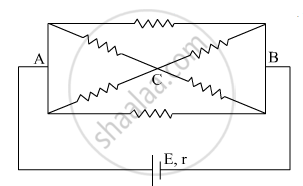
Concept: Kirchhoff’s Laws
State Kirchhoff's rules for an electric network. Using Kirchhoff's rules, obtain the balance condition in terms of the resistances of four arms of Wheatstone bridge.
Concept: Kirchhoff’s Laws
