CBSE Science (English Medium) कक्षा १२ Important Questions for Physics - Moving Charges and Magnetism
Advertisements
Advertisements
Chapter wise important questions with answers and solutions for Physics in CBSE Science (English Medium) कक्षा १२.
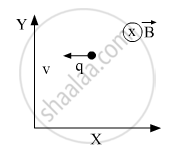
If an electric field \[\vec{E}\] is also applied such that the particle continues moving along the original straight line path, what should be the magnitude and direction of the electric field \[\vec{E}\] ?
अध्याय: [4] Moving Charges and Magnetism
With the help of a neat and labelled diagram, explain the principle and working of a moving coil galvanometer ?
अध्याय: [4] Moving Charges and Magnetism
Define current sensitivity of a galvanometer.
अध्याय: [4] Moving Charges and Magnetism
State Kirchhoff's rules and explain on what basis they are justified.
अध्याय: [4] Moving Charges and Magnetism
Given the resistances of 1 Ω, 2 Ω, 3 Ω, how will be combine them to get an equivalent resistance of (11/3) Ω?
अध्याय: [4] Moving Charges and Magnetism
Given the resistances of 1 Ω, 2 Ω, 3 Ω, how will be combine them to get an equivalent resistance of (11/5) Ω?
अध्याय: [4] Moving Charges and Magnetism
Why does a galvanometer when connected in series with a capacitor show a momentary deflection, when it is being charged or discharged?
How does this observation lead to modifying the Ampere's circuital law?
Hence write the generalised expression of Ampere's law.
अध्याय: [4] Moving Charges and Magnetism
A wire AB is carrying a steady current of 12 A and is lying on the table. Another wire CD carrying 5 A is held directly above AB at a height of 1 mm. Find the mass per unit length of the wire CD so that it remains suspended at its position when left free. Give the direction of the current flowing in CD with respect to that in AB. [Take the value of g = 10 ms−2]
अध्याय: [4] Moving Charges and Magnetism
A wire AB is carrying a steady current of 10 A and is lying on the table. Another wire CD carrying 6 A is held directly above AB at a height of 2 mm. Find the mass per unit length of the wire CD so that it remains suspended at its position when left free. Give the direction of the current flowing in CD with respect to that in AB. [Take the value of g = 10 ms−2]
अध्याय: [4] Moving Charges and Magnetism
A wire AB is carrying a steady current of 6 A and is lying on the table. Another wire CD carrying 4 A is held directly above AB at a height of 1 mm. Find the mass per unit length of the wire CD so that it remains suspended at its position when left free. Give the direction of the current flowing in CD with respect to that in AB. [Take the value of g = 10 ms−2]
अध्याय: [4] Moving Charges and Magnetism
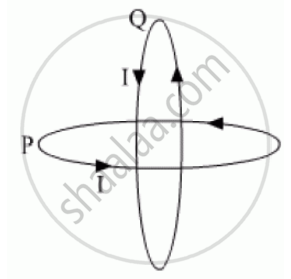
Two identical circular wires P and Q each of radius R and carrying current ‘I’ are kept in perpendicular planes such that they have a common centre as shown in the figure. Find the magnitude and direction of the net magnetic field at the common centre of the two coils.
अध्याय: [4] Moving Charges and Magnetism
A rectangular loop of wire of size 4 cm × 10 cm carries a steady current of 2 A. A straight long wire carrying 5 A current is kept near the loop as shown. If the loop and the wire are coplanar, find
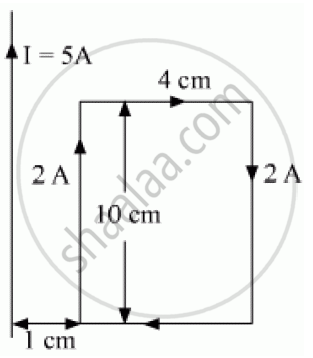
(i) the torque acting on the loop and
(ii) the magnitude and direction of the force on the loop due to the current carrying wire.
अध्याय: [4] Moving Charges and Magnetism
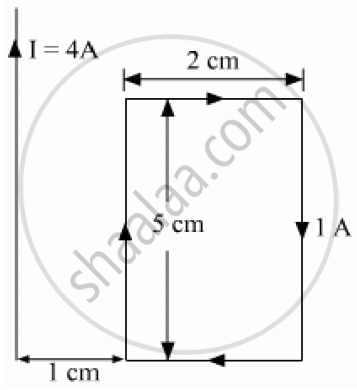
A rectangular loop of wire of size 2 cm × 5 cm carries a steady current of 1 A. A straight long wire carrying 4 A current is kept near the loop as shown. If the loop and the wire are coplanar, find (i) the torque acting on the loop and (ii) the magnitude and direction of the force on the loop due to the current carrying wire.
अध्याय: [4] Moving Charges and Magnetism
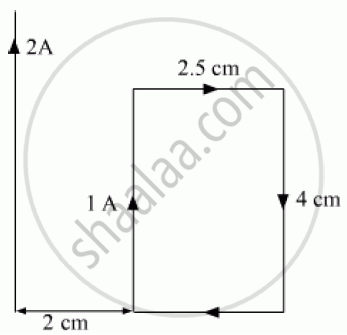
A rectangular loop of wire of size 2.5 cm × 4 cm carries a steady current of 1 A. A straight wire carrying 2 A current is kept near the loop as shown. If the loop and the wire are coplanar, find the (i) torque acting on the loop and (ii) the magnitude and direction of the force on the loop due to the current carrying wire.
अध्याय: [4] Moving Charges and Magnetism
Calculate the value of the resistance R in the circuit shown in the figure so that the current in the circuit is 0.2 A. What would b the potential difference between points B and E?

अध्याय: [4] Moving Charges and Magnetism
Calculate the value of the resistance R in the circuit shown in the figure so that the current in the circuit is 0.2 A. What would b the potential difference between points A and B?

अध्याय: [4] Moving Charges and Magnetism
A magnetised needle of magnetic moment 4.8 × 10⁻² JT−1 is placed at 30° with the direction of uniform magnetic field of magnitude 3 × 10⁻² T. Calculate the torque acting on the needle.
अध्याय: [4] Moving Charges and Magnetism
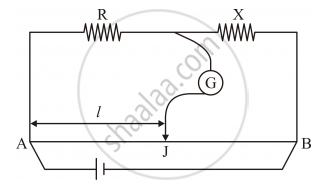
In the meter bridge experiment, balance point was observed at J with AJ = l.
(i) The values of R and X were doubled and then interchanged. What would be the new position of balance point?
(ii) If the galvanometer and battery are interchanged at the balance position, how will the alance point get affected?
अध्याय: [4] Moving Charges and Magnetism
In the given circuit, assuming point A to be at zero potential, use Kirchhoff’s rules to determine the potential at point B.

अध्याय: [4] Moving Charges and Magnetism
State the principle of the working of a moving coil galvanometer, giving its labeled diagram ?
