Definitions [15]
The phenomenon in which electric current is generated in a conductor or closed coil due to a varying magnetic field is called electromagnetic induction.
Magnetic flux linked with any surface is equal to the total number of magnetic lines of force passing normally through it.
Magnetic flux (ΦB) is the measure of magnetic field lines passing through a surface.
Define the right-hand thumb rule.
If the current-carrying conductor is held in the right hand such that the thumb points in the direction of the current, then the direction of the curl of the fingers will give the direction of the magnetic field.
Whenever the number of magnetic lines of force (magnetic flux) passing through a coil changes, an electric current is induced in the coil. This current is called the induced current.
The direction of the induced EMF (and hence the induced current) in a closed conducting loop is always such that it opposes the change in magnetic flux that produced it.
The emf induced across the ends of a conductor due to its motion in a magnetic field is called motional emf.
Inductance is the ratio of total magnetic flux linkage to the current producing it.
For a closely wound coil of N turns, the total magnetic flux associated with the coil is called the flux linkage.
Define mutual inductance.
The mutual inductance (M) of two circuits (or coils) is the magnetic flux (Φs) linked with the secondary circuit per unit current (IP) of the primary circuit.
The property of two coils by which a change in current in one coil induces an emf in the other coil — equal to the magnetic flux linked with one circuit per unit current in the other, or the value of induced emf produced in the secondary circuit per unit rate of change in current in the primary circuit — is called mutual inductance.
OR
Mutual Inductance (M) of a pair of coils is defined as the ratio of the total magnetic flux linkage in the secondary coil to the current in the primary coil that produces it.
The coefficient of coupling K between two coils is the fraction of the total magnetic flux produced by one coil that links with the other coil.
Define the coefficient of self-induction.
It is defined as magnetic flux linked with the solenoid when unit current flows through it.
Define self-inductance.
The self-inductance of a circuit is the ratio of magnetic flux (produced due to current in the circuit) linked with the circuit to the current flowing in it.
The property of a coil by which it opposes the change in its own current and induces an emf in itself — numerically equal to the ratio of magnetic flux (produced due to current in the circuit) linked with the circuit to the current flowing in it, or the ratio of induced emf produced around the circuit to the rate of change of current in it — is called self-inductance.
OR
The self-inductance (L) of a coil is defined as the ratio of the total magnetic flux linkage through the coil to the current flowing in it. Equivalently, it equals the magnitude of the induced EMF per unit rate of change of current.
An a.c. generator is a device which converts the mechanical energy into the electrical energy using the principle of electromagnetic induction.
Formulae [8]
For a uniform magnetic field and a plane surface,
Where:
| Symbol | Meaning |
|---|---|
| ΦB | Magnetic flux |
| \[\vec B\] | Magnetic field |
| \[\vec A\] | Area vector of the surface |
| A | Area of the surface |
| θ | Angle between \[\vec B\] and \[\vec A\] |
For a non-uniform magnetic field or a curved surface, divide the surface into very small area elements \[d\vec A\].
\[{\Phi_B=\int\vec{B}\cdot d\vec{A}}\]
For a coil of N turns, when every turn contributes equally,
\[{\Phi=NBA\cos\theta}\]
This is the magnetic flux linkage of the coil.
The mathematical form of Faraday's law with Lenz's law incorporated is
\[\varepsilon=-N\frac{d\Phi_B}{dt}\]
e = Blv
- B = magnetic field
- l = length of conductor
- v = velocity
N2ϕ21 ∝ I1 ⟹ N2ϕ21 = M ⋅ I1
Therefore:
M = K\[\sqrt {L_1L_2}\]
Where:
- L1, L2 = Self-inductances of coil 1 and coil 2
- K = Coefficient of coupling (dimensionless, no units)
- Range: 0 ≤ K ≤ 1
Therefore:
M ≤ \[\sqrt {L_1L_2}\]
L = \[\frac{N\Phi_B}{I}\]
ε = -L\[\frac{dI}{dt}\]
Where:
| Symbol | Meaning | SI Unit |
|---|---|---|
| L | Self-inductance (coefficient) | Henry (H) |
| N | Number of turns in the coil | — |
| \[Φ_B\] | Magnetic flux through one turn | Weber (Wb) |
| I | Current through the coil | Ampere (A) |
| ε | Induced EMF (self-induced) | Volt (V) |
| dI/dt | Rate of change of current | A s⁻¹ |
Theorems and Laws [7]
Statement:
The direction of the induced emf, or the induced current, in any circuit is such as to oppose the cause that produces it. This law is known as Lenz’s Law.
Explanation / Proof:
- When the north pole of a magnet is moved towards the coil, an induced current flows in the coil in such a direction that the near (left) face of the coil behaves like a north pole.
- Due to the repulsion between the like poles, the motion of the magnet towards the coil is opposed.
- When the north pole of the magnet is moved away from the coil, the induced current flows in such a direction that the near face of the coil becomes a south pole.
- The attraction between opposite poles then opposes the motion of the magnet away from the coil.
In both cases, the induced current opposes the magnet's motion, which is the cause of the current. Therefore, work has to be done to move the magnet, and this mechanical work appears as electrical energy in the coil.
Direction of Induced Current (Fleming’s Right-Hand Rule):
- Stretch the right-hand thumb, forefinger, and middle finger so that they are mutually perpendicular.
- The forefinger points in the direction of the magnetic field.
- The thumb points in the direction of motion of the conductor.
- The middle finger then gives the direction of the induced current.
Conclusion:
Lenz’s Law shows that the induced current always acts in such a direction as to oppose the cause that produces it. This ensures that mechanical energy is converted into electrical energy, and no energy is produced without work being done.
State Faraday’s laws of electromagnetic induction.
First law: Whenever there is a change of magnetic flux in a closed circuit, an induced emf is produced in the circuit. This law is a qualitative law as it only indicates the characteristics of induced emf.
Second law: The magnitude of the induced emf produced in the circuit is directly proportional to the rate of change of the magnetic flux linked with the circuit. This law is known as the quantitative law, as it gives the magnitude of the induced emf.
Faraday’s First Law: Whenever the magnetic flux linked with a circuit changes, an emf is induced in the circuit.
Faraday’s Second Law: The magnitude of the induced emf is equal to the rate of change of magnetic flux.
e = `-(d phi)/dt`
For a coil of N turns:
e = `-N (d phi)/dt`
Negative sign indicates Lenz’s law (direction opposes cause).
State Lenz’s Law.
It is stated that the direction of induced e.m.f. is always in such a direction that it opposes the change in magnetic flux.
e = `(d phi)/(dt)`
Consider a rectangular metal coil PQRS. Let ‘L’ be the length of the coil. It is placed in a partly magnetic field ‘B’. The direction of the magnetic field is perpendicular to the paper and into the paper. The ‘x’ part of the coil is in the magnetic field at instant t. If the coil is moved towards the right with a velocity v = `dx/dt` with the help of an external agent, such as a hand. The magnetic flux through the coil is:
Φ = BA = BLx
∴ Φ = BLx ...(1)
There is relative motion of a current through the coil. Let ‘i’ be current through the coil.
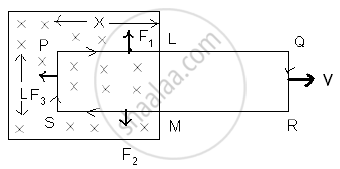
Three forces act on the coil.
F1 on conductor PL ∴ F1 = Bi x, vertically upward.
F2 on conductor MS ∴ F2 = Bi x, vertically downward.
F3 on conductor SP ∴ F3 = Bi L towards left.
F1 and F2 are equal and opposite and also on the same line. They will cancel each other; F3 is a resultant force. The external agent has to do work against this force.
∴ F3 = −Bi l ...(−ve sign indicates that force is opposite to dx.)
If dx is the displacement in time dt, then the work done (dw) = F3 dx.
∴ dw = − BiL dx
This power is an electrical energy ‘ei’ where ‘e’ is an induced e.m.f.
∴ ei = `-(B_i ldx)/(dt)`
∴ e = `-(BLdx)/(dt)`
∴ e = −BLv
∴ e = `-d/dt (BLx)`
∴ e = `(-d phi)/(dt)` ...[from eq (1)]
Lenz’s Law states that the direction of the induced electromotive force (EMF) and the resulting current in a conductor is always such that it opposes the change in magnetic flux that caused it.
Mathematically, Lenz’s Law is expressed as:
ε = `(-d phi_B)/dt`
Where,
ε = Induced EMF
ΦB = Magnetic flux
The negative sign indicates opposition to the change in flux.
Statement:
When the magnetic flux through a circuit is changing, an induced electromotive force (emf) is set up in the circuit whose magnitude is equal to the negative rate of change of magnetic flux. This is also known as Neumann’s Law.
Mathematical Expression:
If ΔΦB is the change in magnetic flux in a time interval Δt, then the induced emf e is given by:
e = \[-\frac{\Delta\Phi_B}{\Delta t}\]
In the limiting case as Δt → 0:
e = \[-\frac{d\Phi_{B}}{dt}\]
- If dΦB is in weber (Wb) and dtdtdt in seconds (s), then the emf eee will be in volts (V).
- This equation represents an independent experimental law, which cannot be derived from other experimental laws.
For a tightly-wound coil of N turns, the induced emf becomes:
e = \[-N\frac{d\Phi_B}{dt}\] or e = \[-\frac{d(N\Phi_B)}{dt}\]
Here, NΦB is called the ‘number of magnetic flux linkages’ in the coil, and its unit is weber-turns.
Explanation:
Consider a magnet and a coil:
- When the north pole of a magnet is near a coil, a certain number of magnetic flux lines pass through the coil.
- If either the coil or the magnet is moved, the number of magnetic flux lines (i.e., the magnetic flux) through the coil changes.
Cases:
- Magnet moved away from the coil → Decrease in magnetic flux through the coil.
- Magnet brought closer to the coil → Increase in magnetic flux through the coil.
In both cases, an emf is induced in the coil during the motion of the magnet.
- Faster motion → Greater rate of change of flux → Higher induced emf.
- If both the magnet and coil are stationary, or both are moving in the same direction with the same velocity, there is no change in flux → No induced emf.
Special Case:
- If the coil is an open circuit (i.e., infinite resistance), emf is still induced, but no current flows.
- This shows that it is the change in magnetic flux that induces emf, not current.
Conclusion:
Neumann’s Law establishes that a changing magnetic flux through a circuit induces an emf, and the induced emf is proportional to the rate of change of flux, with a negative sign indicating the direction (as per Lenz’s law).
Statement
The induced EMF in a closed loop has a direction such that the current it drives would create a magnetic flux to oppose the change in flux through the circuit.
Mathematically, this is captured by the negative sign:
Proof (Lenz's Law as Conservation of Energy)
Claim: Lenz's law is a necessary consequence of the Law of Conservation of Energy.
Proof by contradiction:
Suppose, contrary to Lenz's law, the induced current aided the change in flux instead of opposing it.
- When the N-pole of a magnet approaches a coil, the induced current (if aiding) would create a South pole on the near face of the coil
- This South pole would attract the incoming North pole of the magnet
- The magnet would accelerate towards the coil without any external effort
- The accelerating magnet would induce more current, which would attract the magnet even more strongly
- This would result in continuously increasing kinetic energy and electrical energy, generated from nothing
- This is a perpetual motion machine — a direct violation of the Law of Conservation of Energy
Since this is impossible, the induced current must oppose the flux change — Lenz's law is proved.
Conclusion
- Lenz's law is not an arbitrary rule — it is mandated by energy conservation
- The work done by the external agent (to overcome the opposing electromagnetic force) is the source of all electrical energy generated
- Without Lenz's law, electromagnetic induction would violate the most fundamental law of physics
Statement: The mutual inductance of coil 1 with respect to coil 2 equals the mutual inductance of coil 2 with respect to coil 1.
This is called the Reciprocity Theorem of Mutual Inductance.
Implication: It does not matter which coil drives the current — the mutual inductance M between the pair is always the same property of the system, not just one coil.youtube
Two circular loops, one of small radius r and the other of larger radius R, such that R >> r, are placed coaxially with centres coinciding. Obtain the mutual inductance of the arrangement.

Let a current IP flow through the circular loop of radius R. The magnetic induction at the centre of the loop is
BP = `(mu_0I_P)/(2R)`
As, r << R, the magnetic induction BP may be considered to be constant over the entire cross-sectional area of the inner loop of radius r. Hence magnetic flux linked with the smaller loop will be
`Φ_S = B_PA_S = (mu_0I_P)/(2R)pir^2`
Also, ΦS = MIP
∴ M = `Phi_S/I_P = (mu_0pir^2)/(2R)`
Key Points
- Electricity and magnetism are interrelated.
- Electric current can produce a magnetic field.
- A changing magnetic field can produce electric current.
- The production of electric current by a varying magnetic field is called electromagnetic induction.
- Michael Faraday showed in 1831 that a moving magnet can produce current in a conductor.
- The current produced due to electromagnetic induction is called induced current.
- Generators, transformers, induction motors, and wireless chargers work on electromagnetic induction.
- Current is induced in a coil either by flux from a neighbouring coil or by the coil's own changing flux.
- For a closely wound coil, flux linkage = NΦB.
- Inductance L is the constant of proportionality: NΦB = LI.
- L depends only on coil geometry and material properties — not on current.
- Like capacitance, inductance is a scalar with SI unit henry (H) and dimensional formula [ML2T−2A−2].
Important Questions [52]
- A circular coil of cross-sectional area 200 cm^2 and 20 turns is rotated about the vertical diameter with angular speed of 50 rad s^−1 in a uniform magnetic field of magnitude 3.0 × 10^−2T. Calculate the maximum value of the current in the coil.
- A horizontal straight wire 10 m long extending from east to west is falling with a speed of 5.0 m s−1, at right angles to the horizontal component of the earth’s magnetic field, 0.30 × 10⁻⁴ Wb m−2.
- When a Bar Magnet is Pushed Towards (Or Away) from the Coil Connected to a Galvanometer, the Pointer in the Galvanometer Deflects. Identify the Phenomenon Causing this Deflection and Write the Factors on Which the Amount and Direction of the Deflection Depends. State the Laws Describing this Phenomenon.
- Show Diagrammatically How an Alternating Emf is Generated by a Loop of Wire Rotating in a Magnetic Field. Write the Expression for the Instantaneous Value of the Emf Induced in the Rotating Loop.
- When Puja, a Student of 10th Class, Watched Her Mother Washing Clothes in the Open, She Observed Coloured Soap Bubbles and Was Curious to Know Why the Soap Bubbles Appear Coloured.
- Welders Wear Special Goggles Or Face Masks with Glass Windows to Protect Their Eyes from Electromagnetic Radiations. Name the Radiations and Write the Range of Their Frequency.
- A Light Metal Disc on the Top of an Electromagnet is Thrown up as the Current is Switched On. Why? Give Reason.
- Welders wear special glass goggles while working. Why? Explain.
- Plot a Graph Showing the Variation of Magnetic Flux and Induced Emf as a Function of Time.
- Figure Shows a Rectangular Loop Conducting Pqrs in Which the Arm Pq is Free to Move. a Uniform Magnetic Field Acts in the Direction Perpendicular to the Plane of the Loop.
- How Does the Mutual Inductance of a Pair of Coils Change When (I) Distance Between the Coils is Increased and (Ii) Number of Turns in the Coils is Increased?
- The Current Flowing Through an Inductor of Self Inductance L is Continuously Increasing. Plot a Graph Showing the Variation of Magnetic Flux Versus the Current
- Draw a Schematic Sketch of an Ac Generator Describing Its Basic Elements. State Briefly Its Working Principle.
- A pair of adjacent coils has a mutual inductance of 1.5 H. If the current in one coil changes from 0 to 20 A in 0.5 s, what is the change of flux linkage with the other coil?
- When a conducting loop of resistance 10 Ω and area 10 cm2 is removed from an external magnetic field acting normally, the variation of induced current-I in the loop with time t is as
- State the Principle and Working of a Dynamo.
- State Faraday’s laws of electromagnetic induction.
- State Lenz’s Law.
- What is the Direction of Induced Currents in Metal Rings 1 and 2 When Current I in the Wire is Increasing Steadily?
- Predict the Direction of Induced Current in a Metal Ring When the Ring is Moved Towards a Straight Conductor with Constant Speed V. the Conductor is Carrying Current I in the Direction Shown
- Predict the Direction of Induced Current in Metal Rings 1 and 2 When Current I in the Wire is Steadily Decreasing?
- Describe a Simple Experiment (Or Activity) to Show that the Polarity of Emf Induced in a Coil
- Show that Lenz'S Law is a Consequence of Conservation of Energy.
- A Bar Magnet is Moved in the Direction Indicated by the Arrow Between Two Coils Pq and Cd. Predict the Directions of Induced Current in Each Coil.
- Explain, with the Help of a Suitable Example, How We Can Show that Lenz'S Law is a Consequence of the Principle of Conservation of Energy.
- State Lenz'S Law. Illustrate, by Giving an Example, How this Law Helps in Predicting the Direction of the Current in a Loop in the Presence of a Changing Magnetic Flux.
- Predict the Directions of Induced Currents in Metal Rings 1 and 2 Lying in the Same Plane Where Current I in the Wire is Increasing Steadily.
- Write the S.I. unit of mutual inductance.
- Explain the Meaning of the Term Mutual Inductance.
- Draw a Necessary Arrangement for Winding of Primary and Secondary Coils in a Step-up Transformer
- Define mutual inductance.
- Find Out the Expression for the Emf Induced in the Coil C1 Due to a Change in the Current Through the Coil C2.
- Plot a Graph Showing the Variation Of Magnetic Potential Energy Stored Versus the Current.
- A long solenoid with 15 turns per cm has a small loop of area 2.0 cm2 placed inside the solenoid normal to its axis. If the current carried by the solenoid changes steadily from 2.0 A to 4.0 A
- Consider Two Concentric Circular Coils, One of Radius R1 and the Other of Radius R2 (R1 < R2) Placed Coaxially with Centres Coinciding with Each Other. Obtain the Expression for the Mutual Inductance of the Arrangement.
- Define mutual inductance.
- The Currents Flowing in the Two Coils of Self-inductance L1 = 16 Mh and L2 = 12 Mh Are Increasing at the Same Rate. If the Power Supplied to the Two Coil is Equal, Find the Ratio of the Energies Store
- Derive the expression for the self-inductance of a long solenoid of cross sectional area A and length l, having n turns per unit length.
- The Currents Flowing in the Two Coils of Self-inductance L1 = 16 Mh and L2 = 12 Mh Are Increasing at the Same Rate. If the Power Supplied to the Two Coil is Equal, Find the Ratio of the Currents ?
- The Currents Flowing in the Two Coils of Self-inductance L1 = 16 Mh and L2 = 12 Mh Are Increasing at the Same Rate. If the Power Supplied to the Two Coil is Equal, Find the Ratio of Induced Voltages ?
- A Plot of Magnetic Flux (φ) Versus Current (I) is Shown in the Figure for Two Inductors a and β. Which of the Two Has Larger Value of Self Inductance?
- A Toroidal Solenoid with Air Core Has an Average Radius of 15 Cm, Area of Cross-section 12 Cm2 And Has 1200 Turns. Calculate the Self-inductance of the Toroid.
- Define Self Inductance. Write Its S.I. Units.
- Derive an Expression for Self Inductance of a Long Solenoid of Length L, Cross-sectional Area a Having N Number of Turns.
- Define Self-inductance of a Coil. Show that Magnetic Energy Required to Build up the Current I in a Coil of Self Inductance L is Given by 1 2 L I 2
- When an Inductor is Connected to a 200 V Dc Voltage, a Current at 1a Flows Through It. When the Same Inductor is Connected to a 200 V, 50 Hz Ac Source, Only 0.5 a Current Flows. Explain, Why?
- Define Self-inductance. Write Its Si Units.
- Define the coefficient of self-induction.
- In a Given Coil of Self-inductance of 5 Mh, Current Changes from 4 a to 1 a in 30 ms. Calculate the Emf Induced in the Coil.
- Calculate the self-inductance of a coil using the following data obtained when an AC source of frequency (200π) Hz and a DC source are applied across the coil.
- A current of 1A flows through a coil when it is connected across a DC battery of 100V. If the DC battery is replaced by an AC source of 100 V and angular frequency of 100 rad s-1, the current reduces
- Explain the construction and working of an electric generator (AC) with the help of a neat diagram.
