(English Medium)
Academic Year: 2013-2014
Date: मार्च 2014
Advertisements
Question 1 is compulsory
Attempt any four From Question 2 to Question 7
Choose the correct answer from the options given below:
Ionisation potential increases over a period from left to right because of the
(A) Atomic radius increases and nuclear charge increases
(B) Atomic radius decreases and nuclear charge decreases
(C) Atomic radius increases and nuclear charge decreases
(D) Atomic radius decreases and nuclear charge increases
Chapter: [1] Periodic Table, Periodic Properties and Variations of Properties
Choose the correct answer from the options given below:
A compound X consists of only molecules. Hence, X will have
A. A crystalline hard structure
B. A low melting point and low boiling point
C. An ionic bond
D. A strong force of attraction between its molecules
Chapter: [2] Chemical Bonding
When fused lead bromide is electrolysed, we observe ______.
A silver grey deposit at the anode and a reddish brown deposit at the cathode.
A silver grey deposit at the cathode and a reddish brown deposit at the anode.
A silver grey deposit at the cathode and reddish brown fumes at the anode.
Silver grey fumes at the anode and reddish brown fumes at the cathode.
Chapter:
Choose the correct answer from the options given below:
The main ore used for the extraction of iron is
A. Haematite
B. Calamine
C. Bauxite
D. Cryolite
Chapter:
Choose the correct answer from the options given below:
Heating an ore in a limited supply of air or in the absence of air at a temperature just below its melting point is known as
A. Smelting
B. Ore-dressing
C. Calcination
D. Bessemerisation
Chapter:
Choose the correct answer from the options given below:
If an element A belongs to Period 3 and Group II, then it will have
A. 3 shells and 2 valence electrons
B. 2 shells and 3 valence electrons
C. 3 shells and 3 valence electrons
D. 2 shells and 2 valence electrons
Chapter: [1] Periodic Table, Periodic Properties and Variations of Properties
Choose the correct answer from the options given below:
The molecule containing a triple covalent bond is
A. Ammonia
B. Methane
C. Water
D. Nitrogen
Chapter:
Choose the correct answer from the options given below:
The electrolyte used for electroplating an article with silver is
A. Silver nitrate solution
B. Silver cyanide solution
C. Sodium argentocyanide solution
D. Nickel sulfate solution
Chapter: [6] Electrolysis
Choose the correct answer from the options given below:
Aluminum powder is used in thermite welding because
A. It is a strong reducing agent
B. It is a strong oxidizing agent
C. It is corrosion resistant
D. It is a good conductor of heat
Chapter:
Choose the correct answer from the options given below:
The IUPAC name of acetylene is
A. Propane
B. Propyne
C. Ethene
D. Ethyne
Chapter:
Fill in the blanks from the choices given within brackets:
The basicity of acetic acid is-------- (3, 1, 4).
Chapter: [9.6] Carboxylic Acids
Fill in the blanks from the choices given within brackets:
The compound formed when ethanol reacts with sodium is____ (sodium ethanoate, sodium ethoxide, sodium propanoate).
Chapter:
Quicklime is not used to dry HCl gas because _____.
CaO is alkaline.
CaO is acidic.
CaO is neutral.
Chapter: [8.4] Sulphuric Acid
Ammonia gas is collected by ______.
upward displacement of air
downward displacement of water
downward displacement of air
Chapter: [8.2] Ammonia
Cold, dilute nitric acid reacts with copper to give ______.
Sulphur dioxide
Nitrogen dioxide
Nitric oxide
Sulphuric acid
Hydrogen
Chapter: [8.3] Nitric Acid
Give one word or phrase for the following:
The ratio of the mass of a certain volume of gas to the mass of an equal volume of hydrogen under the same conditions of temperature and pressure.
Chapter: [5.2] Relative Atomic Mass, Relative Molecular Mass and Mole Concept
Give one word or phrase for the following:
Formation of ions from molecules
Chapter: [1] Periodic Table, Periodic Properties and Variations of Properties
Give one word or phrase for the following:
Electrolytic deposition of a superior metal on a baser metal.
Chapter: [6] Electrolysis
Give one word or phrase for the following:
Hydrocarbons containing a \[ \begin{array}{ccccc} & & \mathrm{O} & & \\[-2pt] & & \big\| & & \\[-2pt] & \!-\! & \mathrm{C} & \!-\! & \end{array} \] functional group
Chapter:
Give one word or phrase for the following:
The amount of energy released when an atom in the gaseous state accepts an electron to form an anion.
Chapter: [1] Periodic Table, Periodic Properties and Variations of Properties
Match the options A to E with the statements
| A | Alkyne | 1 | No. of molecules in 22.4 dm-3 of carbon dioxide at STP |
| B | Alkane | 2 | An element with the electronic configuration 2,8,8,3 |
| C | Iron | 3 | CnH2n + 2 |
| D | 6.023 × 10²³ | 4 | CnH2n − 2 |
| E | Metal | 5 | The metal which forms two types of ions |
Chapter:
Write a balanced equation for the action of heat on a mixture of copper and concentrated nitric acid.
Chapter: [8.3] Nitric Acid
Write a balanced equation for the action of warm water on magnesium nitride.
Chapter: [8.3] Nitric Acid
Write balanced chemical equations to show : The oxidizing action of conc. Sulphuric acid on carbon
Chapter: [8.4] Sulphuric Acid
Write a balanced equation for the action of dilute hydrochloric acid on sodium sulphide.
Chapter: [8.1] Hydrogen Chloride
Give a balanced chemical equation for Preparation of ethane from Sodium propionate
Chapter:
Distinguish between the given pair of compounds using the test given within brackets:
Iron (II) sulphate and iron (III) sulphate (using ammonium hydroxide)
Chapter: [8.2] Ammonia
Distinguish between the given pair of compounds using the test given within bracket:
A lead salt and a zinc salt (using excess ammonium hydroxide)
Chapter: [3.2] Salts and their Preparations
Distinguish between the given pair of compounds using the test given within brackets:
Sodium nitrate and sodium sulphite (using dilute sulphuric acid).
Chapter: [8.4] Sulphuric Acid
Distinguish between the given pairs of compounds using the test given within brackets:
Dilute sulphuric acid and dilute hydrochloric acid (using barium chloride solution)
Chapter: [8.4] Sulphuric Acid
Distinguish between the given pair of compounds using the test given within bracket:
Ethane and ethene (using alkaline potassium permanganate solution).
Chapter:
Oxygen oxidises ethyne to carbon dioxide and water as shown by the equation:
\[\ce{2C2H2 + 5O2 -> 4CO2 + 2H2O}\]
What volume of ethyne gas at STP required to produce 8.4 dm3 of carbon dioxide at STP?
[H = 1, C = 12, O = 16]
Chapter:
A compound made up of two elements X and Y has an empirical formula X2Y. If the atomic weight of X is 10 and that of Y is 5 and the compound ha a vapor density 25, find its molecular formula.
Chapter: [5.3] Percentage Composition, Empirical and Molecular Formulae
State your observation in given case when dilute hydrochloric acid is added to sodium carbonate crystals
Chapter:
State your observation when excess sodium hydroxide is added to calcium nitrate solution
Chapter: [4] Analytical Chemistry
State your observation at the cathode, when acidified aqueous copper sulphate solution is electrolysed with copper electrodes.
Chapter:
State your observation of the following case:
When calcium hydroxide is heated with ammonium chloride crystals.
Chapter: [8.1] Hydrogen Chloride
State your observation When moist starch iodide paper is introduced into chlorine gas.
Chapter: [8.1] Hydrogen Chloride
Advertisements
Study the figure given below and answer the questions which follow:
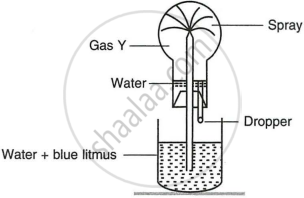
- Identify the gas Y.
- What property of gas Y does this experiment demonstrate?
- Name another gas which has the same property and can be demonstrated through this experiment.
Chapter: [8.1] Hydrogen Chloride
Name the other ion formed when ammonia dissolves in water.
Chapter: [8.2] Ammonia
Give one test which can be used to detect the presence of the ion produced
Chapter:
State the conditions required for the given reaction to take place:
Catalytic hydrogenation of ethyne.
Chapter:
State the conditions required for the given reaction to take place:
Preparation of ethyne from ethylene dibromide.
Chapter:
State the conditions required for the given reaction to take place:
Catalytic oxidation of ammonia to nitric oxide.
Chapter: [8.2] Ammonia
State the conditions required for the given reaction to take place:
Any two conditions for the conversion of sulphur dioxide to sulphur trioxide.
Chapter: [8.4] Sulphuric Acid
State the main components of the following alloys:
Brass
Chapter:
State the main components of the following alloys:
Duralumin
Chapter:
State the main components of the following alloys:
Bronze
Chapter:
Give a balanced chemical equation for Laboratory preparation of Nitric acid.
Chapter: [8.3] Nitric Acid
Give a balanced equation for the preparation of ethanol from monochloroethane and aq. sodium hydroxide.
Chapter:
Give the structural formula for 1, 2-dichloroethane
Chapter: [9.1] Organic Compounds
Draw the structure of the stable positive ion formed when an acid dissolves in water.
Chapter: [3.2] Salts and their Preparations
State the inference drawn from the following observations:
On carrying out the flame test with a salt P, a brick red flame was obtained. What is the cation in P?
Chapter:
State the inference drawn from the following observations:
A gas Q turns moist lead acetate paper silvery black. Identify the gas Q.
Chapter:
State the inference drawn from the following observations
pH of liquid R is 10. What kind of substance is R?
Chapter:
State the inference drawn from the following observations:
Salt S is prepared by reacting dilute sulphuric acid with copper oxide. Identify S.
Chapter: [8.4] Sulphuric Acid
Advertisements
Name the following:
The property possessed by metals by which they can be beaten into sheets.
Chapter:
Name the following: A compound added to lower the fusion temperature of electrolytic bath in the extraction of aluminum
Chapter:
Name the following:
An ore of zinc containing its sulphide.
Chapter:
Give one equation to show the following properties of sulphuric acid:
Dehydrating property
Chapter: [8.4] Sulphuric Acid
Give one equation to show the following properties of sulphuric acid:
Acidic nature
Chapter: [8.4] Sulphuric Acid
Give one equation to show the following properties of sulphuric acid:
As a non-volatile acid
Chapter: [8.4] Sulphuric Acid
Give balanced chemical equations to prepare the following salts
Lead sulphate from lead carbonate
Chapter: [3.2] Salts and their Preparations
Give balanced chemical equation to prepare the following salt:
Sodium sulphate using dilute sulphuric acid.
Chapter:
Give balanced chemical equation to prepare the following salt:
Copper chloride using copper carbonate
Chapter: [3.2] Salts and their Preparations
A cylinder contains 68 g of ammonia gas at STP.
1) What is the volume occupied by this gas?
2) How many moles of ammonia are present in the cylinder?
3) How many molecules of ammonia are present in the cylinder?
[N = 14, H = 1]
Chapter:
Why do covalent compounds exist as gases, liquids or soft solids?
Chapter:
Which electrode—anode or cathode—is the oxidising electrode? Why?
Chapter:
Name the kind of particles present in sodium hydroxide solution.
Chapter: [4] Analytical Chemistry
Name the kind of particles present in carbonic acid.
Chapter: [3.2] Salts and their Preparations
Name the kind of particles present in the sugar solution.
Chapter:
An element Z has atomic number 16. Answer the following questions on Z:
- State the period and group to which Z belongs.
- Is Z a metal or a non-metal?
- State the formula between Z and hydrogen.
- What kind of a compound is this?
Chapter:
M is a metal above hydrogen in the activity series and its oxide has the formula M2O. This oxide when dissolved in water forms the corresponding hydroxide which is a good conductor of electricity. In the above context, answer the following:
1) What kind of combination exists between M and O?
2)How many electrons are there in the outermost shell of M?
3) Name the group to which M belongs.
4) State the reaction taking place at the cathode.
5) Name the product at the anode.
Chapter:
Other Solutions
Submit Question Paper
Help us maintain new question papers on Shaalaa.com, so we can continue to help studentsonly jpg, png and pdf files
CISCE previous year question papers ICSE Class 10 Chemistry with solutions 2013 - 2014
Previous year Question paper for CISCE ICSE Class 10 -2014 is solved by experts. Solved question papers gives you the chance to check yourself after your mock test.
By referring the question paper Solutions for Chemistry, you can scale your preparation level and work on your weak areas. It will also help the candidates in developing the time-management skills. Practice makes perfect, and there is no better way to practice than to attempt previous year question paper solutions of CISCE ICSE Class 10 .
How CISCE ICSE Class 10 Question Paper solutions Help Students ?
• Question paper solutions for Chemistry will helps students to prepare for exam.
• Question paper with answer will boost students confidence in exam time and also give you an idea About the important questions and topics to be prepared for the board exam.
• For finding solution of question papers no need to refer so multiple sources like textbook or guides.
