Advertisements
Advertisements
प्रश्न
With the help of labelled diagrams, describe an activity to find out the conditions under which iron rusts.
Advertisements
उत्तर

- In the initial test tube holding an iron nail, we introduced anhydrous calcium chloride and sealed its opening with a secure cork [see figure (a)]. Anhydrous calcium chloride is introduced to absorb moisture from the humid air in the test tube, thereby drying it. The iron nail in the initial test tube is maintained in an arid atmosphere devoid of water vapour. This test tube is set aside for approximately one week.
- In the second test tube containing an iron nail, we added boiled distilled water [see figure (b)]. Boiled water contains no dissolved air (or oxygen) because boiling removes it. An oil layer is applied over the boiled water in the test tube to prevent external air from interacting with it. The iron nail in the second test tube is maintained in an oxygen-free, boiling aqueous solution. The opening of this test tube is sealed with a cork, and it is set away for approximately one week.
- In the third test tube containing an iron nail, we added unboiled water to ensure that about two-thirds of the nail is submerged, with the remainder above the water and exposed to humid air [see figure (c)]. The iron nail in the third test tube has been simultaneously exposed to air and water. The orifice of this test tube is sealed with a cork, and it is set aside for approximately one week.
After one week, we observe the iron nails kept in all three test tubes, one by one. We find that:
- No rust is seen on the surface of an iron nail kept in dry air (water-free air) in the first test-tube [see figure (a)]. This tells us that rusting of iron does not take place in air alone.
- No rust is seen on the surface of the iron nail kept in air-free, boiled water in the second test-tube [see figure (b)]. This tells us that rusting of iron does not take place in water alone.
- Red-brown rust is observed on the surface of the iron nail placed in the third test tube containing both air and water [see figure (c)]. This indicates that iron rusts in the simultaneous presence of air and water.
The above experiment demonstrates that the rusting of iron requires both air (oxygen) and water (moisture). The rusting of iron objects can be prevented by keeping them dry.
APPEARS IN
संबंधित प्रश्न
What are alloys?
Two methods by which rusting of iron can be prevented are ______ and ______.
What is anodising? Give its applications.
Explain why, iron sheets are coated with zinc.
The process of depositing a thin layer of zinc on iron articles is called ______.
Tiffin boxes are electroplated with ______ but car bumpers are electroplated with ______ to protect them from rusting.
What is corrosion?
Name a common metal which is highly resistant to corrosion.
Name the metal which is a constituent of blood pigment?
State under what conditions corrosion is faster ?
Answer the following question.
List two properties of alloys.
Explain the term – rusting and give a word equation for the formation of rust. If polished iron nails are kept in three separate test tubes, state the contents in each test tube required, to prove the conditions for rusting.
State whether the statement given below is true or false. If false write the correct statement.
Graphite is a lustrous non-metal which conducts electricity.
Observe the following picture and answer the following questions:
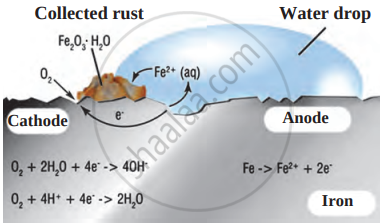
- What is rust?
- Write the chemical formula of rust.
- Write the reaction of oxidation of iron at the anode.
- Write the reaction of oxidation of iron at the cathode.
- What is corrosion?
Write scientific reason.
On exposure to air, silver articles turn blackish after some time.
Draw a neat labelled diagram.
Anodizing
Observe the following diagram and write answers.
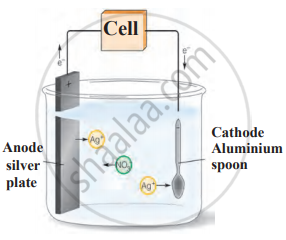
- Name the method.
- Explain the method.
- Give two examples of this method.
Observe the following figure and write the answer of the question.
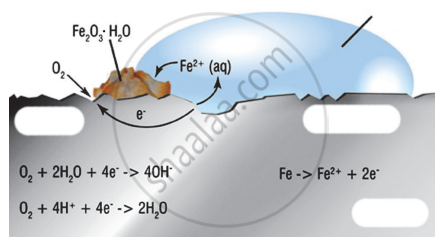
- Which process is shown in the figure?
- Explain the chemical reaction shown in the figure.
- Write the reactions on anode and cathode.
The diagram shows the reaction between metal and dil. acid.

What is the reason for different behaviour of Mg in test tube B?
State whether the following statement is true or false:
Ships suffer a lot of damage though they are painted.
