Advertisements
Advertisements
प्रश्न
The poet has asked a question at the beginning of every stanza. Explain the effect it creates on the reader.
Advertisements
उत्तर
The questions at the beginning of each stanza are used by the poet to stir a sense of inquiry and wonderment in the reader’s mind. It gets the reader curious to know about the nature of the garment woven by the weaver and the reason behind weaving that garment at that particular time. The lines used to raise those questions also serve the purpose of adding the effect of alliteration as a figure of speech.
APPEARS IN
संबंधित प्रश्न
Match the pairs of the words in column ‘A’ with their meaning in column ‘B’ :
Column ‘A’ Column ‘B’
(i) dangling (a) connected with farming
(ii) squeezing (b) attract the attention
(iii) agrarian (c) hanging freely
(iv) captivate (d) pressing firmly
Give antonyms of the following words by adding prefixes :
(i) gratitude
(ii) clear
(iii) believe
(iv) significance
Notice the underlined words in these sentences and choose the option that best explains their meanings.
“What a thunderclap these words were to me!”
The words were:
Notice the underlined words in these sentences and choose the option that best explains their meanings.
Don’t go so fast, you will get to your school in plenty of time.
You will get to your school ______
A crofter is a person who rents or owns a small farm especially in Scotland. Think of other uncommon terms for ‘a small farmer’, including those in your language.
List other words that you know that fall into this category.
Form groups and explain the following word with an example. You can take the help of your teacher.
Humility
Form groups and explain the following words with examples. You can take help of your teacher.
Gratitude
Form groups and explain the following words with examples. You can take help of your teacher.
Sympathy
- He committed the crime in broad daylight (not bright daylight or narrow darkness).
- I had a cup of strong tea (not rich tea).
- The fast train is coming (not quick train).
Such words or group of words which habitually occur together and thereby convey meaning by association are called collocations. A collocation is a combination of words in a language that often go together.
Find out the words in column ‘B’ which collocate with the words in column ‘A’.
| Column 'A' | Column 'B' |
| regular | meal |
| mid day | concept |
| key | food |
| fast | exercise |
| try | decorated |
| richly | hard |
| free | jam |
| traffic | time |
| social | animal |
| wild | justice |
- He committed the crime in broad daylight (not bright daylight or narrow darkness).
- I had a cup of strong tea (not rich tea).
- The fast train is coming (not quick train).
Such words or group of words which habitually occur together and thereby convey meaning by association are called collocations. A collocation is a combination of words in a language that often go together.
Learning collocations is essential for making your English sound fluent and natural. Make collocations and use in your own sentences.

Conchology means the scientific study or collection of mollusc shell. Refer to the dictionary and find out the meaning of Etymology.
Conchology means the scientific study or collection of mollusc shell. Refer to the dictionary and find out the meaning of Archaeology
Choose appropriate phrases/expressions from the extract given in the options and fill in the blank appropriately.
I was on diet for some days but today I am going to eat _______.
The verbs in bold letters are made up of a verb and a small adverb.
(Adverb particles are not the same as prepositions.)
For example, shake (verb) + up (adverb). These are called ‘phrasal verbs.’ The meaning of a phrasal verb may be idiomaticdifferent from the meanings of the two separate words.
Read carefully the following sentence from the text and underline the phrasal verb.
I remember, in fact, after my first trip to Southeast Asia, more than a decade ago. How I would come back to my apartment in New York.
The verbs in bold letters are made up of a verb and a small adverb.
(Adverb particles are not the same as prepositions.)
For example, shake (verb) + up (adverb). These are called ‘phrasal verbs.’ The meaning of a phrasal verb may be idiomaticdifferent from the meanings of the two separate words.
Read carefully the following sentence from the text and underline the phrasal verb.
All, in that sense, believed in, “being moved"______
Fill in the blank selecting the correct phrase from the alternatives given.
[be completely stumped, be broken, feel out of place, speak at length, feel at home, a sea of knowledge, broaden one’s horizon, one’s second innings, touch the hearts, keep one going]
To succeed in any competitive examination, one requires a _______.
Fill in the blank selecting the correct phrase from the alternatives given.
[be completely stumped, be broken, feel out of place, speak at length, feel at home, a sea of knowledge, broaden one’s horizon, one’s second innings, touch the hearts, keep one going]
The work done by Sindhutai Sapkal _______ of millions.
Fill in the blank selecting the correct phrase from the alternatives given.
[be completely stumped, be broken, feel out of place, speak at length, feel at home, a sea of knowledge, broaden one’s horizon, one’s second innings, touch the hearts, keep one going]
The teacher _______ explaining the concept.
Fill in the blank selecting the correct phrase from the alternatives given.
[be completely stumped, be broken, feel out of place, speak at length, feel at home, a sea of knowledge, broaden one’s horizon, one’s second innings, touch the hearts, keep one going]
The speaker was ________ by the intelligent questions asked by the audience.
The poet has used many describing words such as ‘healthy’ in this poem.
Make a list and classify them as -
- For the world _______
- For himself ________
- For the road _______
The road in the poem does not mean only the road to travel. The poet wants to suggest the road of life. Explain the metaphor with the help of the poem.
Make a word register for clothes/attire/dress.
Write an appreciation of the poem 'Indian Weavers' by Sarojini Naidu.
- About the poem/poet and the title
- The theme
- Poetic style
- The language/poetic devices used in the poem
- Special features
- Message, values, morals in the poem
- Your opinion about the poem
Some words in the poem are related to different parts of a ship or a mariner’s life. Given below is the meaning of those terms. Identify the word.
Helps in steering the ship
Select the appropriate figure of speech from the box given below and complete the table.
| Metaphor, Alliteration, Repetition, Personification, Inversion, Simile, Apostrophe, Onomatopoeia |
| Examples | Figure of Speech | Explanation |
| 1. Sir Ralph the Rover tore his hair. | Alliteration | The close repetition of consonant sounds at the beginning of words |
Pick out the describing words from the poem and add a noun of your own. One is done for you.
| Toiling (time) | Toiling (day) |
There are a few examples of homonyms in the poem. For example ‘spoke’. List homonyms from the poem and give their meanings.
The rhyme scheme of the first stanza is ‘aabb’. Find the rhyme scheme of other stanzas
Complete the following using suitable describing word as appeared in the poem with the help of the words given in the option:
Father’s tea
Identify and write the lines from the poem which express the following figures of speech.
| Figures of speech | Lines |
| 1. Simile | |
| 2. Alliteration | |
| 3. Onomatopoeia |
A contraction is a shortened version of the written and spoken forms of the word, syllable or word groups created by omission of internal letters and sounds. Find out the instances of contractions from the poem.
Find out from the poem example of Personification.
Find from the text the collocation for the following.
.......... dog
Find from the text the collocation for the following.
ticket ..........
Find from the text the collocation for the following.
.......... spirits
From the story, find the collocation of the following.
frail and .........
Refer to a dictionary to find out the meanings of the following words.
Spirit - a person’s mind or feelings or soul.
- Spiritual
- Spirituality
- Spiritualism
- Spiritualist
From the lesson, pick out one word for the following.
increase the speed
From the lesson, pick out one word for the following.
nearness in space
Let’s use the Thesaurus.
Along with your partner, go to the library or search the internet for a standard Thesaurus to complete the following table. One is done for you.
| Sr. No. | Word | Type | Synonym | Antonym |
| 1. | observe | verb | notice, discern, detect, mark | ignore, overlook |
| 2. | abandoned | |||
| 3. | grateful | |||
| 4. | initiative | |||
| 5. | peril | |||
| 6. | separation |
Homograph: Homograph is a word spelled and pronounced like another word but with a different meaning.
For example: the word ‘fast’ has two meanings. The different meanings are -
fast- hold firmly
fast- to abstain from food
fast- opposite of slow.
Go through the text again and make a list of meanings of all the homographs that are found in the text. Also, make a list of such words that you know, heard, or read somewhere.
Discuss the meanings of the following idioms/phrases and use them in your own sentence.
Under the cover of.
Discuss the meanings of the following idioms/phrases and use them in your own sentence.
A spell of.
Complete the following table.
| Idioms | Meanings | Your own sentences |
| 1. bird’s eye view | view from somewhere high | |
| 2. as free as a bird | he/she is carefree | After finishing her exam. she will be as free as a bird. |
| 3. eagle’s eye | ability to observe something closely | |
| 4. spread ones wings | to try to work on things independently |
Find more such idioms using the following key word.
name of animals
Read the following word carefully and make a meaningful sentence of your own, and write in your notebook.
Curveting
Read the following words carefully and fill in the blank by choosing the appropriate word given in brackets.
(afraid, plunged, appeared, shrilly, skimmed, devoured, cowardice)
Arun is full of ______.
Read the following words carefully and fill in the blank by choosing the appropriate word given in brackets.
(afraid, plunged, appeared, shrilly, skimmed, devoured, cowardice)
One by one, the stars ______ in the sky.
Pick the Homophone from the text.
see
Explain how the underlined Homographs differ in meaning.
- The head of the institution was on leave.
- He bent his head down with chin.
Use the following word/phrase in your own sentence.
quirk of fate
Use the following word/phrase in your own sentence.
exaggeration
Use the following word/phrase in your own sentence.
millenium
Identify the new words and phrases which seem to be important, in the review. Try to guess their meaning from the context. You can use a dictionary to confirm it. Fill up the table.
| Word | Meaning conveyed | One Synonym/Antonym | Word Class | Other forms | Translation in Mother tongue | |
| 1. | mischievous | naughty but innocent | Synonym - naughty, troublesome Antonym - good and well-behaved | Adjective | mischief mischievously | शरारती (Hindi) खोडकर (Marathi) |
| 2. | ||||||
| 3. | ||||||
| 4. | ||||||
| 5. |
Look at the word and its meaning. Select the correct alternative.
disaster
Choose the correct option and write in front of the given word.
culminate: ...............
Make a meaningful sentence by using the following phrase.
to give up
Write minimum 5 hidden words of more than 4 letters from-‘intergovernmental’.
Find antonym of the following word from the story.
new × ............
Find antonym of the following word from the story.
frowned × ...........
Find antonym of the following word from the story.
disrespect × .............
Find synonym from the story for the following word.
Humiliate
Make sentences of your own using the following word.
debut
Make a sentences of your own using the following word.
sponsor
Find the antonym of the following word from the text.
Arrogant × ..............
Using a dictionary, find the difference between the following pairs of phrases. Make sentences of your own with each of them.
| Phrases | Meaning | Own Sentences |
| 1. to cut in to cut out |
.................. .................. |
.................. .................. |
| 2. to be held by to be held up |
.................. .................. |
.................. .................. |
| 3. to run away to run for |
.................. .................. |
.................. .................. |
| 4. to be known as to be known for |
.................. .................. |
.................. .................. |
| 5. to go with to go after |
.................. .................. |
.................. .................. |
| 6. to put fire into to put fire out |
.................. .................. |
.................. .................. |
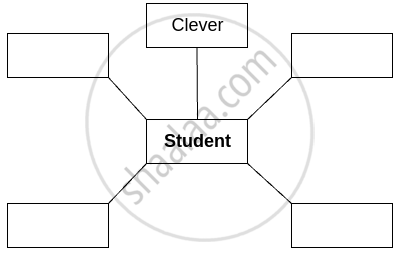
Write the related words as shown in the example:
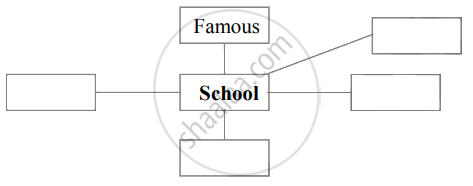
Write the related words as shown in the example: