हिंदी

Read the Comic Strip Based On. H.G. Wells' Novells. Answer the Questions by Ticking the Correct Option. - English - Communicative

Advertisements
Advertisements

प्रश्न

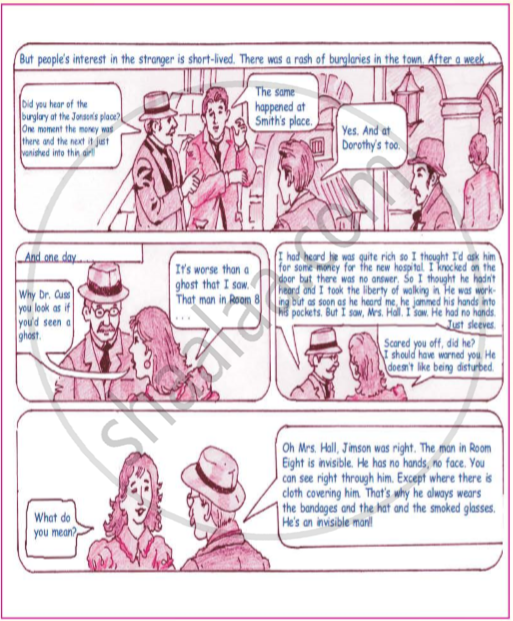
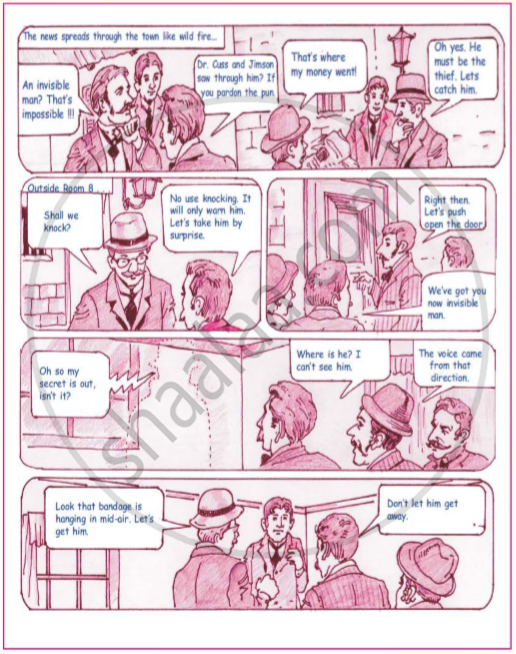
Read the comic strip based on. H.G. Wells' novells. 

Answer the questions by ticking the correct option. 

(a) The strange-looking man wanted .... 
(i) the best room at the inn. 
(ii} a room with a fire and a good lock. 
(iii} a room with a good view. 
(iv) a room where he could work quietly. 
(b) Jimson was suspicious of the stranger because ... 
(i} he did not answer Jimson's questions. 
(ii} he did not want to talk about the weather. 
(iii} he kept his back turned towards Jimson at all times. 
(iv) he shouted atJimson when he entered his room. 
(c) The people of the town gossiped about the stranger as ... 
(i} he did not go out or talk to anyone in the town. 
(ii} he had met with an accident and his face was bandaged. 
(iii} he was new to the town and behaved rudely. 
(iv) he stayed in his room and did not show his face to anyone. 
(d) 'There was a rush of burglaries in the town. This means that ________
(i} there were many robberies in the town. 
(ii) a few people in the town had seen a rob her. 
(iii} the burglaries in the town were done in a rush. 
(iv) the burglar was a rash and careless man. 
(e) Although Jimson and Dr Cuss are suspicious of the strange guest, Mrs Hall tolerates him because .... 
(i} she is not superstitious or ignorant. 
(ii) she is sorry for the stranger who is bandaged. 
(iii} the stranger is paying her a good amount of money for the room. 
(iv} the stranger is polite and kind to Mrs Hall at all times. 
(f) The stranger who was staying at the inn can be described as being .... 
(I} violent 
(ii} upright 
(iii} dishonest 
(iv) sensible 

संक्षेप में उत्तर
Advertisements

उत्तर

(a) The strange-looking man wanted - a room with a fire and a good lock.

(b) Jimson was suspicious of the stranger because - he kept his back turned towards Jimson at all times.

(c) The people of the town gossiped about the stranger as - he stayed in his room and did not show his face to anyone.

(d) 'There was a rush of burglaries in the town. This means that - there were many robberies in the town.

(e) Although Jimson and Dr Cuss are suspicious of the strange guest, Mrs Hall tolerates him because - the stranger is paying her a good amount of money for the room.

(f) The stranger who was staying at the inn can be described as being - violent

shaalaa.com
Reading
  क्या इस प्रश्न या उत्तर में कोई त्रुटि है?
अध्याय 5.2: The Invisible Man - Exercise [पृष्ठ ९२]

APPEARS IN

सीबीएसई English Communicative - Main Course Book Interact in English [English] Class 9
अध्याय 5.2 The Invisible Man
Exercise | Q 5 | पृष्ठ ९२

संबंधित प्रश्न

Why does he break down in tears after the fire?


Answer of these question in a short paragraph (about 30 words).

How does she describe her feelings at the summit of the Everest?


Six humans trapped by happenstance
In black and bitter cold.
Each one possessed a stick of wood,
Or so the story's told.
Their dying fire in need of logs;
The first man held his back.
For on the faces around the fire,
He noticed one was black.

Read the lines given above and answer the question that follow:

What does happenstance mean?


"Now tell us what 'twas all about,"
Young Peterkin, he cries;
And little wilhelmine looks up
with wonder-waiting eyes;
"Now tell us all about the war,
And what they fought each other for."
"It was the English," Kaspar cried,
"Who put the French to rout;
But what they fought each other for,
I could not well make out;
But everybody said,"quoth he,
"That 'twas a famous victory.

Read the lines given above and answer the question that follow.

Did the children wonder about the reason for the war?


He looked at me very blankly and tiredly, and then said, having to share his worry with someone, “The cat will be all right, I am sure. There is no need to be unquiet about the cat. But the others. Now what do you think about the others?”
“Why they’ll probably come through it all right.”
“You think so?”
“Why not,” I said, watching the far bank where now there were no carts.
“But what will they do under the artillery when I was told to leave because of the artillery?”
“Did you leave the dove cage unlocked?” I asked.
“Yes.”
“Then they’ll fly.”
“Yes, certainly they’ll fly. But the others. It’s better not to think about the others,” he said.

Read the extract given below and answer the question that follow.

Why is the old man not worried about the birds?


She lighted another match, and then she found herself sitting under a beautiful Christmas-tree. It was larger and more beautifully decorated than the one which she had seen through the glass door at the rich merchant’s. Thousands of tapers were burning upon the green branches, and colored pictures, like those she had seen in the show- windows, looked down upon it all. The little one stretched out her hand towards them, and the match went out.

The Christmas lights rose higher and higher, till they looked to her like the stars in the sky. Then she saw a star fall, leaving behind it a bright streak of fire. “Someone is dying,” thought the little girl, for her old grandmother, the only one who had ever loved her, and who was now dead, had told her that when a star falls, a soul was going up to God.

Read the extract given below and answer the question that follow.

What did she see when she lighted another match?


They stood in the doorway of the underground for a moment until it was raining hard. Then they closed the door and heard the gigantic sound of the rain falling in tons and avalanches, everywhere and forever.

“Will it be seven more years?” “Yes. Seven.” Then one of them gave a little cry. “Margot!” “What?” “She’s still in the closet where we locked her.” “Margot.”

They stood as if someone had driven them, like so many stakes, into the floor. They looked at each other and then looked away. They glanced out at the world that was raining now and raining and raining steadily. They could not meet each other’s glances. Their faces were solemn and pale. They looked at their hands and feet, their faces down. “Margot.” One of the girls said, “Well.. .?” No one moved. “Go on,” whispered the girl. They walked slowly down the hall in the sound of the cold rain. They turned through the doorway to the room in the sound of the storm and thunder, lightning on their faces, blue and terrible. They walked over to the closet door slowly and stood by it. Behind the closed door was only silence. They unlocked the door, even more slowly, and let Margot out.

Read the extract given below and answer the question that follow.

Why does the author describe their faces as blue and terrible?


Read the extract given below and answer the questions that follow: 

"He was not accustomed to facing the entire class and speaking out aloud. He knew that he did not have a flair for making speeches. However, he had worked hard on his assignment and had written it from the depth of his heart." (India's Heroes-Anonymous! 

(i) Who was 'he'? What evidence is there that he was not used to facing the entire class? 

(ii) What was the assignment? How was our assignment different from the others?

(iii) Who was the first person to feature in 'his' assignment? What did 'he' say about him? 

(iv) Who was the General Manager of the Taj Hotel ' What role did he play?

(v) What, according to this speaker, is the only true religion in the world? What human qualities have I been highlighted through 'his' speech? 


What reception did Ile get wizen he reached the address that had been advertised? Whom did tit house belong to? 


Read the extract given below and answer the questions that follow: 

Trotter: Yes. You've been extraordinarily foolish, you know. You've run a very good chance of being killed by holding out on me. As a result, you've been in serious danger more than once. 
Mollie: I don't know what you mean. 
Trotter: (moving slowly above the sofa table to the Right of the sofa, still quite natural and friendly) Come now, Mrs. Ralston. We, policemen, aren't quite so dumb as you think. All along I've realized that you had first-hand knowledge of the Langridge Farm affair. You know Mrs. Boyle was the magistrate concerned. In fact, you knew all about it. Why didn't you speak up and say so?
Mollie:  (Very much affected) I don't understand. I wanted to forget-forget. (She sits at the Left end of the sofa.) 

(i) What was the 'Longridge Farm' affair? 

(ii) Trotter revealed to Mollie some facts that he had uncovered about her past. What were they? 

(iii) What did Mollie want to forget? How was she linked with the ‘Longridge Farm affair’? 

(iv) How did Trotter manage a pass himself off as a policeman? How had he reached Monkswell Manor? 

(v) What did Trotter reveal to Mollie about this true identity? How was Mollie saved at the end of the play?


Why did the narrator climb the trees?


What were the primary objectives of the NASA Viking Mission to Mars?


Why did Swami Haridas say Tansen was ‘talented’?


Why would the child need a hankie?


Why was all the ‘mystery’ spoilt?


Why does Mary O’ Neill call English “a wonderful game’?


When Lorenzo says, 'Fair ladies, you drop manna in the way/of starved people.' he means that Portia and Nerissa have ______.


Read the following extract from Robert Browning's poem, “The Patriot” and answer the question that follows.

Alack, it was I who leaped at he sun

To give it my loving friends to keep!

Nought man could do, have I left undone:

And you see my harvest, what I reap

This very day, now a year is run.

  1. What can you conclude of the Patriot's mood from the given lines?
    Quote the line from the given extract which tells us that the Patriot did his utmost to satisfy his people?   [3]
  2. The last line of the extract suggests that a year has gone by.
    How had the speaker been treated a year ago?   [3]
  3. How did the situation change a year later? Give details of his present state.   [3]
  4. Why were only a ‘palsied few” onlookers seated at the windows?
    ‘Where had the other townspeople gone?‘Why had they gone there?   [3]
  5. How is the speaker's faith in God revealed at the end of the poem?
    Do you think the poem ends on a note of hope or despair? Justify your answer.   [4]

Read the following extract from Stephen Leacock’s short story, ‘With the Photographer’ and answer the questions that follow:

“The photographer beckoned me in. I thought he seemed quieter and graver than before. I think, too, there was a certain pride in his manner.

He unfolded the proof of a large photograph, and we both looked at it in silence.

‘Is it me?’ I asked.

“Yes,” he said quietly, ‘it is you,” and we went on looking at it.”

  1. Where was the narrator?
    Why had he gone there?
    Why do you think that there was a certain pride in the photographer's manner?  [3]
  2. What does the word "proof” mean in this context?
    Why did the narrator ask, “Is it me?”?  [3]
  3. Which of the narrator's facial features had the photographer altered?  [3]
  4. What was the only part of the narrator's face that seemed original in the photograph?
    How did the photographer plan to ‘fix’ this?  [3]
  5. At the end of the story, the narrator flies into a rage.
    What makes him angry?
    How would you justify the narrator's angry outburst?  [4]

The poem Beethoven explores the role of pain and suffering in the process of artistic creativity and excellence. Justify this statement in 200-250 words.


Share
Notifications

Englishहिंदीमराठी


      Forgot password?
Use app×