Advertisements
Advertisements
Question
Read the comic strip based on. H.G. Wells' novells.


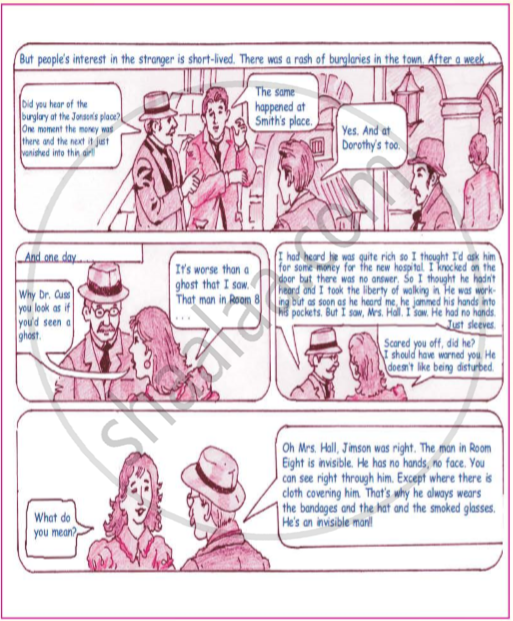
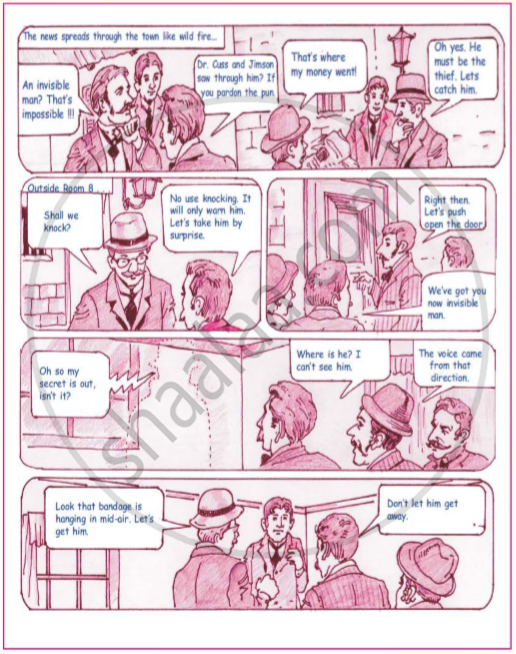
Answer the questions by ticking the correct option.
(a) The strange-looking man wanted ....
(i) the best room at the inn.
(ii} a room with a fire and a good lock.
(iii} a room with a good view.
(iv) a room where he could work quietly.
(b) Jimson was suspicious of the stranger because ...
(i} he did not answer Jimson's questions.
(ii} he did not want to talk about the weather.
(iii} he kept his back turned towards Jimson at all times.
(iv) he shouted atJimson when he entered his room.
(c) The people of the town gossiped about the stranger as ...
(i} he did not go out or talk to anyone in the town.
(ii} he had met with an accident and his face was bandaged.
(iii} he was new to the town and behaved rudely.
(iv) he stayed in his room and did not show his face to anyone.
(d) 'There was a rush of burglaries in the town. This means that ________
(i} there were many robberies in the town.
(ii) a few people in the town had seen a rob her.
(iii} the burglaries in the town were done in a rush.
(iv) the burglar was a rash and careless man.
(e) Although Jimson and Dr Cuss are suspicious of the strange guest, Mrs Hall tolerates him because ....
(i} she is not superstitious or ignorant.
(ii) she is sorry for the stranger who is bandaged.
(iii} the stranger is paying her a good amount of money for the room.
(iv} the stranger is polite and kind to Mrs Hall at all times.
(f) The stranger who was staying at the inn can be described as being ....
(I} violent
(ii} upright
(iii} dishonest
(iv) sensible
Advertisements
Solution
(a) The strange-looking man wanted - a room with a fire and a good lock.
(b) Jimson was suspicious of the stranger because - he kept his back turned towards Jimson at all times.
(c) The people of the town gossiped about the stranger as - he stayed in his room and did not show his face to anyone.
(d) 'There was a rush of burglaries in the town. This means that - there were many robberies in the town.
(e) Although Jimson and Dr Cuss are suspicious of the strange guest, Mrs Hall tolerates him because - the stranger is paying her a good amount of money for the room.
(f) The stranger who was staying at the inn can be described as being - violent
APPEARS IN
RELATED QUESTIONS
Answer the following with reference to the story.
“I wouldn’t throw it away.”
- Who says these words?
- What does ‘it’ refer to?
- What is it being compared with by the speaker?
Match the meanings with the words/expressions in italic, and write the appropriate
meaning next to the sentence.
You really gave me a fright when you crept up behind me like that.
Thinking about the Text
On the following map mark out the route, which the author thought of but did not take, to Delhi.

Now dramatise the play. Form groups of eight to ten students. Within each group,
you will need to choose
- a director, who will be overall incharge of the group's presentation.
- the cast, to play the various parts.
- someone to be in charge of costumes.
- someone to be in charge of props.
- a prompter.
Within your groups, do ensure that you - read both scenes, not just your part within one scene if you are acting.
- discuss and agree on the stage directions.
- read and discuss characterization.
- hold regular rehearsals before the actual presentation.
Staging - The stage can be very simple, with exits on either side representing doors to the outside and
to the rest of the house respectively.
In pairs, study the completed sentences in 5 above. You will notice that words like a little and much go with certain nouns. Are these nouns Countable [C] or Uncountable [U]?
What does he plant who plants a tree?
He plants, in sap and leaf and wood,
In love of home and loyalty
And far-cast thought of civic good____
His blessing on the neighbourhood,
Who in the hollow of his hand
Holds all the growth of all our land____
A nation's growth from sea to sea
Stirs in his heart who plants a tree.
Read the lines given above and answer the question that follow:
Does the man plant a tree because of his love of society and his nation?
There was a time when our people covered the land as the waves of a wind-ruffled sea cover its shell-paved floor, but that time long since passed away with the greatness of tribes that are now but a mournful memory. 1 will not dwell on, nor mourn over, our untimely decay, nor reproach my paleface brothers with hastening it, as we too may have been somewhat to blame.
Youth is impulsive. When our young men grow angry at some real or imaginary wrong, and disfigure their faces with black paint, it denotes that their hearts are black, and that they are often cruel and relentless, and our old men and old women are unable to restrain them. Thus it has ever been. Thus it was when the white man began to push our forefathers ever westward. But let us hope that the hostilities between us may never return. We would have everything to lose and nothing to gain. Revenge by young men is considered gain, even at the cost of their own lives, but old men who stay at home in times of war, and mothers who have sons to lose, know better.
Read the extract given below and answer the question that follow.
When did the hostilities between the Trials and the White men begin?
“There were three animals altogether,” he explained. “There were two goats and a cat and then there were four pairs of pigeons.”
“And you had to leave them?” I asked.
“Yes. Because of the artillery. The captain told me to go because of the artillery.” “And you have no family?” I asked, watching the far end of the bridge where a few last carts were hurrying down the slope of the bank.
“No,” he said, “only the animals I stated. The cat, of course, will be all right. A cat can look out for itself, but I cannot think what will become of the others.”
“What politics have you?” I asked.
“I am without politics,” he said. “I am seventy-six years old. I have come twelve kilometers now and I think now I can go no further.”
“This is not a good place to stop,” I said. “If you can make it, there are trucks up the road where it forks for Tortosa.”
“I will wait a while,” he said, “ and then I will go. Where do the trucks go?” “Towards Barcelona,” I told him.
“I know no one in that direction,” he said, “but thank you very much.
Read the extract given below and answer the question that follow.
Where did the narrator want the old man to go?
I was in for a surprise. When the time came for the broad-jump trials, I was startled to see a tall boy hitting the pit at almost 26 feet on his practice leaps! He turned out to be a German named Luz Long. 1 was told that Hitler hoped to win the jump with him. I guessed that if Long won, it would add some new support to the Nazis’ “master race” (Aryan superiority) theory. After all, I am a Negro. Angr about Hitler’s ways, 1 determined to go out there and really show Der Fuhrer and his master race who was superior and who wasn’t. An angry athlete is an athlete who will make mistakes, as any coach will tell you. I was no exception. On the first of my three qualifying jumps, I leaped from several inches beyond the takeoff board for a foul. On the second jump, I fouled even worse. “Did I come 3,000 miles for this?” I thought bitterly. “To foul out of the trials and make a fool of myself ?” Walking a few yards from the pit, 1 kicked disgustedly at the dirt.
Read the extract given below and answer the question that follow.
I supposed that if Long won, it would add some new support to the Nazis’ Aryan- superiority theory. What did Jesse Owens want to show to Hitler?
Why does Portia disapprove of the County Palatine? Who would she rather marry?
The author felt sorry for complaining about his boots. What made him feel so?
What do you know about Golu?
How did the jealous courtiers plan to harm Tansen? How did the great musician save his honour as well as official position?
Comment on the aptness of the title of the story, ‘A Pact with the Sun’. What message or idea does the story bring home to you?
Read the lines in which the following phrases occur. Then discuss with your partner the meaning of each phrase in its context.
meadow houses
Multiple Choice Question:
Where does real beauty lie?
What activities are dear to little children? Who does the child envy and why in the poem Vocation?
In the short story, The Story of an Hour, what according to the doctor did Mrs. Mallard die of?
| Caliban: |
No noise, and enter |
In the above lines taken from Act IV Scene i of the play, The Tempest, what does Caliban refer to by the phrase “good mischief“?
Read the two statements from the short story, The Cookie Lady and choose the correct option from the ones given below.
Statement I: “Why don’t you read to me from your books? You know I don’t see too well anymore and it’s comfort to me to be read to.”
Statement II: “You don’t mind if I touch your arm, do you?”
