Advertisements
Advertisements
प्रश्न
Thinking about Poem
What finally kills the tree?
Advertisements
उत्तर
The tree is finally killed by the uprooting of its roots. When the roots, which had anchored it lying hidden in the earth for years, were dug out, the tree’s strength was exposed and this led to the death of the tree. It dried up after it had been uprooted.
संबंधित प्रश्न
Answer the following question.
“I got him for her by accident.”
(i) Who says this?
(ii) Who do ‘him’ and ‘her’ refer to?
(iii) What is the incident referred to here?
Thinking about the Text
On the following map mark out the route, which the author thought of but did not take, to Delhi.
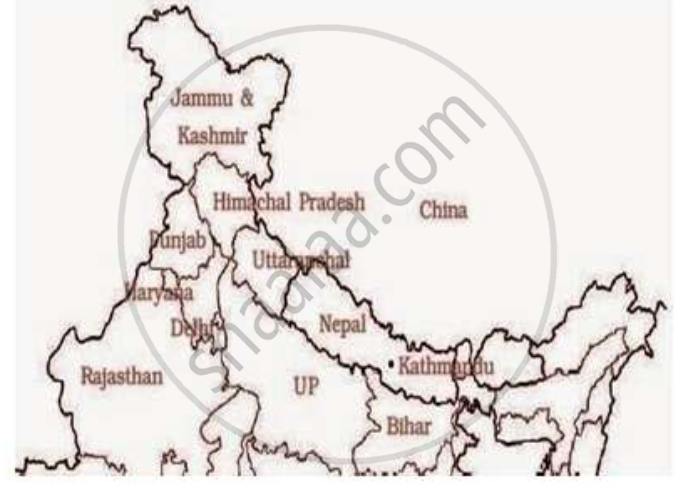
Look at these words:
...peace comes dropping slow
Dropping from the veils of the morning to where the cricket sings
What do these words mean to you? What do you think “comes dropping slow...from the veils of the morning”? What does “to where the cricket sings” mean?
In pairs, study the completed sentences in 5 above. You will notice that words like a little and much go with certain nouns. Are these nouns Countable [C] or Uncountable [U]?
Notices
Read the following captions
. Change them into active (voice) and explain their meaning.
e.g. All credit cards accepted.
We accept credit cards.
Meaning: The organization accepts credit cards from customers for all their transactions.
1. Domestic help required
_______________________________________
2. All types of computer servicing undertaken.
_______________________________________
3. Using cell phones is not allowed (University Campus)
_______________________________________
4. Spoken English classes conducted.
_______________________________________
5. All Recharge Coupons sold here.
_______________________________________
Some are Purple and gold flecked grey
For she who has journeyed through life midway,
Whose hands have cherished , whose love has blest,
And cradled fair sons on her faithful breast,
And serves her household in fruitful pride,
And worship the gods at her husband's side.
Read the lines given above and answer the question that follow:
What in the passage will repel a modern woman?
It was my business to cross the bridge, explore the bridge head 3 beyond and find out to what point the enemy had advanced. I did this and returned over the bridge. There were not so many carts now and very few people on foot, but the old man was still there.’’Where do you come from?” I asked him.
“From San Carlos,” he said, and smiled.
That was his native town and so it gave him pleasure to mention it and he smiled.
“I was taking care of animals,” he explained.
“Oh,” I said, not quite understanding.
“Yes,” he said, “I stayed, you see, taking care of animals. I was the last one to leave the town of San Carlos.”
He did not look like a shepherd nor a herdsman and I looked at his black dusty clothes and his gray dusty face and his steel rimmed spectacles and said, “What animals were they?”
“Various animals,” he said, and shook his head. “I had to leave them.”
Read the extract given below and answer the question that follow.
Why did the old man leave his hometown? Why did he leave it reluctantly?
Lights were shining from every window, and there was a savoury smell of roast goose, for it was New-year’s eve—yes, she remembered that. In a corner, between two houses, one of which projected beyond the other, she sank down and huddled herself together. She had drawn her little feet under her, but she could not keep off the cold; and
she dared not go home, for she had sold no matches, and could not take home even a penny of money. Her father would certainly beat her; besides, it was almost as cold at home as here, for they had only the roof to cover them, through which the wind howled, although the largest holes had been stopped up with straw and rags. Her little hands were almost frozen with the cold. Ah! perhaps a burning match might be some good, if she could draw it from the bundle and strike it against the wall, just to warm her fingers. She drew one out—“scratch!” how it sputtered as it burnt! It gave a warm, bright light, like a little candle, as she held her hand over it. It was really a wonderful light. It seemed to the little girl that she was sitting by a large iron stove, with polished brass feet and a brass ornament. How the fire burned! and seemed so beautifully warm that the child stretched out her feet as if to warm them, when, lo! the flame of the match went out, the stove vanished, and she had only the remains of the half-burnt match in her hand.
Read the extract given below and answer the question that follow.
Why could the girl not go home?
Sibia sprang.
From boulder to boulder she came leaping like a rock goat. Sometimes it had seemed difficult to cross these stones, especially the big gap in the middle where the river coursed through like a bulge of glass. But now she came on wings, choosing her footing in midair without even thinking about it, and in one moment she was beside the shrieking woman. In the boiling bloody water, the face of the crocodile, fastened round her leg, was tugging to and fro, and smiling. His eyes rolled on to Sibia. One slap of the tail could kill her. He struck. Up shot the water, twenty feet, and fell like a silver chain. Again! The rock jumped under the blow. But in the daily heroism of the jungle, as common as a thorn tree, Sibia did not hesitate. She aimed at the reptile’s eyes. With all the force of her little body, she drove the hayfork at the eyes, and one prong went in—right in— while its pair scratched past on the horny cheek. The crocodile reared up in convulsion, till half his lizard body was out of the river, the tail and nose nearly meeting over his stony back. Then he crashed back, exploding the water, and in an uproar of bloody foam he disappeared. He would die. Not yet, but presently, though his death would not be known for days; not till his stomach, blown with gas, floated him. Then perhaps he would be found upside down among the logs at the timber boom, with pus in his eye. Sibia got arms round the fainting woman, and somehow dragged her from the water.
Read the extract given below and answer the question that follow.
Why does Sibia think of the two brass vessels when the Gujar woman is attacked?
As it turned out, Luz broke his own past record. In doing so, he pushed me on to a peak performance. I remember that at the instant I landed from my final jump—the one which set the Olympic record of 26 feet 5-5/16 inches—he was at my side, congratulating me. Despite the fact that Hitler glared at us from the stands not a hundred yards away, Luz shook my hand hard—and it wasn’t a fake “smile with a broken heart” sort of grip, either.
You can melt down all the gold medals and cups I have, and they couldn’t be a plating on the 24-carat friendship I felt for Luz Long at that moment. I realized then, too, that Luz was the epitome of what Pierre de Coubertin, founder of the modern Olympic Games, must have had in mind when he said, “The important thing in the Olympic Games is not winning but taking part. The essential thing in life is not conquering but fighting well.”
Read the extract given below and answer the question that follow.
What, according to Coubertin, is the true spirit of the Olympics? Explain the reference to Coubertin.
Read the extract given below and answer the questions that follow:
Portia: To these injunctions every one doth s'vear
That comes to hazard for my worthless self.
Arragon: And so have I address'd me. Fortune now
To my heart's hope! - Gold, silver and base lead.
(i) Who had tried his luck in trying to choose the correct casket before the prince of Arragon? Which casket had that suitor chosen ? What did he find inside the casket?
(ii) What are the three things Arragon was obliged by the oath to obey?
(iii) What was the inscription on the golden casket? How do the actions of the martlet illustrate this inscription?
(iv) Which casket does Arragon finally choose? Whose portrait does he find inside? Which casket actually contains Portia's portrait?
(v) Who enters soon after? What does he say about the young Venetian who has just arrived? What gifts has the Venetian brought with him?
Read the extract given below and answer the questions that follow:
"Now tell us what it was all about"
Young Peterkin, he cries.
And little Willhelmines looks up
With wonder - waiting eyes,
"Now tell us all about the war,
And what they fought each other for".
- After Blenheim, Robert Southey
(i) Who are Peterkin and Wilhelmine? How does the poet describe the scene at the beginning of the poem?
(ii) What did Young Peterkin find and where? Describe it?
(iii) Who is referred to as "each other"? What did they fight for?
(iv) To whom are the words in the extract addressed? How was this person's family affected by the war?
(v) What, according to the poet, are the consequences that are often associated with great and famous victories? What message does the poet want to convey to the readers?
Read the extract given below and answer the questions that follow :
One Sunday morning Squealer announced that the hens, who just come in to lay again, must surrender their eggs.
(i) Why were the hens required to surrender their eggs?
(ii) How did the hens react to receiving this information?
(iii) The three young black Minorca pullets led the other hens in 'something resembling a rebellion'. How exactly did they do this?
(iv) What steps did Napoleon take to put down this 'rebellion'?
(v) How long did the rebellion last? Describe the consequences of the rebellion. What do you learn of Napoleon's character from the way in which he dealt with the rebellion?
How did the wicked couple behave with the dogs passing by their house?
Narrate the tale of two birds in your own words.
What did the specialist prescribe in addition to medicine?
What is the mystery about the child’s school teacher? How does it plan to discover the truth?
Answer the following question.
How do mongooses kill snakes?
Why does Maya think Mr Nath is a crook? Who does she say the Sunday visitor is?
In Stephen Leacock’s ‘With the Photographer’, while waiting for the photographer, the narrator spent time ______.
