Advertisements
Advertisements
प्रश्न
Thinking about Poem
What finally kills the tree?
Advertisements
उत्तर
The tree is finally killed by the uprooting of its roots. When the roots, which had anchored it lying hidden in the earth for years, were dug out, the tree’s strength was exposed and this led to the death of the tree. It dried up after it had been uprooted.
संबंधित प्रश्न
Discuss these question in class with your teacher and then write down your answer
in two or three paragraphs .
How does Kezia begin to see her father as a human being who needs her sympathy?
Thinking about the Poem
What are the things the wind does in the first stanza?
Thinking about the Poem
Write the story of ‘A Legend of the Northland’ in about ten sentences.
Read the play as a whole class with different children reading different parts.
SCENE : The kitchen of the Bishop's cottage, It is plainly but substantially furnished. Doors
R, and L and L.C. Window R.C. Fireplace with heavy mantelpiece down R. Oak settee with
cushions behind door L.C. Table in window R.C. with writing materials and crucifix (wood).
Eight-day clock R. of window. Kitchen dresser with cupboard to lock, down L. Oak dinner
table R.C. Chairs, books, etc. Winter wood scene without. On the mantel piece are two very
handsome candlesticks which look strangely out of place with their surroundings.
[Marie and Persome discovered. Marie stirring some soup on the fire. Persome laying the
cloth, etc.]
Persome: Marie, isn' t the soup boiling yet ?
Marie: Not yet, madam.
Persome: Well, it ought to be. You haven't tended the fire properly, child.
Marie: But, madam, you yourself made the fire up.
Persome: Don't answer me back like that. It is rude.
Marie: Yes, madam.
Persome: Then don't let me have to rebuke you again.
Marie: No, madam.
Persome: I wonder where my brother can be. (Looking at the clock.) It is after eleven o'clock and no sign of him. Marie !
Marie: Yes, madam.
Persome: Did Monseigneur the Bishop leave any message for me ?
Marie: No, madam.
Persome: Did he tell you where he was going?
Marie: Yes, madam.
Persome (imitating): 'Yes, madam'. Then why haven't you told me, stupid!
Marie: Madam didn't ask me.
Persome: But that is no reason for you not telling me, is it ?
Marie: Madam said only this morning I was not to chatter, so I thought...
Persome: Ah, Mon Dieu! You thought! Ah! It is hopeless.
Marie: Yes, madam.
Persome: Don't keep saying 'Yes, Madam' like a parrot, nincompoop!
Marie: No, madam.
Persome: Well. Where did Monseigneur say he was going?
Marie: To my mother's, madam.
Persome: To your mother's indeed ! And why, pray ?
Marie. Monseigneur asked me how she was, and I told him she was feeling poorly.
Persome : You told him she was feeling poorly did you? And so my brother is to be kept out of his bed, and go without his supper because you told him she was feeling poorly. There's gratitude for you!
Marie: Madam, the soup is boiling!
Persome: Then pour it out, fool, and don't chatter. (Marie about to do so.) No, no, not like that. Here, let me do it, and did you put the salt-cellars on the table-the silver ones?
Marie: The silver ones, madam?
Persome: Yes, the silver ones. Are you deaf as well as stupid?
Marie: They are sold, madam.
Persome: Sold! (with horror) Sold! Are you mad? Who sold them? Why were they sold?
Marie: Monseigneur the Bishop told me this afternoon, while you were out, to take them to Monseigneur Gervais, who has often admired them, and sell them for as much as I could.
Persome: But you had no right to do so without asking me.
Marie (with awe): But, madam, Monseigneur the Bishop told me.
Persome: Monseigneur the Bishop is a-ahem! But-but what can he have wanted with the money!
Marie: Pardon, madam, but I think it was for Mere Gringoire.
Persome: Mere Gringoire indeed! Mere Gringoire! What, the old witch who lives at the top of the hill, and who says she is bedridden because she is too lazy to do any work? And what did Mere Gringoire want with the money, pray ?
Marie: Madam, it was for the rent. The bailiff would not wait any longer, and threatened to turn her out to-day if it were not paid, so she sent little Jean to Monseigneur to
ask for help, and-
Persome: Oh, mon Dieu! It is hopeless, hopeless. We shall have nothing left. His estate is sold, his savings have gone. His furniture, everything. Were it not for my little dot we should starve ! And now my beautiful-beautiful (sobs) salt-cellars. Ah, it is too much, too much. (She breaks down crying.)
Marie: Madam, I am sorry, if I had known-
Persome: Sorry, and why pray? If Monseigneur the Bishop chooses to sell his salt-cellars
he may do so, I suppose. Go and wash your hands, they are disgracefully dirty.
Marie: Yes, madam (going towards R.)
[Enter the Bishop, C.]
Bishop: Ah! How nice and warm it is in here! It is worth going out in the cold for the sake of the comfort of coming in. [Persome has hastened to help him off with his coat etc. Marie has dropped a deep courtesy.]
Bishop: Thank you, dear. (Looking at her.) Why, what is the matter ? You have been crying. Has Marie been troublesome, eh ? (shaking his finger at her) Ah !
Persome: No, it wasn't Marie-but-but-
Bishop: Well, well, you shall tell me presently! Marie, my child, run home now; your mother is better. I have prayed with her, and the doctor has been. Run home! (Marie putting on cloak and going.) And, Marie, let yourself in quietly in case your mother is asleep.
Marie: Oh, thanks, thanks, Monseigneur. [She goes to door C. ; as it opens the snow drives in.]
Bishop: Here, Marie, take my comforter, it will keep you warm. It is very cold to-night.
Marie: Oh, no Monseigneur ! (shamefacedly). What nonsense, brother, she is young, she won't hurt.
Bishop: Ah, Persome, you have not been out, you don't know how cold it has become. Here, Marie, let me put it on for you. (Does so) There! Run along little one.
[Exit Marie, C.]
Persome: Brother, I have no patience with you. There, sit down and take your soup, it has been waiting ever so long. And if it is spoilt, it serves you right.
Bishop: It smells delicious.
Persome: I'm sure Marie's mother is not so ill that you need have stayed out on such a night as this. I believe those people pretend to be ill just to have the Bishop call on them. They have no thought of the Bishop!
Bishop: It is kind of them to want to see me.
Persome: Well, for my part, I believe that charity begins at home.
Bishop: And so you make me this delicious soup. You are very good to me, sister.
Persome: Good to you, yes! I should think so. I should like to know where you would be without me to look after you. The dupe of every idle scamp or lying old woman in the parish!
Bishop: If people lie to me they are poorer, not I.
Persome: But it is ridiculous; you will soon have nothing left. You give away everything, everything!!!
Bishop: My dear, there is so much suffering in the world, and I can do so little (sighs), so very little.
Persome: Suffering, yes; but you never think of the suffering you cause to those who love you best, the suffering you cause to me.
Bishop (rising): You, sister dear ? Have I hurt you ? Ah, I remember you had been crying. Was it my fault ? I didn' t mean to hurt you. I am sorry.
Persome: Sorry. Yes. Sorry won't mend it. Humph ! Oh, do go on eating your soup before it gets cold.
Bishop: Very well, dear. (Sits.) But tell me-
Persome: You are like a child. I can't trust you out of my sight. No sooner is my back turned than you get that little minx Marie to sell the silver salt-cellars.
Bishop: Ah, yes, the salt-cellars. It is a pity. You-you were proud of them ?
Persome: Proud of them. Why, they have been in our family for years.
Bishop: Yes, it is a pity. They were beautiful; but still, dear, one can eat salt out of china just as well.
Persome: Yes, or meat off the floor, I suppose. Oh, it's coming to that. And as for that old wretch, Mere Gringoire, I wonder she had the audacity to send here again. The last time I saw her I gave her such a talking to that it ought to have had some effect.
Bishop: Yes! I offered to take her in here for a day or two, but she seemed to think it might distress you.
Persome: Distress me !!!
Bishop: And the bailiff, who is a very just man, would not wait longer for the rent, so -soyou see I had to pay it.
Persome: You had to pay it. (Gesture of comic despair.)
Bishop: Yes, and you see I had no money so I had to dispose off the salt-cellars. It was fortunate I had them, wasn't it ? (Smiling) But I'm sorry, I have grieved you.
Persome: Oh, go on! Go on! You are incorrigible. You'll sell your candlesticks next.
Bishop (with real concern): No, no, sister, not my candlesticks.
Persome: Oh! Why not ? They would pay somebody's rent, I suppose.
Bishop: Ah, you are good, sister, to think of that; but-but I don't want to sell them. You see, dear, my mother gave them to me on-on her death-bed just after you were born, and-and she asked me to keep them in remembrance of her, so I would like to keep them; but perhaps it is a sin to set such store by them ?
Persome: Brother, brother, you will break my heart (with tears in her voice). There! Don't say anything more. Kiss me and give me your blessing. I'm going to bed. (He blesses her)
[Bishop makes the sign of the Cross and murmurs a blessing. Persome locks up the
cupboard door and goes R.]
Persome: Don't sit up too long and tire your eyes.
Bishop: No, dear! Good night! [Persome exits R.]
Bishop (comes to table and opens a book, then looks up at the candlesticks). They
would pay somebody's rent. It was kind of her to think of that. [He stirs the fire, trims the lamp, arranges some books and papers, sits down, is restless, shivers slightly ; the clock outside strikes twelve and he settles down to read. Music during this. Enter a Convict stealthily ; he has a long knife and seizes the Bishop from behind]
Convict: If you call out you are a dead man !
Bishop: But, my friend, as you see, I am reading. Why should I call out? Can I help you in any way ?
Convict (hoarsely): I want food. I'm starving, I haven't eaten anything for three days. Give me food quickly, quickly, curse you!
Bishop (eagerly): But certainly, my son, you shall have food. I will ask my sister for the keys of the cupboard. [Rising.] Convict: Sit down !!! (The Bishop sits smiling.) None of that, my friend! I'm too old a bird to be caught with chaff. You would ask your sister for the keys, would you ? A likely
story! You would rouse the house too. Eh ? Ha! ha! A good joke truly. Come, where is the food ? I want no keys. I have a wolf inside me tearing at my entrails, tearing me; quick, tell me; where the food is?
Bishop (aside): I wish Persome would not lock the cupboard. (Aloud) Come, my friend, you have nothing to fear. My sister and I are alone here.
Convict: How do I know that ?
Bishop : Why, I have just told you. [Convict looks long at the Bishop.]
Convict: Humph! I'll risk it. (Bishop, going to door R.) But mind! Play me false and as sure as there are devils in hell, I'll drive my knife through your heart. I have nothing to lose.
Bishop: You have your soul to lose, my son; it is of more value than my heart. (At door R.,
calling.) Persome! Persome! [The Convict stands behind him, with his knife ready.]
Persome (within): Yes, brother.
Bishop: Here is a poor traveller who is hungry. If you have not settled as yet, will you
come and open the cupboard and I will give him some supper. Persome (within). What, at this time of night ? A pretty business truly. Are we to have no sleep now, but to be at the beck and call of every ne'er-do-well who happens to pass?
Bishop: But, Persome, the traveller is hungry. Perome. Oh, very well. I am coming. (Persome enters R. She sees the knife in the Convict's hand.) (Frightened) Brother, what is he doing with that knife?
Bishop: The knife-oh, well, you see, dear, perhaps he may have thought that I-I had sold
ours. [Laughs gently.]
Persome: Brother, I am frightened. He glares at us like a wild beast (aside to him).
Convict: Hurry, I tell you. Give me food or I'll stick my knife in you both and help myself.
Bishop: Give me the keys, Persome (she gives the keys to him). And now, dear, you may
go to bed. [Persome going. The Convict springs in front of her. ]
Convict : Stop! Neither of you shall leave this room till I do. [She looks at the Bishop.]
Bishop: Persome, will you favour this gentleman with your company at supper ? He
evidently desires it.
Persome: Very well, brother. [She sits down at the table staring at the two.]
Bishop: Here is some cold pie and a bottle of wine and some bread.
Convict: Put them on the table, and stand behind it so that I can see you. [Bishop does so and opens drawer in table, taking out knife and fork, looking at
the knife in Convict's hand.]
Convict: My knife is sharp. (He runs his finger along the edge and looks at them meaningfully.) And as for forks…. (taking it up) (laughs) Steel! (He throws it away). We don't use forks in prison.
Persome: Prison ?
Convict: (Cutting off an enormous slice from the pie he tears it with his fingers like an animal. Then starts) What was that ? (He looks at the door.) Why the devil do you leave the window unshuttered and the door unbarred so that anyone can come in ? (shutting them.)
Bishop: That is why they are left open.
Convict: Well, they are shut now !
Bishop (sighs): For the first time in thirty years. [Convict eats voraciously and throws a bone on the floor.]
Persome: Oh, my nice clean floor! [Bishop picks up the bone and puts it on plate.]
Convict: You're not afraid of thieves?
Bishop: I am sorry for them.
Convict: Sorry for them. Ha ! Ha ! Ha! (Drinks from bottle,) That's a good one. Sorry for them. Ha! Ha! Ha! (Drinks) (suddenly) Who the devil are you ?
Bishop: I am a Bishop.
Convict: Ha! Ha ! Ha ! A Bishop! Holy Virgin, a Bishop.
Bishop: I hope you may escape that, my son. Persome, you may leave us; this gentleman will excuse you.
Persome: Leave you with-
Bishop: Please! My friend and I can talk more-freely then. [By this time, owing to his starving condition, the wine has affected the Convict:]
Convict: What's that ? Leave us. Yes, yes, leave us. Good night. I want to talk to the Bishop, The Bishop: Ha! Ha! [Laughs as he drinks, and coughs.]
Bishop: Good night, Persome: [He holds the door open and she goes out R., holding in her skirts as she passes the Convict:]
Convict (chuckling to himself): The Bishop: Ha ! Ha ! Well I'm-(Suddenly very loudly) D'you know what I am ?
Bishop: I think one who has suffered much.
Convict: Suffered ? (puzzled) Suffered? My God, yes. (Drinks) But that's a long time ago. Ha! Ha! That was when I was a man. Now I'm not a man; now I'm a number; number 15729, and I've lived in Hell for ten years.
Bishop. Tell me about it-about Hell.
Convict: Why? (Suspiciously) Do you want to tell the police-to set them on my track ?
Bishop: No! I will not tell the police.
Convict: (looks at him earnestly). I believe you (scratching his head), but damn me if I knew why.
Bishop. (laying his hand on the Convict's arm). Tell me about the time, the time before
you went to Hell.
Convict: It's been so long ago.... I forget; but I had a little cottage, there were vines growing on it. (Dreamily) They looked pretty with the evening sun on them, and, and.... there was a woman, she was (thinking hard), she must have been my wife-yes. (Suddenly and very rapidly). Yes, I remember! She was ill, we had no food, I could get no work, it was a bad year, and my wife, my Jeanette, was ill, dying (pause), so I stole to buy food for her. (Long pause. The Bishop gently pats
his hand.) They caught me. I pleaded with them, I told them why I stole, but they laughed at me, and I was sentenced to ten years in the prison hulks (pause), ten years in Hell. The night I was sentenced, the gaoler told me-told me Jeanette was dead. (Sobs with fury) Ah, damn them, damn them. God curse them all. [He sinks on the table, sobbing.]
Bishop: Now tell me about the prison ship, about Hell.
Convict: Tell you about it ? Look here, I was a man once. I'm a beast now, and they made
me what I am. They chained me up like a wild animal, they lashed me like a hound. I fed on filth, I was covered, with vermin, I slept on boards, and when I complained, they lashed me again. For ten years, ten years. Oh God! They took away my name, they took away my soul, and they gave me a devil in its place. But one day they were careless, one day they forgot to chain up their wild beast,
and he escaped. He was free. That was six weeks ago. I was free, free to starve.
Bishop: To starve ?
Convict: Yes, to starve. They feed you in Hell, but when you escape from it you starve. They were hunting me everywhere and I had no passport, no name. So I stole again. I stole these rags. I stole my food daily. I slept in the woods, in barns, any where. I dare not ask for work, I dare not go into a town to beg, so I stole, and they have made me what I am, they have made me a thief. God curse them all. [Empties the bottle and throws it into the fire-place R., smashing it.]
Bishop: My son, you have suffered much, but there is hope for all.
Convict: Hope ! Hope ! Ha ! Ha ! Ha ! [Laughs wildly.]
Bishop: You have walked far; you are tired. Lie down and sleep on the couch there, and I will get you some coverings.
Convict: And if anyone comes ?
Bishop: No one will come; but if they do, are you not my friend ?
Convict: Your friend ? (puzzled)
Bishop: They will not molest the Bishop's friend.
Convict: The Bishop's friend. [Scratching his head, utterly puzzled]
Bishop: I will get the coverings. [Exit L.]
Convict: (looks after him, scratches his head) The Bishop's friend! (He goes to fire to warm himself and notices the candlesticks, He looks round to see if he is alone, and takes them down, weighing them.) Silver, by God, heavy. What a prize! [He hears the Bishop coming, and in his haste drops one candlestick on the table.] [Enter the Bishop]
Bishop: (sees what is going on, but goes to the settee up L. with coverings.) Ah, you are
admiring my candlesticks. I am proud of them. They were a gift from my mother.
A little too handsome for this poor cottage perhaps, but all I have to remind me of
her. Your bed is ready. Will you lie down now ?
Convict: Yes, yes, I'll lie down now. (puzzled) -Look here, why the devil are you kind to
me? (Suspiciously). What do you want? Eh?
Bishop: I want you to have a good sleep, my friend.
Convict: I believe you want to convert me; save my soul, don't you call it? Well, it's no
good-see? I don't want any damned religion, and as for the Church-bah! I hate
the Church.
Bishop: That is a pity, my son, as the Church does not hate you.
Convict: You are going to try to convert me. Oh! Ha! ha! That's a good idea. Ha ! ha ! ha! No, no, Monseigneur the Bishop: I don't want any of your Faith, Hope, and Charity --see? So anything you do for me you're doing to the devil-understand? (defiantly)
Bishop: One must do a great deal for the devil in order to do a little for God.
Convict: (angrily). I don't want any damned religion, I tell you.
Bishop: Won't you lie down now? It is late?
Convict: (grumbling). Well, alright, but I won't be preached at, I-I-(on couch). You're sure no one will come?
Bishop: I don't think they will; but if they do-you yourself have locked the door.
Convict: Humph! I wonder if it's safe. (He goes to the door and tries it, then turns and sees the Bishop holding the covering, annoyed) Here! you go to bed. I'll cover myself. (The Bishop hesitates.) Go on, I tell you.
Bishop: Good night, my son. [Exit L.]
[Convict waits till he is off, then tries the Bishop's door.]
Convict: No lock, of course. Curse it. (Looks round and sees the candlesticks again.) Humph! I'll have another look at them. (He takes them up and toys with them.) Worth hundreds, I'll warrant. If I had these turned into money, they'd start me fair. Humph! The old boy's fond of them too, said his mother gave him them. His mother, yes. They didn't think of my mother when they sent me to Hell. He was kind to me too-but what's a Bishop for except to be kind to you? Here, cheer up, my hearty, you're getting soft. God! Wouldn't my chain-mates laugh to see 15729 hesitating about collaring the plunder because he felt good. Good ! Ha ha! Oh, my God! Good! Ha! Ha! 15729 getting soft. That's a good one. Ha ! ha! No, I'll take his candlesticks and go. If I stay here he'll preach me in the morning and I'll get soft. Damn him and his preaching too. Here goes!
[He takes the candlesticks, stows them in his coat, and cautiously exits L.C. As he does so the door slams.]
Persome (without): Who's there ? Who's there, I say ? Am I to get no sleep to-night ? Who's there, I say ? (Enter R, Persome) I'm sure I heard the door shut. (Looking round.) No one here ? (Knocks at the Bishop's door L. Sees the candlesticks have gone.) The candlesticks, the candlesticks. They are gone. Brother, brother, come out. Fire, murder, thieves! [Enter Bishop L. ]
Bishop: What is it, dear, what is it ? What is the matter ?
Persome: He has gone. The man with the hungry eyes has gone, and he has taken your
candlesticks.
Bishop: Not my candlesticks, sister, surely not those. (He looks and sighs.) Ah, that is hard, very hard, I………I-He might have left me those. They were all I had (almost breaking down).
Persome: Well, but go and inform the police. He can't have gone far. They will soon catch him, and you'll get the candlesticks back again. You don't deserve them, though, leaving them about with a man like that in the house.
Bishop: You are right, Persome: It was my fault. I led him into temptation.
Persome: Oh, nonsense I led him into temptation indeed. The man is a thief, a common unscrupulous thief. I knew it the moment I saw him. Go and inform the police or I will.
[Going ; but he stops her.]
Bishop: And have him sent back to prison? (very softly) Sent back to Hell. No Persome: It is a just punishment for me; I set too great store by them. It was a sin. My punishment is just; but Oh God! it is hard, It is very hard. [He buries his head in his hands.]
Persome: No, brother, you are wrong. If you won't tell the police, I will. I will not stand by and see you robbed. I know you are my brother and my Bishop, and the best man in all France; but you are a fool, I tell you, a child, and I will not have your goodness abused, I shall go and inform the police (Going).
Bishop: Stop, Persome. The candlesticks were mine. They are his now. It is better so. He has more need of them than me. My mother would have wished it so, had she been here.
Persome: But-[Great knocking without.]
Sergeant (without). Monseigneur, Monseigneur, we have something for you. May we enter ?
Bishop: Enter, my son. [Enter Sergeant and three Gendarmes with Convict bound. The Sergeant
carries the candlesticks.]
Persome: Ah, so they have caught you, villain, have they ?
Sergeant: Yes, madam, we found this scoundrel slinking along the road, and as he wouldn't give any account of himself we arrested him on suspicion. Holy Virgin, isn't he strong and didn't he struggle! While we were securing him these candlesticks fell out of his pockets. (Persome seizes them, goes to table, and brushes them with her apron lovingly.) I remembered the candlesticks of
Monseigneur, the Bishop, so we brought him here that you might identity them, and then we'll lock him up. [The Bishop and the Convict have been looking at each other-the Convict with
dogged defiance.]
Bishop: But - but I don't understand, this gentleman is my very good friend.
Sergeant: Your friend, Monseigneur!! Holy Virgin ! Well!!!
Bishop: Yes, my friend. He did me the honour to sup with me to night, and I-I have given him the candlesticks.
Sergeant: (incredulously) You gave him-him your candlesticks ? Holy Virgin!
Bishop: (severely) Remember, my son, that she is holy.
Sergeant: (saluting) Pardon Monseigneur.
Bishop: And now I think you may let your prisoner go.
Sergeant: But he won't show me his papers. He won't tell me who he is.
Bishop: I have told you he is my friend.
Sergeant: Yes, that's all very well, but....
Bishop: He is your Bishop's friend, surely, that is enough!
Sergeant: Well, but....
Bishop: Surely?
[A pause. The Sergeant and the Bishop look at each other,]
Sergeant: I-I-Humph! (To his men) Loose the prisoner. (They do so). Right about turn, quick march!
[Exit Sergeant and Gendarmes. A long pause.]
Convict: (Very slowly, as if in a dream). You told them you had given me the candlesticks - given me... them. By God!
Persome: (Shaking her fist at him and hugging the candlesticks to her breast). Oh, you scoundrel, you pitiful scoundrel. You come here, and are fed and warmed, andand you thief.... you steal.... from your benefactor. Oh, you blackguard!
Bishop: Persome, you are overwrought. Go to your room.
Persome: What, and leave you with him to be cheated again, perhaps murdered ? No, I will not.
Bishop: (With slight severity). Persome, leave us. I wish it. [She looks hard at him, then
turns towards her door.]
Persome: Well, if I must go, at least I'll take the candlesticks with me.
Bishop: (More severely) Persome, place the candlesticks on that table and leave us.
Persome: (Defiantly). I will not!
Bishop: (Loudly and with great severity). I, your Bishop, commands it.
[Persome does so with great reluctance and exits R.]
Convict: (Shamefacedly) Monseigneur, I'm glad I didn't get away with them; curse me, I am, I'm glad.
Bishop: Now won't you sleep here ? See, your bed is ready.
Convict: No! (Looking at the candlesticks) No ! no! I daren't, I daren't. Besides, I must go on, I must get to Paris; it is big, and I-I can be lost there. They won't find me there. And I must travel at night. Do you understand ?
Bishop: I see-you must travel by night.
Convict: I-I-didn't believe there was any good in the world; one doesn't when one has been in Hell; but somehow I-I-know you're good, and-and it's a queer thing to ask, but-could you... would you.... bless me before I go ? I-I think it would help me. I.... [Hangs his head very shamefacedly.]
[Bishop makes the sign of the Cross and murmurs a blessing.]
Convict: (Tries to speak, but a sob almost chokes him). Good night. [He hurries towards the door.]
Bishop: Stay, my son, you have forgotten your property (giving him the candlesticks).
Convict: You mean me-you want me to take them ?
Bishop: Please.... they may help you. (The Convict takes the candlesticks in absolute amazement.) And, my son, there is a path through the woods at the back of this cottage which leads to Paris; it is a very lonely path and I have noticed that my good friends the gendarmes do not like lonely paths at night. It is curious.
Convict: Ah, thanks, thanks, Monseigneur. I-I-(He sobs.) Ah, I'm a fool, a child to cry, but somehow you have made me feel that.... that it is just as if something had come into me as if I were a man again and not a wild beast. [The door at back is open, and the Convict is standing in it.]
Bishop: (Putting his hand on his shoulder). Always remember, my son, that this poor body is the Temple of the Living God.
Convict: (With great awe). The Temple of the Living God. I'll remember.
About the Writer
Norman Mckinnel (1870-1932) was an actor and a dramatist, As a playwright he is
known for the play, 'The Bishop's Candlesticks' which is an adaptation of a section of
Victor Hugo's "Les Miserables". The play, which is very popular, is based on the
theme that love and kindness can change a man rather than violence. The play is
about a convict who breaks into the Bishop's house and is clothed and warmed. The
benevolence of the Bishop somewhat softens the convict, but, when he sees the
silver candlesticks, he steals them. He is captured and brought back. He expects to
go back to jail, but the Bishop informs the police they are a gift. The act of the Bishop
reforms the convict to a belief in the spirit of God that dwells in the heart of every
human being.
Now, it is your turn. Write and produce your own radio programme. You will need to select your own content. The following are some ideas. You are free, of course, to add your own ideas. Remember, the programme must be in English.
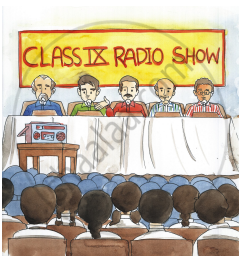
- News stories: about people in your class, about school, about sports (school and local), about the local community
- Comedy: jokes, short plays
- Interviews: with teachers, with exstudents of your school, with a Class IX student who has recently done something very interesting
- Games: general knowledge quiz, panel game, word game
- Advertisements: for shops/industries in the local community, things ‘for sale’ and ‘wanted’ by students
- Local sites: monuments/sites of historical importance and of tourist interest
- Special reports: e.g. safety at school, examination results, school uniform, school assemblies
- Interesting people: role-play interviews with film stars, sports personalities, TV personalities, etc.
- Entertainment reviews: music, films, videos, books, etc.
- Plays
- Songs with lyrics
- Speeches on important personalities
- Tele conference video conference with students, teachers, experts
After considering the matter, and talking it over with his wife, farmer Jones said that he would take John, and do well by him, now that his mother was out of the way; and Mrs. Ellis, who had been looking out for a bound girl, concluded that it would be charitable in her to make choice of Katy, even though she was too young to be of much use for several years.
“I could do much better, I know,” said Mrs. Ellis; “but as no one seems inclined to take her, I must act from a sense of duty expect to have trouble with the child; for she’s an undisciplined thing—used to having her own way.”
But no one said “I’ll take Maggie.” Pitying glances were cast on her wan and wasted form and thoughts were troubled on her account. Mothers brought cast-off garments and, removing her soiled and ragged clothes, dressed her in clean attire. The sad eyes and patient face of the little one touched many hearts, and even knocked at them for entrance. But none opened to take her in. Who wanted a bed-ridden child?
“Take her to the poorhouse,” said a rough man, of whom the question “What’s to be done with Maggie?” was asked. “Nobody’s going to be bothered with her.”
“The poorhouse is a sad place for a sick and helpless child,” answered one.
“For your child or mine,” said the other, lightly speaking; “but for tis brat it will prove a blessed change, she will be kept clean, have healthy food, and be doctored, which is more than can be said of her past condition.”
Read the extract given below and answer the question that follow.
How did the villagers look at Maggie? Why did no one want to take her?
As it turned out, Luz broke his own past record. In doing so, he pushed me on to a peak performance. I remember that at the instant I landed from my final jump—the one which set the Olympic record of 26 feet 5-5/16 inches—he was at my side, congratulating me. Despite the fact that Hitler glared at us from the stands not a hundred yards away, Luz shook my hand hard—and it wasn’t a fake “smile with a broken heart” sort of grip, either.
You can melt down all the gold medals and cups I have, and they couldn’t be a plating on the 24-carat friendship I felt for Luz Long at that moment. I realized then, too, that Luz was the epitome of what Pierre de Coubertin, founder of the modern Olympic Games, must have had in mind when he said, “The important thing in the Olympic Games is not winning but taking part. The essential thing in life is not conquering but fighting well.”
Read the extract given below and answer the question that follow.
How did Luz Long respond to Jesse winning the gold?
Give an account of the trip to The Victoria am Albert Museum that was planned by Braithwaif, for his class.
Why was everyone in the Control Room greatly excited?
How did the author said to encourage his friend to fix the gear-case?
What was the state of the author’s friend at the last?
What was Purcell’s source of earning?
How did different companies affect the character and behaviour of the two birds?
Why was the new governor called to the palace?
Discuss these questions in small groups before you answer them.
When do you think an adult would say this?
No one thinks you are funny.
The cat was very happy to be on the ground. Pick out the phrase used to express this idea.
Why are snakes dangerous, according to you?
Complete the following sentences from memory choosing a phrase from those given in brackets.
Uncle told me ______ while he was away.
Why does the poet say it is not good to be a rebel oneself?
| Caliban: |
No noise, and enter |
In the above lines taken from Act IV Scene i of the play, The Tempest, what does Caliban refer to by the phrase “good mischief“?
