Advertisements
Advertisements
प्रश्न
Who according to poet’s brother stares the poet?
Advertisements
उत्तर
There might be a ghost as has been told by the poet’s brother.
संबंधित प्रश्न
Understanding the tenses:
The tense forms that have been practised and discussed in this chapter, allow
you to show accurately and subtly the time and the relationship of actions and
events with it. We use them in speech and writing.
Understanding and recognising how the tense forms are used.
Can you identity the present tense forms.
|
Simple Present 1. I play tennis |
Present Perfect 1. I have played tennis |
|
Present Continuous 1. I am playing tennis |
|
|
Simple Past 1. I knew about it |
Past Perfect 1. I had known about it |
|
Present Continuous 1. I am reading a book. |
Past Continuous 1. I was reading a book. |
Read the comic strip based on. H.G. Wells' novells.


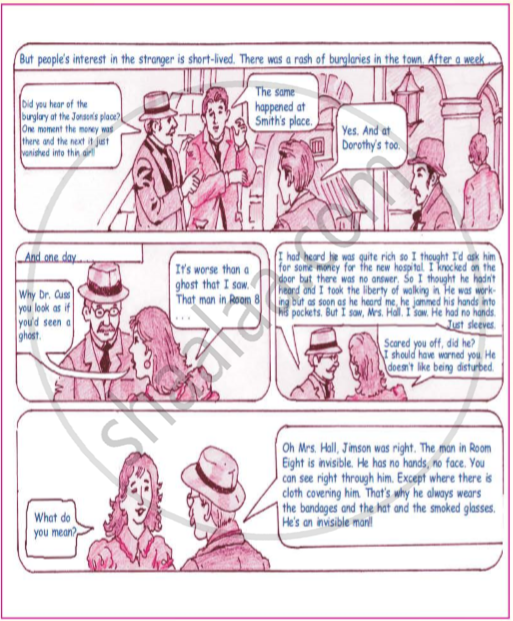
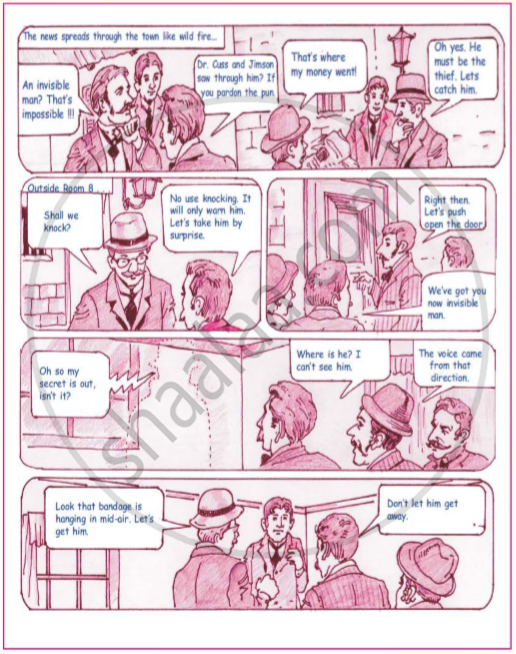
Answer the questions by ticking the correct option.
(a) The strange-looking man wanted ....
(i) the best room at the inn.
(ii} a room with a fire and a good lock.
(iii} a room with a good view.
(iv) a room where he could work quietly.
(b) Jimson was suspicious of the stranger because ...
(i} he did not answer Jimson's questions.
(ii} he did not want to talk about the weather.
(iii} he kept his back turned towards Jimson at all times.
(iv) he shouted atJimson when he entered his room.
(c) The people of the town gossiped about the stranger as ...
(i} he did not go out or talk to anyone in the town.
(ii} he had met with an accident and his face was bandaged.
(iii} he was new to the town and behaved rudely.
(iv) he stayed in his room and did not show his face to anyone.
(d) 'There was a rush of burglaries in the town. This means that ________
(i} there were many robberies in the town.
(ii) a few people in the town had seen a rob her.
(iii} the burglaries in the town were done in a rush.
(iv) the burglar was a rash and careless man.
(e) Although Jimson and Dr Cuss are suspicious of the strange guest, Mrs Hall tolerates him because ....
(i} she is not superstitious or ignorant.
(ii) she is sorry for the stranger who is bandaged.
(iii} the stranger is paying her a good amount of money for the room.
(iv} the stranger is polite and kind to Mrs Hall at all times.
(f) The stranger who was staying at the inn can be described as being ....
(I} violent
(ii} upright
(iii} dishonest
(iv) sensible
Notices
Read the following captions
. Change them into active (voice) and explain their meaning.
e.g. All credit cards accepted.
We accept credit cards.
Meaning: The organization accepts credit cards from customers for all their transactions.
1. Domestic help required
_______________________________________
2. All types of computer servicing undertaken.
_______________________________________
3. Using cell phones is not allowed (University Campus)
_______________________________________
4. Spoken English classes conducted.
_______________________________________
5. All Recharge Coupons sold here.
_______________________________________
What does he plant who plants a tree? a
He plants a friend of sun and sky;b
He plants the flag of breezes free;
The shaft of beauty, towering high;
He plants a home to heaven anigh;
For song and mother-croon of bird
In hushed and happy twilight heard____
The treble of heaven's harmony_____
These things he plants who plants a tree.
Read the lines given above and answer the question that follow:
The black man's face bespoke revenge
As the fire passed from his sight.
For all he saw in his stick of wood
Was a chance to spite the white.
The last man of this forlorn group
Did nought except for gain.
Giving only to those who gave
Was how he played the game.
Their logs held tight in death's still hands
Was proof of human sin.
They didn't die from the cold without
They died from the cold within.
Read the lines given above and answer the question that follow.
What does this say about what prejudice can do to people and the importance of working together?
Bangle sellers are we who bear
Our shining loads to the temple fair...
Who will buy these delicate, bright
Rainbow-tinted circles of light?
Lustrous tokens of radiant lives,
For happy daughters and happy wives.
Read the lines given above and answer the question that follow.
Who is the speaker in the poem?
The blocks were all lined up for those who would use them
The hundred-yard dash and the race to be run
These were nine resolved athletes in back of the starting line
Poised for the sound of the gun.
The signal was given, the pistol exploded
And so did the runners all charging ahead
But the smallest among them,he stumbled and staggered
And fell to the asphalt instead.
He gave out a cry in frustration and anguish
His dreams ands his efforts all dashed in the dirt
But as sure I'm standing here telling this story
The same goes for what next occurred.
Read the lines given above and answer the following question:
Who do you think are the competitors? How do you know which is the event mentioned?
An old man with steel rimmed spectacles and very dusty clothes sat by the side of the road. There was a pontoon bridge across the river and carts, trucks, and men, women and children were crossing it. The mule-drawn carts staggered up the steep bank from the bridge with soldiers helping push against the spokes of the wheels. The trucks ground up and away heading out of it all and the peasants plodded along in the ankle deep dust. But the old man sat there without moving. He was too tired to go any farther.
Read the extract given below and answer the question that follow.
Why were the soldiers “helping to push against the spokes of the wheels”?
Mrs. Thompson did not reply, but presently turned towards the little chamber where her husband had deposited Maggie; and, pushing open the door, went quietly in. Joe did not follow; he saw that, her state had changed, and felt that it would be best to leave her alone with the child. So he went to his shop, which stood near the house, and worked until dusky evening released him from labor. A light shining through the little chamber windows was the first object that attracted Joe’s attention on turning towards the house: it was a good omen. The path led him by this windows and, when opposite, he could not help pausing to look in. It was now dark enough outside to screen him from observation. Maggie lay, a little raised on the pillow with the lamp shining full upon her face. Mrs. Thompson was sitting by the bed, talking to the child; but her back was towards the window, so that her countenance was not seen. From Maggie’s face, therefore, Joe must read the character of their intercourse. He saw that her eyes were intently fixed upon his wife; that now and then a few words came, as if in answers from her lips; that her expression was sad and tender; but he saw nothing of bitterness or pain. A deep-drawn breath was followed by one of relief, as a weight lifted itself from his heart.
Read the extract given below and answer the question that follow.
Why was Joe relieved?
After washing from his hands and face the dust and soil of work, Joe left the kitchen, and went to the little bedroom. A pair of large bright eyes looked up at him from the snowy bed; looked at him tenderly, gratefully, pleadingly. How his heart swelled in his bosom! With what a quicker motion came the heart-beats! Joe sat down, and now, for the first time, examining the thin free carefully under the lamp light, saw that it was an attractive face, and full of a childish sweetness which suffering had not been able to obliterate.
“Your name is Maggie?” he said, as he sat down and took her soft little hand in his.
“Yes, sir.” Her voice struck a chord that quivered in a low strain of music.
“Have you been sick long?”
“Yes, sir.” What a sweet patience was in her tone!
“Has the doctor been to see you?”
“He used to come”
“But not lately?”
“No, sir.”
Read the extract given below and answer the questions that follow.
What did Joe notice about Maggie in the light of the lamp?
Lights were shining from every window, and there was a savoury smell of roast goose, for it was New-year’s eve—yes, she remembered that. In a corner, between two houses, one of which projected beyond the other, she sank down and huddled herself together. She had drawn her little feet under her, but she could not keep off the cold; and
she dared not go home, for she had sold no matches, and could not take home even a penny of money. Her father would certainly beat her; besides, it was almost as cold at home as here, for they had only the roof to cover them, through which the wind howled, although the largest holes had been stopped up with straw and rags. Her little hands were almost frozen with the cold. Ah! perhaps a burning match might be some good, if she could draw it from the bundle and strike it against the wall, just to warm her fingers. She drew one out—“scratch!” how it sputtered as it burnt! It gave a warm, bright light, like a little candle, as she held her hand over it. It was really a wonderful light. It seemed to the little girl that she was sitting by a large iron stove, with polished brass feet and a brass ornament. How the fire burned! and seemed so beautifully warm that the child stretched out her feet as if to warm them, when, lo! the flame of the match went out, the stove vanished, and she had only the remains of the half-burnt match in her hand.
Read the extract given below and answer the question that follow.
What did she imagine when she lighted the first match?
From the day, perhaps a hundred years ago when he sun had hatched him in a sandbank, and he had broken his shell, and got his head out and looked around, ready to snap at anything, before he was even fully hatched-from that day, when he had at once made for the water, ready to fend for himself immediately, he had lived by his brainless craft and ferocity. Escaping the birds of prey and the great carnivorous fishes that eat baby crocodiles, he has prospered, catching all the food he needed, and storing it till putrid in holes in the bank. Tepid water to live in and plenty of rotted food grew him to his great length. Now nothing could pierce the inch-?thick armoured hide. Not even rifle bullets,
which would bounce off. Only the eyes and the soft underarms offered a place. He lived well in the river, sunning himself sometimes with other crocodiles-muggers, as well as the long-? snouted fish-?eating gharials-on warm rocks and sandbanks where the sun dried the clay on them quite white, and where they could plop off into the water in a moment if alarmed. The big crocodile fed mostly on fish, but also on deer and monkeys come to drink, perhaps a duck or two.
Read the extract given below and answer the question that follow.
How did he survive as a baby crocodile from the day he was hatched.
Who was the General Manager of the Taj Hotel ' What role did he play?
What three things did Gopal do before he went to buy his hilsa-fish?
Describe the bearded man in your own words.
How have we learnt to control fire?
Why did Makara dislike tortoises, snakes and lizards? Write a line about each.
Multiple Choice Question:
Who is the poet of this poem?
Answer the following question.
When Jumman’s aunt realised that she was not welcome in his house, what arrangement did she suggest?
The hawker passes time _________.
