Advertisements
Advertisements
प्रश्न
Why did the daimio reward the farmer, but punish his neighbour for the same act?
Advertisements
उत्तर
The farmer had sprinkled the ash over the withered cherry tree and it blossomed. Daimio was pleased seeing the miracle and he rewarded the farmer. His neighbour poured the ash over the cherry tree, but nothing happened to the tree.
Fine particles from the ash entered the eyes of the daimio and his wife. They began to sneeze and cough.
This spoiled the splendour of the procession and so the neighbour was punished by man of the landlord.
संबंधित प्रश्न
Explain what the reason for the following is .
Einstein wanting to study in Switzerland rather than in Munich.
Now fill in the blanks with suitable words from the ones that you have formed.
(i) Mass literacy was possible only after the ___________ of the printing machine.
(ii) Ramesh is unable to tackle the situation as he lacks ____________.
(iii) I could not resist the _____________ to open the letter.
(iv) Hardwork and ___________are the main keys to success.
(v) The children were almost fainting with ______________after being made to stand in the sun.
Thinking about the Text
Answer these question.
I said it with bullets.”
(i) Who says this?
(ii) What does it mean?
(iii) Is it the truth? What is the speaker’s reason for saying this?
What does he plant who plants a tree?
He plants, in sap and leaf and wood,
In love of home and loyalty
And far-cast thought of civic good____
His blessing on the neighbourhood,
Who in the hollow of his hand
Holds all the growth of all our land____
A nation's growth from sea to sea
Stirs in his heart who plants a tree.
Read the lines given above and answer the question that follow:
The next man looking 'cross the way
Saw one not of his church
And Couldn't bring himself to give
The fire his stick of birch.
The third one sat in tattered clothes.
He gave his coat a hitch.
Why should his log be put to use
To warm the idle rich?
The rich man just sat back and thought
of the wealth he had in store
And how to keep what he had earned
From the lazy shiftless poor.
Read the lines given above and answer the question that follow.
Explain with reference to context
"Now tell us what 'twas all about,"
Young Peterkin, he cries;
And little wilhelmine looks up
with wonder-waiting eyes;
"Now tell us all about the war,
And what they fought each other for."
"It was the English," Kaspar cried,
"Who put the French to rout;
But what they fought each other for,
I could not well make out;
But everybody said,"quoth he,
"That 'twas a famous victory.
Read the lines given above and answer the question that follow.
Name the two opposing sides. Who won?
The blocks were all lined up for those who would use them
The hundred-yard dash and the race to be run
These were nine resolved athletes in back of the starting line
Poised for the sound of the gun.
The signal was given, the pistol exploded
And so did the runners all charging ahead
But the smallest among them,he stumbled and staggered
And fell to the asphalt instead.
He gave out a cry in frustration and anguish
His dreams ands his efforts all dashed in the dirt
But as sure I'm standing here telling this story
The same goes for what next occurred.
Read the lines given above and answer the following question:
Explain with reference to context.
Of the seven hundred villages dotting the map of India, in which the majority of India’s five hundred million live, flourish and die, Kritam was probably the tiniest, indicated on the district survey map by a microscopic dot, the map being meant more for the revenue official out to collect tax than for the guidance of the motorist, who in any case could not hope to reach it since it sprawled far from the highway at the end of a rough track furrowed up by the iron-hooped wheels of bullock carts. But its size did not prevent its giving itself the grandiose name Kritam, which meant in Tamil coronet or crown on the brow of the subcontinent. The village consisted of fewer than thirty houses, only one of them built from brick and cement and painted a brilliant yellow and blue all over with
gorgeous carvings of gods and gargoyles on its balustrade, it was known as the Big House. The other houses, distributed in four streets, were generally of bamboo thatch, straw, mud and other unspecified material. Muni’s was the last house in the fourth street, beyond which stretched the fields. In his prosperous days Muni had owned a flock of sheep and goats and sallied forth every morning driving the flock to the highway a couple of miles away.
Read the extract given below and answer the question that follow.
What did the Big House look like?
“Do the scientists really know? Will it happen today, will it ?”
“Look, look; see for yourself !”The children pressed to each other like so many roses, so many weeds, intermixed, peering out for a look at the hidden sun. It rained. It had been raining for seven years; thousands upon thousands of days compounded and filled from one end to the other with rain, with the drum and gush of water, with the sweet crystal fall of showers and the concussion of storms so heavy they were tidal waves come over the islands. A thousand forests had been crushed under the rain and grown up a thousand times to be crushed again. And this was the way life was forever on the planet Venus, and this was the schoolroom of the children of the rocket men and women who had come to a raining world to set up civilization and live out their lives.
Read the extract given below and answer the question that follow.
Describe the rain and its effect on life on Venus.
Read the extract given below and answer the questions that follow:
Mabel: Oh! Why didn’t I face it? But I couldn’t—I had to believe.
Dancy: And now you can’t. It’s the end, Mabel.
Mabel: [Looking up at him] No.
[Dancy goes suddenly on his knees and seizes her hand.]
Dancy: Forgive me!
Mabel: [Putting her hand on his head] Yes; oh, yes! I think I’ve known for a long time, really. Only — why? What made you?
(i) How does Dancy respond to Mabel’s question?
(ii) What makes Dancy say ‘that’s not in human nature’ a little later?
(iii) Why does Inspector Dede arrive at Dancy’s house? How does Mabel try to stall him?
(iv) To whom was Dancy’s suicide note addressed? What had he written in it?
(v) What does Margaret mean when she says that keeping faith is ‘not enough’ and ‘we’ve all done that’?
What, in your opinion, should his friends have done?
Why did Chandni refuse to join the group of wild goats?
Why did Abbu Khan feel sad?
Discuss the question in pairs before you write the answer.
Who did he choose next?
Word in the box given below indicates a large number of… For example, ‘a herd of cows’ refers to many cows. Complete the following phrase with a suitable word from the box.
a _____________of chicks
Use the clues given below to complete this crossword puzzle.
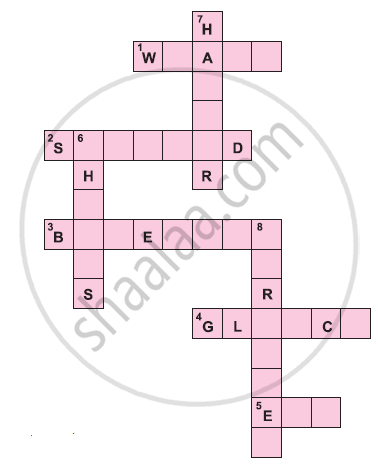
Across
1. very tired
2. had an angry look on the face
3. short trousers
4. a fault in a machine that prevents it from working properly
5. a small and naughty boy-fairy
Down
6. work that must be done every day, often boring
7. a basket with a lid
8. gave a short, high-pitched cry
Make noun from the word given below by adding –ness, ity, ty or y
Creative___________.
Try to make a kite with your friends. Collect the things required such as colour paper/newspaper, thread, glue, a thin stick that can be bent. After making the kite see if you can fly it.
Which incident made the visitor to the school ten times more thoughtful than ever?
Complete the following sentences from memory choosing a phrase from those given in brackets.
The first time I took a chance I got ____________
The child wishes so because ____________.
