Advertisements
Advertisements
प्रश्न
Write ‘True’ or ‘False’ against each of the following
(i) Soapy did not want to go to prison. ______
(ii) Soapy had been to prison several times. _____
(iii) It was not possible for Soapy to survive in the city through the winter. _____
(iv) Soapy hated to answer questions of a personal nature. ______
Advertisements
उत्तर
(i) Soapy did not want to go to prison. - False.
(ii) Soapy had been to prison several times. - True.
(iii) It was not possible for Soapy to survive in the city through the winter.- False.
(iv) Soapy hated to answer questions of a personal nature. - True.
संबंधित प्रश्न
Thinking about the Poem
Write the story of ‘A Legend of the Northland’ in about ten sentences.
When we talk about people, we discuss their qualities. The box below contains some words which best describe people.
| unassummg | authoritative | egoist | sympathetic |
| domineering | kind-hearted | thoughtful | tireless |
| laborious | diligent | careless | irresponsible |
| workaholic | sagacious | tiresome |
Work in pairs and select the appropriate words for the following characters.
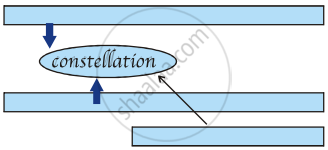
Read the following extracts from the story, and try to puzzle out the meanings of the encircled words from other words and phrases in the extract. Write the clues in the empty boxes. Then give your own explanation of the encircled words.
I saw individual stars, but I could not distinguish the constellation they belonged to. Then dawn came and put out all my stars.
Therefore, constellation means ______.
Know all about Chess . Read and enjoy :
You now know a little about Koneru Humpychess player but do you know how to play chess? Let's know more about it:
Have you ever played chess? Did you know that chess is the oldest skill game in the world? But chess is more than just a. game of skill. It can tell you much about the way people lived in medieval times. If you look at the way a chess board is set up, then study the pieces and how they are used, you will realise that chess is a history of medieval times in miniature. The six different chess pieces on the board represent a cross section of medieval life with its many ceremonies grandeur ,and wars .
Chess was played many centuries ago in China, India, and Persia. No one really knows for sure in which country it originated. Then, in the eighth century, armies of Arabs known as Moors invaded Persia. The Moors learned chess from the Persians. When the Moors later invaded Spain, the soldiers brought the game of chess with them. Soon the Spanish were playing chess, too. From Spain, the popularity of chess quickly spread throughout all of Europe
Europeans gave chess pieces the names we know today; they probably had trouble pronouncing and spelling the Persian names, so they modernized them to reflect the way they lived. Today, the names certainly aren't modem but a thousand years ago they represented the very way in which both ordinary people and persons of rank lived their lives.
The pawns on the chess board represent serfs, or labourers. There are more of them than any other piece on the board, and often they are sacrificed to save the more valuable pieces. In medieval times, serfs were considered no more than the property of landowners, or chattels. Life was brutally hard for serfs during this era of history. They worked hard and died young. They were often left unprotected while wars raged around them. They could be traded, used as a diversion, or even sacrificed to allow the landowners to escape harm.
The castle piece on a chess board is the home, or the refuge, just as it was a home in medieval times. In Chess, each side has two castles, or rooks, as they are sometimes called.
The knight on a chess board represents the professional soldier of medieval times whose job it was to protect persons of rank, and there are two of them per side in a game of chess. Knights in a game of chess are more important than pawns, but less important than bishops, kings, or queens. Their purpose in the game of chess is to protect the more important pieces, and they can be sacrificed to save those pieces just as pawns can.
There is a bishop in the game of chess, who represents the church. The Church was a rich and mighty force in medieval times, and religion played a large part in every person's life. It is no wonder that a figure that represented the concept of religion found its way into the game. A bishop was the name for a priest in the Catholic church who had risen through the ranks to a more powerful position. In the game of chess, there are two bishops for each side.
The queen is the only piece on the board during a chess game that represents a woman, and she is the most powerful piece of the game.
The king is the tallest piece on the board, and is as well defended on the chessboard as in medieval life. In medieval times, the surrender of the king would mean the loss of the kingdom to invading armies and that could mean change for the worse. It was to everyone's advantage, from the lowest serf to the highest-ranking official, to keep the king safe from harm.. The king is the most important, but not the most powerful piece in chess. If you do not protect your king, you lose the game.
The next time you set up your chessboard and get ready 7 to play a friendly game or two, think of chess as a 6 history lesson. The pieces on the board represent a way 5 of life that is no more, and the real life dramas that occurred in medieval times are now only a game.
The black man's face bespoke revenge
As the fire passed from his sight.
For all he saw in his stick of wood
Was a chance to spite the white.
The last man of this forlorn group
Did nought except for gain.
Giving only to those who gave
Was how he played the game.
Their logs held tight in death's still hands
Was proof of human sin.
They didn't die from the cold without
They died from the cold within.
Read the lines given above and answer the question that follow.
Who are ‘they’ referred to here ? Where were they ?
I wandered lonely as a Cloud
That floats on high o'er vales and Hills,
When all at once I saw a crowd,
A host, of golden Daffodils;
Beside the Lake, beneath the trees,
Fluttering and dancing in the breeze.
Read the lines given above and answer the question that follow.
Who wandered like a lonely cloud and where ?
A free bird leaps on the back
Of the wind and floats downstream
Till the current ends and dips his wing
In the orange suns rays
And dares to claim the sky.
Read the above lines and answer the question that follow.
Explain with reference to the context.
He flungs himself down in a corner to recoup from the fatigue of his visit to the shop. His wife said, “You are getting no sauce today, nor anything else. I can’t find anything to give you to eat. Fast till the evening, it’ll do you good. Take the goats and be gone now,” she cried and added, “Don’t come back before the sun is down.”
Read the extract given below and answer the question that follow.
Did The shopkeeper give Muni what he needed? Why/ Why not?
The boy looked up. He took his hands from his face and looked up at his teacher. The light from Mr. Oliver’s torch fell on the boy’s face, if you could call it a face. He had no eyes, ears, nose or mouth. It was just a round smooth head with a school cap on top of it.
And that’s where the story should end, as indeed it has for several people who have had similar experiences and dropped dead of inexplicable heart attacks. But for Mr. Oliver, it did not end there. The torch fell from his trembling hand. He turned and scrambled down the path, running blindly through the trees and calling for help. He was still running towards the school buildings when he saw a lantern swinging in the middle of the path. Mr. Oliver had never before been so pleased to see the night watchman. He stumbled up to the watchman, gasping for breath and speaking incoherently.
What is it, Sahib? Asked the watchman, has there been an accident? Why are you running?
I saw something, something horrible, a boy weeping in the forest and he had no face.
No face, Sahib?
No eyes, no nose, mouth, nothing.
Do you mean it was like this, Sahib? asked the watchman, and raised the lamp to his own face. The watchman had no eyes, no ears, no features at all, not even an eyebrow. The wind blew the lamp out and Mr. Oliver had his heart attack.
Read the extract given below and answer the question that follow.
What was strange about the watchman? What happened to Mr Oliver when the watchman raised the lantern to show his face?
Abbu Khan pushed Chandni into a small hut. This shows that he
Bring out a contrast between Mr. Purcell and the customer.
Who was Abbu Khan?
How did the other bird greet the king?
Who was Ray? What was his handicap?
What did Saeeda tell the sunrays to do?
To whom are these instructions being addressed?
What kind of surprise could be found while walking on the grass?
Answer the following question:
How did she become an astronaut? What gave her the idea that she could be an astronaut?
How did the old aunt get justice?
Speak to five adults in your neighbourhood. Ask them the following questions (in any language they are comfortable in). Then come back and share your findings with the class.
- Do they buy their provisions packed in plastic packets at a big store or loose, from a smaller store near their house?
- Where do they buy their footwear? Do they buy branded footwear or footwear made locally? What reasons do they have for their preference?
- Do they buy readymade clothes or buy cloth and get their clothes stitched by a tailor? Which do they think is better?
