Advertisements
Advertisements
प्रश्न
Read the following conversation.
Ravi: What are you doing?
Mridu: I’m reading a book.
Ravi: Who wrote it?
Mridu: Ruskin Bond.
Ravi: Where did you find it?
Mridu: In the library.
Notice that ‘what’, ‘who’, ‘where’, are question words. Questions that require information begin with question words. Some other question words are ‘when’, ‘why’, ‘where’, ‘which’ and ‘how’.
Remember that
- What asks about acting, things etc.
- Who asks about people.
- Which asks about people or things.
- Where asks about place.
- When asks about time.
- Why asks about reason or purpose.
- How asks about means, manner or degree.
- Whose asks about possessions.
Read the following paragraph and frame questions on the italicised phrases.
Anil is in school. I am in school too. Anil is sitting in the left row. He is reading a book. Anil’s friend is sitting in the second row. He is sharpening his pencil. The teacher is writing on the blackboard. Children are writing in their copybooks. Some children are looking out of the window.
Advertisements
उत्तर
- Where is Anil?
- Which row he is sitting in?
- What is he doing?
- Where is Anil’s friend sitting?
- What is his friend doing?
- Who is writing on the blackboard?
- What are some children doing?
संबंधित प्रश्न
Answer of these question in a short paragraph (about 30 words).
What did he do?
Think about the Text
Discuss in pairs and answer question below in a short paragraph (30 − 40 words).
“I looked into the mirror and smiled,” says the doctor. A little later he says, “I forgot my danger and smiled feebly at myself.” What is the doctor’s opinion about himself when:
(i) he first smiles, and
(ii) he smiles again? In what way do his thoughts change in between, and why?
Thinking about the Poem
What does the poet wish for the snake?
Is Lushkoff a willing worker? Why, then, does he agree to chop wood for Sergei?
Pick out word from the text that mean the same as the following word or expression. (Look in the paragraph indicated.)
the usual way of doing things : _________
Based on your reading of the story, answer the following question by choosing the correct option:
Harold felt that he was deprived of the respect that his classmates would give him as
Some are like fields of sunlit corn,
Meet for a bride on her bridal morn,
Some, like the flame of her marriage fire,
Or, rich with the hue of her heart's desire,
Tinkling,luminous,tender, and clear,
Like her bridal laughter and bridal tear.
Read the lines given above and answer the question that follow.
Besides visual imagery the poet also uses auditory imagery.Pick out the lines.
Sibia sprang.
From boulder to boulder she came leaping like a rock goat. Sometimes it had seemed difficult to cross these stones, especially the big gap in the middle where the river coursed through like a bulge of glass. But now she came on wings, choosing her footing in midair without even thinking about it, and in one moment she was beside the shrieking woman. In the boiling bloody water, the face of the crocodile, fastened round her leg, was tugging to and fro, and smiling. His eyes rolled on to Sibia. One slap of the tail could kill her. He struck. Up shot the water, twenty feet, and fell like a silver chain. Again! The rock jumped under the blow. But in the daily heroism of the jungle, as common as a thorn tree, Sibia did not hesitate. She aimed at the reptile’s eyes. With all the force of her little body, she drove the hayfork at the eyes, and one prong went in—right in— while its pair scratched past on the horny cheek. The crocodile reared up in convulsion, till half his lizard body was out of the river, the tail and nose nearly meeting over his stony back. Then he crashed back, exploding the water, and in an uproar of bloody foam he disappeared. He would die. Not yet, but presently, though his death would not be known for days; not till his stomach, blown with gas, floated him. Then perhaps he would be found upside down among the logs at the timber boom, with pus in his eye. Sibia got arms round the fainting woman, and somehow dragged her from the water.
Read the extract given below and answer the question that follow.
Why does Sibia think of the two brass vessels when the Gujar woman is attacked?
Analyze the character of Luz Long.
Read the extract given below and answer the questions that follow:
Portia: To these injunctions every one doth s'vear
That comes to hazard for my worthless self.
Arragon: And so have I address'd me. Fortune now
To my heart's hope! - Gold, silver and base lead.
(i) Who had tried his luck in trying to choose the correct casket before the prince of Arragon? Which casket had that suitor chosen ? What did he find inside the casket?
(ii) What are the three things Arragon was obliged by the oath to obey?
(iii) What was the inscription on the golden casket? How do the actions of the martlet illustrate this inscription?
(iv) Which casket does Arragon finally choose? Whose portrait does he find inside? Which casket actually contains Portia's portrait?
(v) Who enters soon after? What does he say about the young Venetian who has just arrived? What gifts has the Venetian brought with him?
Answer the following question.
Who advised Golu to go to the Limpopo river?
The king helped the hermit in digging the beds. He even slept on the floor of the hut and lived like a simple man in the hermit’s hut. What lesson we learn from this?
How did the king reach the rishi’s ashram? Why did the two birds behave with the king differently?
Why would the child need a hankie?
Who was Taro? What was his most endearing quality?
How did Taro manage to meet the demand of his father?
Answer the question.
Why does the poet wonder if teachers also do things that other people do?
Who says this to whom and why?
“But is it right, my son, to keep mum and not say what you consider just and fair?”
Look at the following picture. One asks a question, the other answers it. Then the answer is noted in a form as shown below.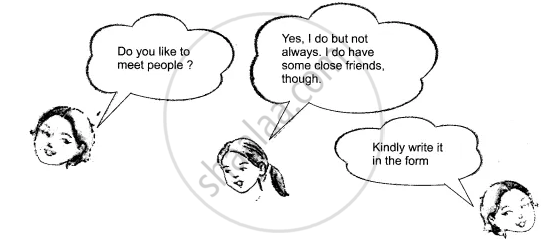
| Questions | Yes/No | Additional Response |
|
1. Do you like to meet people? |
Yes I do, but not always | I do have some close friends, though. |
|
2. Do you like the area you live in? |
No, I Don't | But I have no choice |
The word ‘tip’ has only three letters but many meanings.
Match the word with its meanings below.
- finger tips – be about to say something
- the tip of your nose – make the boat overturn
- tip the water out of the bucket – the ends of one’s fingers
- have something on the tip of your tongue – give a rupee to him, to thank him
- tip the boat over-empty a bucket by tilting it
- tip him a rupee-the pointed end of your nose
- the tip of the bat – if you take this advice
- the police were tipped off – the bat lightly touched the ball
- if you take my tip – the end of the bat
- the bat tipped the ball – the police were told or warned
