Advertisements
Advertisements
प्रश्न
What does the poet call ‘buttercup’ as? Why?
Advertisements
उत्तर
The poet figuratively uses the word ‘buttercup’ for flowers and buds. The poet calls them so because they offer a lot of sweet nector to the butterflies, to sip.
संबंधित प्रश्न
Answer of these question in a short paragraph (about 30 words).
Why did Margie’s mother send for the County Inspector?
Answer the question in 30–40 words.
Where was the shehnai played traditionally? How did Bismillah Khan change this?
Tick the right answer.
When you appreciate something, you (find it good and useful/find it of no use).
Discuss these question in class with your teacher and then write down your answer
in two or three paragraphs .
How does Kezia begin to see her father as a human being who needs her sympathy?
What happens when the zip on his carry-on bag gives way?
Look at the following sentences. They each have two clauses, or two parts each with their own subject and verb or verb phrase. Often, one part (italicised) tells us when or why something happened.
• I reached the market when most of the shops had closed. (Tells us when I reached.)
• When Rahul Dravid walked back towards the pavilion, everyone stood up. (Tells us when everyone stood up.)
• The telephone rang and Ganga picked it up. (Tells us what happened next.)
• Gunjan has been with us ever since the school began. (Tells us for how long he has been with us.)
I. Identify the two parts in the sentences below by underlining the part that gives us the information in brackets.
1. Where other girls wore traditional Indian dresses, Santosh preferred shorts.
(Contrasts her dress with that of others)
2. She left home and got herself enrolled in a school in Delhi. (Tells us what happened after the first action.)
3. She decided to fight the system when the right moment arrived. (Tells us when she was going to fight the system.)
4. Little Maria had not yet celebrated her tenth birthday when she was packed off to train in the United States. (Tells us when Maria was sent to the U.S.)
We notice lots of details about people and their appearance, but in order to
vividly describe them , we need to be specific.
Working in pairs, look carefully at the people around you and complete the
table with appropriate words from the box given on the next page. You may
add words of your own to describe people.

| angular | close-cropped | well-tailored | well-tailored casual | stocky |
| elegant | unshaven | ill-fitting | formal | lanky |
| bearded | sloppy | medium | petite | hefty |
| balding | slim | plaited | thick | round |
| open | friendly | wavy | long | receding |
| over weight | sharp-featured |
| A | B | C | D | |
| Face | ||||
| Hair | ||||
| Dress | ||||
| Build |
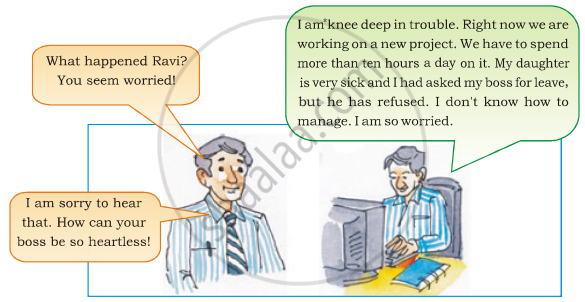
Read the following conversation between two friends.
It was my business to cross the bridge, explore the bridge head 3 beyond and find out to what point the enemy had advanced. I did this and returned over the bridge. There were not so many carts now and very few people on foot, but the old man was still there.’’Where do you come from?” I asked him.
“From San Carlos,” he said, and smiled.
That was his native town and so it gave him pleasure to mention it and he smiled.
“I was taking care of animals,” he explained.
“Oh,” I said, not quite understanding.
“Yes,” he said, “I stayed, you see, taking care of animals. I was the last one to leave the town of San Carlos.”
He did not look like a shepherd nor a herdsman and I looked at his black dusty clothes and his gray dusty face and his steel rimmed spectacles and said, “What animals were they?”
“Various animals,” he said, and shook his head. “I had to leave them.”
Read the extract given below and answer the question that follow.
What was the name of the old man’s native town?
The king had done right things at the right time. Explain giving three examples.
Why Maya called Nishad Seven?
Sketch the character of Ray in about 80 words. What qualities of Ray do you admire most?
Who was Taro? What was his most endearing quality?
Multiple Choice Question:
Why does the flier have to run?
What do you learn in the lesson about camels?
Answer the following question.
“God lives in the heart of the Panch.” the aunt said. What did she mean?
The words given against the sentences below can be used both as nouns and verbs. Use them appropriately to fill in the blanks.
(i) The police are _______________________ the area to catch the burglars. (comb)
(ii) An ordinary plastic ______________________________ costs five rupees.
How would you describe Rasheed’s ‘bad luck’?
Can there be a good reason behind speaking when everybody else is silent?
What does Prospero intend to do with his book before his interaction with Alonso in Act V of the play, The Tempest?
