Advertisements
Advertisements
प्रश्न
Simple Present Tense
In these sentences words like everyday, often, seldom, never, every
month, generally, usually, etc. may be used.
Fill in the blanks with the correct form of the verb in brackets.
The African lungfish can live without water for up to four years. During drought, it
___(dig) a pit and ___(enclose) itself in a capsule of slime and earth, leaving a tiny opening
for air. The capsule ___(dry) and ___(harden), but when rain ___(come), the mud
___(dissolve) and the lungfish ___(swim) away.
Advertisements
उत्तर
The African lungfish can live without water for up to four years. During drought, it digs a pit and encloses itself in a capsule of slime and earth, leaving a tiny opening for air. The capsule dries and hardens, but when rain comes, the mud dissolves and the lung fish swims away.
संबंधित प्रश्न
Answer this question in 30–40 words.
Find at least two instances in the text which tell you that Bismillah Khan loves India and Benaras.
What did Einstein call his desk drawer at the patent office? Why?
This story about a frightening incident is narrated in a humorous way. What makes it
humorous? (Think of the contrasts it presents between dreams and reality. Some of them
are listed below.)
1. (i) The kind of person the doctor is (money, possessions)
(ii) The kind of person he wants to be (appearance, ambition)
2.(i) The person he wants to marry
(ii) The person he actually marries
3.(i) His thoughts when he looks into the mirror
(ii) His thoughts when the snake is coiled around his arm
Write short paragraphs on each of these to get your answer.
Discuss in pair and answer question below in a short paragraph (30 − 40 words.
What did George and Harris offer to pack and why?
Answer of these question in a short paragraph (about 30 words).
Santosh Yadav got into the record books both times she scaled Mt Everest. What were the reasons for this?
A Russian girl, Maria Sharapova, reached the summit of women’s tennis when she was barely eighteen. As you read about her, see if you can draw a comparison between her and Santosh Yadav.
Match the following.
| something disarming | something that makes you feel friendly, taking away your suspiciousness |
| at odds with | in contrast to; not agreeing with |
| glamorous attire | attractive and exciting clothes |
| in almost no time | quickly, almost immediately |
| poised beyond her years | more calm, confident and in control than people of her age usually are |
| packed off | sent off |
| launched | started |
| heart wrenching | causing strong feelings of sadness |
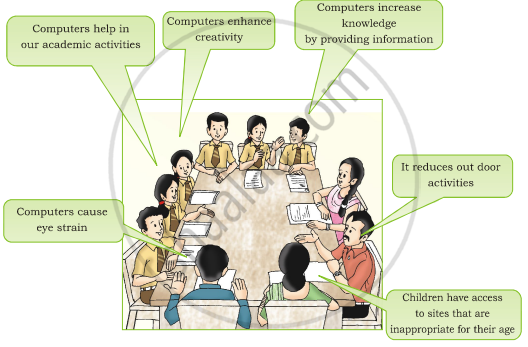
This is a meeting of the school’s Parent-Teacher Association. Some student representatives have also been invited to participate to discuss the role that Information technology/computers play in the growth and development of children.
Read the following passage on New Zealand.
New Zealand is a Mecca for nature lovers. Throughout most of New Zealand's geological history, it was a bird's paradise. The islands were once part of the southern super - continent Gondwana from which they broke off around 80 million years ago before mammals had evolved and spread.
(courtesy: Terra Green Sept 2008 issue 06)
The underlined words express a relationship usually of space or time between the words with which they stand. Such 'Positional' words which are used before nouns (pre-position) are called prepositions.

Six humans trapped by happenstance
In black and bitter cold.
Each one possessed a stick of wood,
Or so the story's told.
Their dying fire in need of logs;
The first man held his back.
For on the faces around the fire,
He noticed one was black.
Read the lines given above and answer the question that follow:
What is suggested by the use of the word trapped?
Read the extract given below and answer the questions that follow:
'Tell me not in mournful numbers,
Life is but an empty dream!
For the soul is dead that slumbers,
And things are not what they seem.'
(A Psalm of Life-H. W. Longfellow)
(i) Explain-'Tell me not in mournful numbers, Life is but an empty dream!' What should not be considered the goal of life?
(ii) What is the beating of the heart compared to? How is the heart described? IV/wt does the beating of the heart remind us of?
(iii) What does the poet mean when lie compares the world to a battlefield? What should our role be in this battle?
(iv) How should we view the past and the future? what advice does the past give in this context?
(v) What do we learn from the lives of great men? What is the final message of the poem ? Give one reason why the poem appeals to you.
Answer the following question.
Kari learnt the commands to sit and to walk. What were the instructions for each command?
What was the king’s reaction when he came to know that he had lost the challenge?
How did Golu help the python?
Why did Abbu Khan name his young goat as Chandni?
How did Ray communicate with him?
How did the monkey and the crocodile become good friends?
Answer the following question. (Refer to that part of the text whose number is given against the question. This applies to the comprehension questions throughout the book.)
In what subjects did the little man need help to do Patrick’s homework? (5, 6)
Answer the following question.
What was the ‘game’ that every child in the school had to play?
What does the poem Whatif talk about? Give a few examples of some of the child’s worries or cynical fears.
What activities are dear to little children? Who does the child envy and why in the poem Vocation?
