Advertisements
Advertisements
Question
Simple Present Tense
In these sentences words like everyday, often, seldom, never, every
month, generally, usually, etc. may be used.
Fill in the blanks with the correct form of the verb in brackets.
The African lungfish can live without water for up to four years. During drought, it
___(dig) a pit and ___(enclose) itself in a capsule of slime and earth, leaving a tiny opening
for air. The capsule ___(dry) and ___(harden), but when rain ___(come), the mud
___(dissolve) and the lungfish ___(swim) away.
Advertisements
Solution
The African lungfish can live without water for up to four years. During drought, it digs a pit and encloses itself in a capsule of slime and earth, leaving a tiny opening for air. The capsule dries and hardens, but when rain comes, the mud dissolves and the lung fish swims away.
RELATED QUESTIONS
Thinking about the Poem
What are the things the wind does in the first stanza?
Answer of these question in a short paragraph (about 30 words).
What characteristics does he say he inherited from his parents?
On the basis of your understanding of the poem, answer the following questions
by ticking the correct choice.
The setting of the poem is ___________.
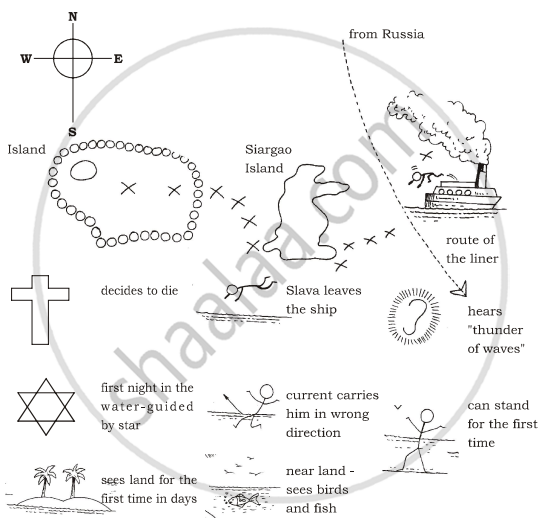
Given below is a map of the area in which Slava Kurilov faced his ordeal. You will also see the major events in the story, in mixed order, each accompanied by a symbol. After you have read ‘Ordeal in the Ocean’, draw the appropriate symbol against each x mark. (One is already drawn for you.) Draw the symbols or number the symbols, and transfer them to the map.)
The horse was nearly life-size, moulded out of clay, baked, burnt, and brightly coloured, and reared its head proudly, prancing its forelegs in the air and flourishing its tail in a loop; beside the horse stood a warrior with scythelike mustachios, bulging eyes, and aquiline nose. The old image-makers believed in indicating a man of strength by bulging out his eyes and sharpening his moustache tips, and also decorated the man’s chest with beads which looked today like blobs of mud through the ravages of sun and wind and rain (when it came), but Muni would insist that he had known the beads to sparkle like the nine gems at one time in his life.
Read the extract given below and answer the question that follow.
Why had the image makers given the warrior bulging eyes and aquiline nose?
“Do the scientists really know? Will it happen today, will it ?”
“Look, look; see for yourself !”The children pressed to each other like so many roses, so many weeds, intermixed, peering out for a look at the hidden sun. It rained. It had been raining for seven years; thousands upon thousands of days compounded and filled from one end to the other with rain, with the drum and gush of water, with the sweet crystal fall of showers and the concussion of storms so heavy they were tidal waves come over the islands. A thousand forests had been crushed under the rain and grown up a thousand times to be crushed again. And this was the way life was forever on the planet Venus, and this was the schoolroom of the children of the rocket men and women who had come to a raining world to set up civilization and live out their lives.
Read the extract given below and answer the question that follow.
What is supposed to happen on this particular day?
Answer the following question.
What is “the master call”? Why is it the most important signal for an elephant to learn?
Find in the poem lines that match the following. Read both one after the other.
He is noisy on purpose
Do you think we should help people in need? Why so?
How do the desert plants fulfill their need for water?
Why was everyone delighted to see the iron chest on the camel’s back?
How did the jealous courtiers plan to harm Tansen? How did the great musician save his honour as well as official position?
What does the last sentence of the story suggest? What would the crocodile tell his wife?
There are twelve words hidden in this table. Six can be found horizontally and the remaining six vertically. All of them are describing words like ‘good’, ‘happy’, etc. The first letters of the words are given below:
Horizontal: H R F F S G
Vertical: A W S F L Q 2020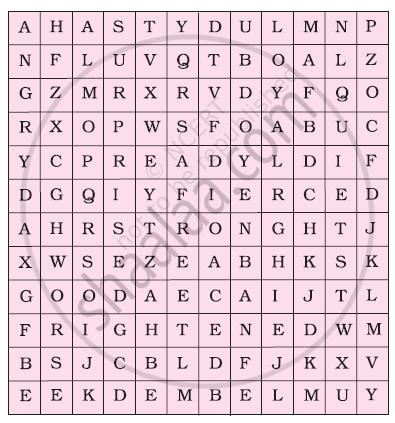
Answer the question.
What do you think these phrases from the poem mean?Punished in the corner.
What activities are dear to little children? Who does the child envy and why in the poem Vocation?
What did the squirrel do if someone came too close to his tree?
Fill in the blanks with the words given in the box.
| how, what, when, where, which |
You should decide soon ______ to start building your house.
Fill in the blanks with the words given in the box.
| how, what, when, where, which |
Do you know ______ to ride a bicycle? I don’t remember ______ and ______ I learnt it
'The eight other athletes stopped in their tracks' means that they ______.
