Advertisements
Advertisements
प्रश्न
Why did he buy a young goat?
Advertisements
उत्तर
He bought a young goat as he thought it would stay with him much longer. It would begin to love him as well as the food he would give her everyday, and would never want to go to the hills.
संबंधित प्रश्न
Answer these question in one or two words or in short phrase.
Name the two temples the author visited in Kathmandu.
Answer these question in one or two words or in short phrase.
What does Vikram Seth compare to the quills of a porcupine?
Oh yes, we know it keeps them still,
They don't climb out the window sill,
They never fight or kick or punch,
They leave you free to cook the lunch
And wash the dishes in the sink....
But did you ever stop to think,
To wonder just exactly what
This does to your beloved tot?
IT ROTS THE SENSE IN THE HEAD!
IT KILLS IMAGINATION DEAD!
IT CLOGS AND CLUTTERS UP THE MIND!
IT MAKES A CHILD SO DULL AND BLIND
HE CAN NO LONGER UNDERSTAND
A FANTASY, A FAIRYLAND!
HIS BRAIN BECOMES AS SOFT AS CHEESE!
HIS POWERS OF THINKING RUST AND FREEZE!
HE CANNOT THINK - HE ONLY SEES!
Read the lines given above and answer the question given below.
The children Describe the effects of television on children’s mind.
It was my business to cross the bridge, explore the bridge head 3 beyond and find out to what point the enemy had advanced. I did this and returned over the bridge. There were not so many carts now and very few people on foot, but the old man was still there.’’Where do you come from?” I asked him.
“From San Carlos,” he said, and smiled.
That was his native town and so it gave him pleasure to mention it and he smiled.
“I was taking care of animals,” he explained.
“Oh,” I said, not quite understanding.
“Yes,” he said, “I stayed, you see, taking care of animals. I was the last one to leave the town of San Carlos.”
He did not look like a shepherd nor a herdsman and I looked at his black dusty clothes and his gray dusty face and his steel rimmed spectacles and said, “What animals were they?”
“Various animals,” he said, and shook his head. “I had to leave them.”
Read the extract given below and answer the question that follow.
What is the narrator’s job?
“If you are rested I would go,” I urged. “Get up and try to walk now.”
“Thank you,” he said and got to his feet, swayed from side to side and then sat down backwards in the dust.
“I was taking care of animals,” he said dully, but no longer to me. “I was only taking care of animals.”
There was nothing to do about him. It was Easter Sunday and the Fascists were advancing toward the Ebro. It was a grey overcast day with a low ceiling so their planes were not up. That and the fact that cats know how to look after themselves was all the good luck that the old man would ever have.
Read the extract given below and answer the question that follow.
Why could the Fascists planes not fly?
Of the seven hundred villages dotting the map of India, in which the majority of India’s five hundred million live, flourish and die, Kritam was probably the tiniest, indicated on the district survey map by a microscopic dot, the map being meant more for the revenue official out to collect tax than for the guidance of the motorist, who in any case could not hope to reach it since it sprawled far from the highway at the end of a rough track furrowed up by the iron-hooped wheels of bullock carts. But its size did not prevent its giving itself the grandiose name Kritam, which meant in Tamil coronet or crown on the brow of the subcontinent. The village consisted of fewer than thirty houses, only one of them built from brick and cement and painted a brilliant yellow and blue all over with
gorgeous carvings of gods and gargoyles on its balustrade, it was known as the Big House. The other houses, distributed in four streets, were generally of bamboo thatch, straw, mud and other unspecified material. Muni’s was the last house in the fourth street, beyond which stretched the fields. In his prosperous days Muni had owned a flock of sheep and goats and sallied forth every morning driving the flock to the highway a couple of miles away.
Read the extract given below and answer the question that follow.
Name the village in which Muni lived.
Find in the poem an antonym (a word opposite in meaning)for the following word.
long
Find in the poem lines that match the following. Read both one after the other.
The rebel refuses to cut his hair.
Describe Ravi’s character in the story.
What proves that Mr Gessler was not an Englishman?
How did Golu help the python?
Describe the Cat and the Dad situation in the beginning and at the end of the poem.
State an adjective used to describe the tree.
Read the lines in which the following phrases occur. Then discuss with your partner the meaning of each phrase in its context.
Velvet grass
Use the clues given below to complete this crossword puzzle.
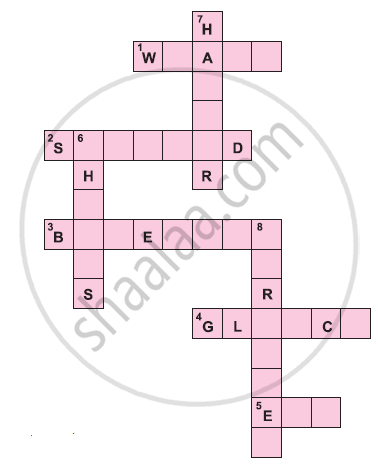
Across
1. very tired
2. had an angry look on the face
3. short trousers
4. a fault in a machine that prevents it from working properly
5. a small and naughty boy-fairy
Down
6. work that must be done every day, often boring
7. a basket with a lid
8. gave a short, high-pitched cry
In groups of four, discuss the following lines and their meanings.
And everyone’s longing today to hear
Some fresh and beautiful thing
What does the poet tell you about the world of words? Do you agree with him?
Who is the speaker in the poem Whatif? What is she worried about? Can you suggest ways to get rid of silly fears?
Read the lines given below and answer the following question:
| Iris: Of her society Be not afraid. I met her deity Cutting the clouds towards Paphos, and her son Dove-drawn with her. |
Why was the person addressed afraid of “her”?
In Act V, Scene I of the play, The Tempest, Ariel reminds Prospero that it was the sixth hour because ______.
