Advertisements
Advertisements
प्रश्न
Discuss in pairs and answer question below in a short paragraph (30 − 40 words.
How did George and Harris react to this? Did Jerome like their reaction?
Advertisements
उत्तर
George and Harris readily accepted Jerome’s suggestion. George smoked a pipe and “spread himself over the easy-chair”, while Harris put his legs on the table and lit a cigar. No, Jerome irritated by their reaction.
संबंधित प्रश्न
This poem describes the journey of a stream from its place of origin to the river that it joins. The poem has been written in the form of an autobiography where the brook relates its experiences as it flows towards the river. In Literature, such a device by which an inanimate object is made to appear as a living creature is called Personification. Just as the brook has been personified in this poem, write a poem on any inanimate object making it come alive. You could begin with a poem of 6-8 lines. The poem should have a message. Maintain a rhyme scheme. Try and include similes, metaphors, alliteration etc. to enhance the beauty of the poem. You could write a poem on objects such as a candle/a tree/a rock/a desert etc.
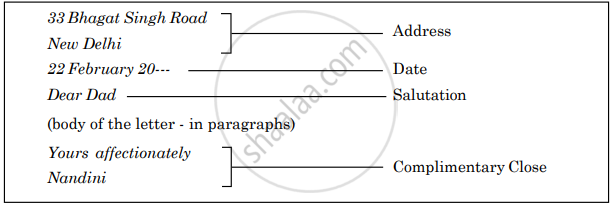
When we write informal letters (to a friend, or to a member of our family), we use this layout.
"Now tell us what 'twas all about,"
Young Peterkin, he cries;
And little wilhelmine looks up
with wonder-waiting eyes;
"Now tell us all about the war,
And what they fought each other for."
"It was the English," Kaspar cried,
"Who put the French to rout;
But what they fought each other for,
I could not well make out;
But everybody said,"quoth he,
"That 'twas a famous victory.
Read the lines given above and answer the question that follow.
Did the children wonder about the reason for the war?
'All right!' you 'll cry.'All right!' you'll say,
'But if we take the set away,
What shall we do to entertain
Our darling children?Please explain!'
We'll answer this by asking you,
'What used the darling ones to do?
'How used they keep themselves contented
Before this monster was invented?'
Have you forgotten? Don't you know?
We'll say it very loud and slow:
THEY ... USED ... TO ... READ! They'd READ and READ,
AND READ and READ, and then proceed
To READ some more. Great Scott! Gadzooks!
One half their lives was reading books!
The nursery shelves held books galore!
Books cluttered up the nursery floor!
And in the bedroom, by the bed,
More books were waiting to be read!
Read the lines given above and answer the question given below.
How according to the poet, can children benefit from reading books?
The horse was nearly life-size, moulded out of clay, baked, burnt, and brightly coloured, and reared its head proudly, prancing its forelegs in the air and flourishing its tail in a loop; beside the horse stood a warrior with scythelike mustachios, bulging eyes, and aquiline nose. The old image-makers believed in indicating a man of strength by bulging out his eyes and sharpening his moustache tips, and also decorated the man’s chest with beads which looked today like blobs of mud through the ravages of sun and wind and rain (when it came), but Muni would insist that he had known the beads to sparkle like the nine gems at one time in his life.
Read the extract given below and answer the question that follow.
What destruction did the village boys do to the things near the statue?
Suddenly all the tension seemed to ebb out of my body as the truth of what he said hit me. Confidently, I drew a line a full foot in back of the board and proceeded to jump from there. I qualified with almost a foot to spare.
That night I walked over to Luz Long’s room in the Olympic village to thank him. I knew that if it hadn’t been for him I probably wouldn’t be jumping in the finals the following day. We sat in his quarters and talked for two hours—about track and field, ourselves, the world situation, a dozen other things.
When I finally got up to leave, we both knew that a real friendship had been formed. Luz would go out to the field the next day trying to beat me if he could. But I knew that he wanted me to do my best—even if that meant my winning.
Read the extract given below and answer the question that follow.
How did Owens manage to qualify for the finals with a foot to spare?
Who is Nerissa? What does she say to cheer up Portia?
Who had agreed to act as an intermediary between the Animal Farm and the outside world ' Describe h~
Why did Chandni hate the rope round her neck?
Tilloo pressed the red button and “the damage was done”. What was the damage?
How was the bear punished when he attacked a beehive?
Where did each of them find a home?
Fans don’t talk, but it is possible to imagine that they do. What is it, then, that sounds like the fan’s chatter?
Write two pairs of rhyming words from the poem.
Why did the little man’s face wrinkle and frown?
Mark the right item:
“This made Taro sadder than ever.”
‘This’ refers to ______
Match the following.
|
1. |
unprecedented space tragedy |
|
|
2. |
certified flight instructor |
|
|
3. |
space mission |
|
|
4. |
super specialisation |
|
|
5. |
encyclopaedic knowledge |
|
|
6. |
awe-inspiring |
|
|
7. |
in this age |
|
Answer the question.
How does the poet plan to find out? What will he do once he finds out?
Speak to five adults in your neighbourhood. Ask them the following questions (in any language they are comfortable in). Then come back and share your findings with the class.
- Do they buy their provisions packed in plastic packets at a big store or loose, from a smaller store near their house?
- Where do they buy their footwear? Do they buy branded footwear or footwear made locally? What reasons do they have for their preference?
- Do they buy readymade clothes or buy cloth and get their clothes stitched by a tailor? Which do they think is better?
Gratiano explains, "We are the Jasons, we have won the fleeee." In this context the word 'fleeee' refers to ______.
