Advertisements
Advertisements
प्रश्न
Answer the following question in one or two sentences.
Who were the people in Kezia’s family?
Advertisements
उत्तर
Kezia’s family consisted of her mother, father, grandmother and herself.
संबंधित प्रश्न
When does he realize that he has lost his way? How have his anxiety and insecurity been described?
You can find more information about Robert Frost at the following websites.
http://www.poets.org/poets/poets.cfm?prmID=1961.
Hear the poet (who died almost forty years ago!) reading the poem at
http://www.poets.org/poems/poems.cfm ?prmID= 1645
To view a beautiful New England scene with each poem on this web site: "Illustrated
Poetry of Robert Frost":
http://www.geocities.com/Athens/Olympus/1487/index.html
Sometimes we see something beautiful and striking, and we remember it for a
long time afterwards. Can you recollect this ever happening to you? If so, what
was it? What do you remember about it now? Are the details of what you saw or
the feelings you experienced at that time fresh in your mind? Think for a few
minutes, then share your thoughts with the class.
Read the following extracts from the story, and try to puzzle out the meanings of the encircled words from other words and phrases in the extract. Write the clues in the empty boxes. Then give your own explanation of the encircled words.
I saw individual stars, but I could not distinguish the constellation they belonged to. Then dawn came and put out all my stars.
Therefore, constellation means ______.

Read the comic strip based on. H.G. Wells' novells.


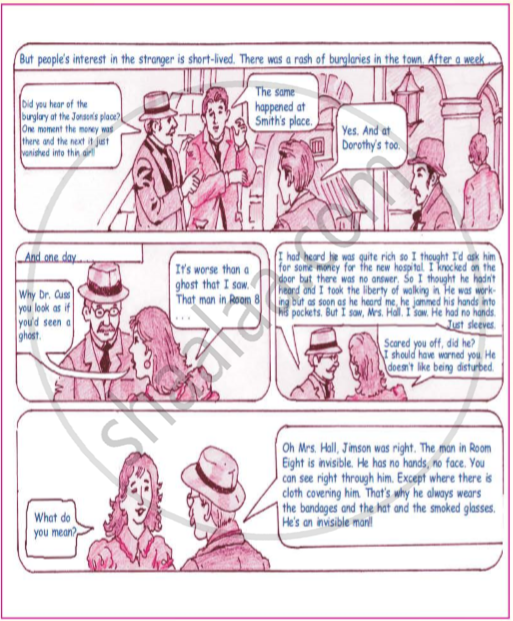
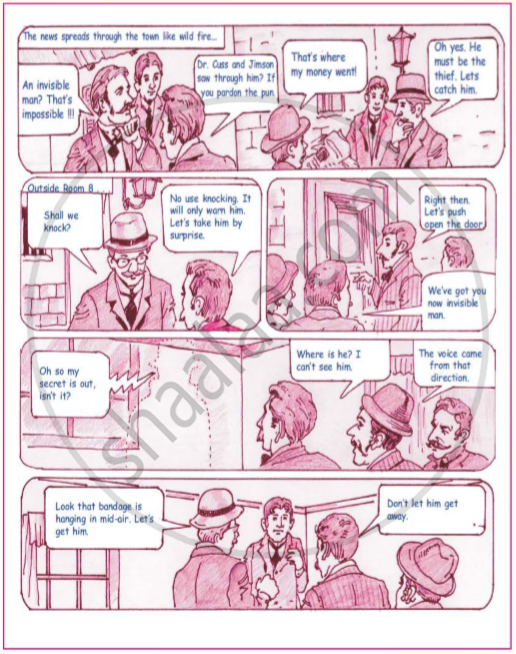
Answer the questions by ticking the correct option.
(a) The strange-looking man wanted ....
(i) the best room at the inn.
(ii} a room with a fire and a good lock.
(iii} a room with a good view.
(iv) a room where he could work quietly.
(b) Jimson was suspicious of the stranger because ...
(i} he did not answer Jimson's questions.
(ii} he did not want to talk about the weather.
(iii} he kept his back turned towards Jimson at all times.
(iv) he shouted atJimson when he entered his room.
(c) The people of the town gossiped about the stranger as ...
(i} he did not go out or talk to anyone in the town.
(ii} he had met with an accident and his face was bandaged.
(iii} he was new to the town and behaved rudely.
(iv) he stayed in his room and did not show his face to anyone.
(d) 'There was a rush of burglaries in the town. This means that ________
(i} there were many robberies in the town.
(ii) a few people in the town had seen a rob her.
(iii} the burglaries in the town were done in a rush.
(iv) the burglar was a rash and careless man.
(e) Although Jimson and Dr Cuss are suspicious of the strange guest, Mrs Hall tolerates him because ....
(i} she is not superstitious or ignorant.
(ii) she is sorry for the stranger who is bandaged.
(iii} the stranger is paying her a good amount of money for the room.
(iv} the stranger is polite and kind to Mrs Hall at all times.
(f) The stranger who was staying at the inn can be described as being ....
(I} violent
(ii} upright
(iii} dishonest
(iv) sensible
Six humans trapped by happenstance
In black and bitter cold.
Each one possessed a stick of wood,
Or so the story's told.
Their dying fire in need of logs;
The first man held his back.
For on the faces around the fire,
He noticed one was black.
Read the lines given above and answer the question that follow:
What do the logs denote?
Most terribly cold it was; it snowed, and was nearly quite dark, and evening— the last evening of the year. In this cold and darkness there went along the street a poor little girl, bareheaded, and with naked feet. When she left home she had slippers on, it is true; but what was the good of that? They were very large slippers, which her mother had hitherto worn; so large were they; and the poor little thing lost them as she scuffled away across the street, because of two carriages that rolled by dreadfully fast.
One slipper was nowhere to be found; the other had been laid hold of by an urchin, and off he ran with it; he thought it would do capitally for a cradle when he some day or other should have children himself. So the little maiden walked on with her tiny naked feet, that were quite red and blue from cold. She carried a quantity of matches in an old apron, and she held a bundle of them in her hand. Nobody had bought anything of her the whole livelong day; no one had given her a single farthing. She crept along trembling with cold and hunger—a very picture of sorrow, the poor little thing!
Read the extract given below and answer the question that follow.
Which day of the year was it in the story?
What is De Levis going through at this point of time ? What light does it throw upon his character ? What change do we see in his character later in the play ? Give a reason to justiji; your answer.
Do the following activity in groups.
Go to the library and collect information about the lifestyle of people in desert areas— their food, clothes, work, social customs, etc. Share this information with the group.
Read the following sentence.
(a) If she knows we have a cat, Paati will leave the house.
(b) She won’t be so upset if she knows about the poor beggar with sores on his feet.
(c) If the chappals do fit, will you really not mind?
Notice that the sentence consists of two parts. The first part begins with ‘if’. It is known as if-clause. Rewrite each of the following pairs of sentences as a single sentence. Use ‘if’ at the beginning of the sentence.
Don’t tire yourself now. You won’t be able to work in the evening.
Why do we make swings on trees?
Why do you think the child ran away on seeing the snake?
What was Patrick’s chief interest?
Multiple Choice Question:
When is beauty heard?
Fill in the blank to name a different kind of intelligence. One has been done for you.
When I enjoy listening to people and solving their problems I use my interpersonal intelligence
When I enjoy dancing or physical activity, I use my ____________ intelligence.
The words given against the sentences below can be used both as nouns and verbs. Use them appropriately to fill in the blanks.
(i) He made his ______ in essay-writing. (mark)
(ii) Articles ______ ‘sold’ are reserved.
What is the significance of the title? To who or to what does it refer?
Now let us look at the uses of the word break. Match the word with its meanings below. Try to find out at least three other ways in which to use the word.
- The storm broke – could not speak; was too sad to speak
- Daybreak – this kind of weather ended
- His voice is beginning to break – it began or burst into activity
- Her voice broke and she cried – the beginning of daylight
- The heat wave broke – changing as he grows up
- Broke the bad news – end it by making the workers submit
- Break a strike – gently told someone the bad news
- (Find your own expression. Give its meaning here)
Read the passage given below and answer the questions (i), (ii) and (iii) that follow:
|
(1) |
Something happens to cats after we have enjoyed a delicious meal. Call it a feline sugar hit or a rush of good feelings. Abandoning our usually sedentary nature, we transform into crazy beasts who thunder down corridors, spring from one piece of furniture to another, or pounce from behind half-closed doors to attack the shoelaces of unsuspecting passersby. It is as though we are temporarily possessed. |
5 |
|
(2) |
That, at least, is my excuse, dear reader - and the only explanation I can offer for my entirely unplanned global TV debut. |
|
|
(3) |
To be fair, I had no way of knowing that my master was receiving visitors that particular afternoon. Nor that he was being interviewed live, let alone by one of America’s most famous journalists. |
10 |
|
(4) |
All I knew was that, a few minutes after gorging myself on a favourite treat of creamy pudding, I felt that sudden, primal explosion of energy. I made my way back to the suite of rooms that I shared with my master and felt an overpowering compulsion to do something completely mad. I wanted to run like a furious jungle cat, at that particular moment. |
15 |
|
(5) |
Bursting through the door of the room in which my master received visitors, I tore up the carpet as I raced towards the sofa opposite where he was sitting. I ripped its fabric as I scrambled up its side like a savage creature clawing its way up a perilous cliff. Then with a final, frenzied burst, I launched myself off one arm of the sofa, leaping towards the other. |
20 |
|
(6) |
It was only at this point that I realised the sofa was occupied by the journalist. She was halfway through a sentence, and my abrupt appearance caught my master's guest completely by surprise. |
|
|
(7) |
You know, when something truly unexpected happens, time can seem to slow down. Well, that’s how it was. As I flew past the woman's face, her expression turned from one of calm engagement to that of total surprise. |
25 |
|
(8) |
I As she pushed back in her seat to avoid me, the shock on her face could not have been more evident. |
|
|
(9) |
But, dear reader, she was not more shaken than me. I had not been expecting anyone on the sofa, let alone a TV celebrity, nor one who was mid-interview. As I headed towards the opposite end of the sofa, for the first time I observed the lighting, the cameras and the crew watching the action from the shadows. By the time I landed on the other arm of the sofa, all the energy that had propelled me was gone. |
30
35 |
|
(10) |
I was, no longer, a furious jungle cat. |
|
|
(11) |
The journalist looked at me. I looked at her. Both of us were taking in what had just happened. I was also conscious of the cameras still rolling as well as many pairs of eyes watching me at that moment. My moment of global glory. |
|
|
|
Adapted from: The Dalai Lama's Cat Omnibus |
|
(i)
- Given below are three words and phrases. Find the words which have a similar meaning in the passage: [3]
- inactive
- eating in a greedy manner
- dangerous
- For each of the words given below, write a sentence of at least ten words using the same word unchanged in form, but with a different meaning from that which it carries in the passage: [3]
- thunder (line 3)
- spring (line 3)
- past (line 26)
(ii) Answer the following questions in your own words as briefly as possible:
- What is the usual nature of the narrator's kind? How is it differently presented in the passage? [2]
- What did the 'favourite treat of creamy pudding' do to the narrator? [2]
- Describe the actions of the narrator after bursting into the visitors' room. [2]
- How did the journalist react when the narrator 'flew past' her face? [2]
(iii) Summarise how the narrator became a global celebrity (paragraphs 4 to 11). You are required to write the summary in the form of a connected passage in about 100 words. Failure to keep within the word limit will be penalised. [6]
When Antony says, ‘This is a slight unmeritable man/Meet to be sent on errands’, he refers to ______.
