Advertisements
Advertisements
प्रश्न
Locate the points P(3, 4), Q(1, 0), R(0, 4), S(4, 1) on a graph sheet and write the coordinates of the point of intersection of line segments PQ and RS.
Advertisements
उत्तर

Observing the graph, we see that the line segments PQ and RS intersect at the point T(2, 2).
APPEARS IN
संबंधित प्रश्न
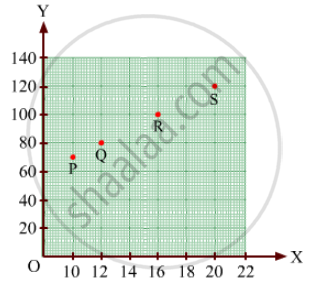
Find the coordinates of points P, Q, R and S in Fig. 27.8.
______ displays data that changes continuously over periods of time.
We need ______ coordinates for representing a point on the graph sheet.
A point in which the x-coordinate is zero and y-coordinate is non-zero will lie on the ______.
For the point (5, 2), the distance from the x-axis is ______ units.
In the point (4, 7), 4 denotes the ______.
In the point (2, 3), 3 denotes the y-coordinate.
Draw a parallelogram ABCD on a graph paper with the coordinates given in Table I. Use this table to complete Tables II and III to get the coordinates of E, F, G, H and J, K, L, M.
| Point | (x, y) |
| A | (1, 1) |
| B | (4. 4) |
| C | (8, 4) |
| D | (5, 1) |
Table I
| Point | (0.5x, 0.5y) |
| E | (0.5, 0.5) |
| F | |
| G | |
| H |
Table II
| Point | (2x, 1.5y) |
| J | (2, 1.5) |
| K | |
| L | |
| M |
Table III
Draw parallelograms EFGH and JKLM on the same graph paper.
Plot the points (2, 4) and (4, 2) on a graph paper, then draw a line segment joining these two points.
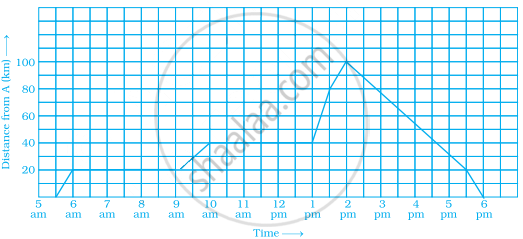
A man started his journey on his car from location A and came back. The given graph shows his position at different times during the whole journey.
- At what time did he start and end his journey?
- What was the total duration of journey?
- Which journey, forward or return, was of longer duration?
- For how many hours did he not move?
- At what time did he have the fastest speed?
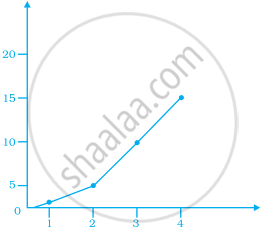
Observe the given graph carefully and complete the table given below.
| x | 1 | 2 | 3 | 4 | 5 |
| y |