Advertisements
Advertisements
प्रश्न
Let A = {–1, 0, 1, 2}, B = {–4, –2, 0, 2} and f, g : A → B be functions defined by f(x) = x2 – x, x ∈ A and g(x) = `2|x - 1/2| – 1`, x ∈ A. Are f and g equal?
Justify your answer. (Hint: One may note that two functions f : A → B and g : A → B such that f(a) = g(a) ∀ a ∈ A are called equal functions.)
Advertisements
उत्तर
It is given that A = {–1, 0, 1, 2}, B = {–4, –2, 0, 2}.
Also, it is given that f, g: A → B are defined by f(x) = x2 – x, x ∈ A and `g(x) = 2|x - 1/2| - 1, x ∈ A`.
It is observed that:
When x = –1,
f(–1) = 12 – (–1)
= 1 + 1
= 2
g(–1) = `2|(-1)-1/2| - 1`
= `2(3/2) - 1`
= 3 – 1
= 2
⇒ f(–1) = g(–1)
When x = 0,
f(0) = (0)2 – 0 = 0
g(0) = `2|0 - 1/2| - 1`
= `2(1/2) - 1`
= 1 – 1
= 0
⇒ f(0) = g(0)
When x = 1,
f(1) = (1)2 – 1
= 1 – 1
= 0
g(1) = `2|1 - 1/2| - 1`
= `2(1/2) - 1`
= 1 – 1
= 0
⇒ f(1) = g(1)
When x = 2,
f(2) = (2)2 – 2
= 4 – 2
= 2
g(2) = `2|2-1/2| - 1`
= `2(3/2)-1`
= 3 – 1
= 2
⇒ f(2) = g(2)
∴ f(a) = g(a) ∀ a ∈ A
Hence, the functions f and g are equal.
APPEARS IN
संबंधित प्रश्न
Let A and B be sets. Show that f : A × B → B × A such that f(a, b) = (b, a) is bijective function.
Let f : R → R be defined as f(x) = x4. Choose the correct answer.
Classify the following function as injection, surjection or bijection :
f : R → R, defined by f(x) = |x|
Show that the exponential function f : R → R, given by f(x) = ex, is one-one but not onto. What happens if the co-domain is replaced by`R0^+` (set of all positive real numbers)?
Show that the logarithmic function f : R0+ → R given by f (x) loga x ,a> 0 is a bijection.
Show that if f1 and f2 are one-one maps from R to R, then the product f1 × f2 : R → R defined by (f1 × f2) (x) = f1 (x) f2 (x) need not be one - one.
Find fog (2) and gof (1) when : f : R → R ; f(x) = x2 + 8 and g : R → R; g(x) = 3x3 + 1.
Let f be any real function and let g be a function given by g(x) = 2x. Prove that gof = f + f.
Let A = {1, 2, 3, 4}; B = {3, 5, 7, 9}; C = {7, 23, 47, 79} and f : A → B, g : B → C be defined as f(x) = 2x + 1 and g(x) = x2 − 2. Express (gof)−1 and f−1 og−1 as the sets of ordered pairs and verify that (gof)−1 = f−1 og−1.
Let f : [−1, ∞) → [−1, ∞) be given by f(x) = (x + 1)2 − 1, x ≥ −1. Show that f is invertible. Also, find the set S = {x : f(x) = f−1 (x)}.
Which one of the following graphs represents a function?
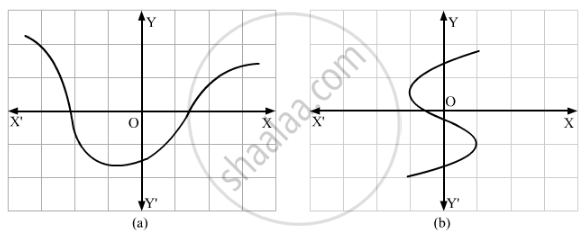
Write the domain of the real function
`f (x) = sqrt([x] - x) .`
Let A = {1, 2, 3}, B = {4, 5, 6, 7} and let f = {(1, 4), (2, 5), (3, 6)} be a function from A to B. State whether f is one-one or not.
If f : {5, 6} → {2, 3} and g : {2, 3} → {5, 6} are given by f = {(5, 2), (6, 3)} and g = {(2, 5), (3, 6)}, then find fog. [NCERT EXEMPLAR]
Let
\[f : R - \left\{ n \right\} \to R\]
Let \[f\left( x \right) = x^2 and g\left( x \right) = 2^x\] Then, the solution set of the equation
If \[F : [1, \infty ) \to [2, \infty )\] is given by
\[f\left( x \right) = x + \frac{1}{x}, then f^{- 1} \left( x \right)\]
Let \[f\left(x\right) = x^3\] be a function with domain {0, 1, 2, 3}. Then domain of \[f^{-1}\] is ______.
Mark the correct alternative in the following question:
Let f : R→ R be defined as, f(x) = \[\begin{cases}2x, if x > 3 \\ x^2 , if 1 < x \leq 3 \\ 3x, if x \leq 1\end{cases}\]
Then, find f( \[-\]1) + f(2) + f(4)
Mark the correct alternative in the following question:
If the set A contains 5 elements and the set B contains 6 elements, then the number of one-one and onto mappings from A to B is
Which function is used to check whether a character is alphanumeric or not?
Write about strcmp() function.
Consider the set A containing n elements. Then, the total number of injective functions from A onto itself is ______
For sets A, B and C, let f: A → B, g: B → C be functions such that g o f is surjective. Then g is surjective.
Let D be the domain of the real valued function f defined by f(x) = `sqrt(25 - x^2)`. Then, write D
Let X = {1, 2, 3}and Y = {4, 5}. Find whether the following subset of X ×Y are function from X to Y or not
f = {(1, 4), (1, 5), (2, 4), (3, 5)}
Let X = {1, 2, 3}and Y = {4, 5}. Find whether the following subset of X ×Y are function from X to Y or not
g = {(1, 4), (2, 4), (3, 4)}
Let A = [–1, 1]. Then, discuss whether the following functions defined on A are one-one, onto or bijective:
k(x) = x2
The function f : R → R given by f(x) = x3 – 1 is ____________.
Let f : [0, ∞) → [0, 2] be defined by `"f" ("x") = (2"x")/(1 + "x"),` then f is ____________.
Range of `"f"("x") = sqrt((1 - "cos x") sqrt ((1 - "cos x")sqrt ((1 - "cos x")....infty))`
The function f: R → R defined as f(x) = x3 is:
Let A = {1, 2, 3}, B = {4, 5, 6, 7} and let f = {(1, 4), (2, 5), (3, 6)} be a function from A to B. Based on the given information, f is best defined as:
Given a function If as f(x) = 5x + 4, x ∈ R. If g : R → R is inverse of function ‘f then
'If 'f' is a linear function satisfying f[x + f(x)] = x + f(x), then f(5) can be equal to:
Let n(A) = 4 and n(B) = 6, Then the number of one – one functions from 'A' to 'B' is:
The solution set of the inequation log1/3(x2 + x + 1) + 1 > 0 is ______.
`x^(log_5x) > 5` implies ______.
Let f: R→Rbe defined as f (x) = `(x^2 + 1)/2`, then ______.
