Advertisements
Advertisements
प्रश्न
In the figure given alongside, a narrow beam of white light is shown to pass through a triangular glass prism. After passing through the prism, it produces a spectrum YX on the screen.
State the colour seen (i) at X, and (ii) at Y.
Advertisements
उत्तर
(i)The colour seen at X is violet (as it is the maximum deviated).
(ii) The colour seen at Y is red (as it is the least deviated).
APPEARS IN
संबंधित प्रश्न
Draw a ray diagram to show the dispersion of white light.
(i) A ray of white light breaks up into its components while passing through a glass prism. Draw a ray diagram to show the path of rays.
(ii) Mark the least deviated colour in your diagram

(iii) Why do different coloured rays deviate differently in a prism?
When a beam of white light is passed through a prism, it splits to form lights of seven colours. Is it possible to recombine the lights of seven colours to obtain the white light again? Explain your answer.
Draw a diagram to show how white light can be dispersed into a spectrum by using a glass prism. Mark the various colours of the spectrum.
Describe how you could demonstrate that white light is composed of a number of colours.
The colour of white light which is deviated the maximum on passing through the glass prism is:
(a) blue
(b) indigo
(c) red
(d) orange
Which of the following colour of white light has the least wavelength?
(a) red
(b) orange
(c) violet
(d) blue
State the speed of light in (a) air, (b) water, and (c) glass
What do you understand by the term spectrum? Name the various colours present in the spectrum of sunlight.
Explain briefly, with the help of a neat labelled diagram, how white light gets dispersed by a prism. On which surface of a prism, there is both dispersion and deviation of light, and on which surface of the prism, there is only deviation of light ?
In an experiment to trace the path of a ray of light through a triangular glass prism, a student would observe that the emergent ray
(a) is parallel to the incident ray.
(b) is along the same direction of incident ray.
(c) gets deviated and bends towards the thinner part of the prism.
(d) gets deviated and bends towards the thicker part (base) of the prism.
Complete the ray diagram given below to show the nature of light produced on the screen.
The completed ray diagram is as shown below:
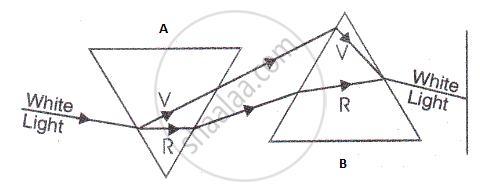
Differentiate between a glass slab and a glass prism.
What is the cause of the dispersion of white light through a glass prism? Draw a ray diagram to show the path of light when two identical glass prisms are arranged together in an inverted position with respect to each other and a narrow beam of white light is allowed to fall obliquely on one of the faces of the prisms.
Sunlight entering through a narrow aperture falls on a prism. Draw a neat labelled ray diagram to show the formation of the spectrum on a screen. Name the colour obtained nearer the base of the prism.
Say TRUE or FALSE
Rainbow is formed by dispersion of which light by water drops
During dispersion of white light by prism placed in air, for a particular value of angle of prism,
______ colour is deviated the least in the spectrum of white light obtained with a glass prism.
Observe the given diagram and answer the questions:
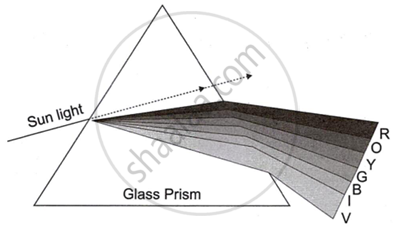
- Name the process shown in the figure.
- Name the colour that deviates the most.
- Name the colour that deviates the least.
- Name any one phenomenon in nature which is based on the above process.
- Define ‘spectrum’.
Make a rainbow
Try to make your own rainbow. You can try this project in the morning or in the evening. Stand with your back towards the Sun. Take a hosepipe or a water pipe used in the garden. Make a fine spray in front of you. You can see different colours of rainbow in the spray.
