Advertisements
Advertisements
प्रश्न
How does Forster trace the human interest in the story to primitive times?
Advertisements
उत्तर
Forster traces the human interest in the story to primitive times by describing that the art of story telling is immensely old. It goes back to Neolithic times, perhaps to palaeolithic times. He refers to the Neanderthal man's liking of stories by referring to the anthropological evidence of the shape of the skull. To bring home the point further, Forster conjectures a picture of the primitive audience as an audience of shock heads, gaping round the camp fire, fatigued with contending against the mammoth or the woolly rhinoceros and only kept awake by suspense. The novelist drones on and, as soon as the audience guessed what happened next, they either fell asleep or killed him. Forster also refers to the character of Scheherazade who had to tell stories one after another to evade the danger of being killed by her husband. Forster mentions that Scheherazade's talent to tell suspense stories made her survive. In this way, Forster traces the human interest in the story to primitive times.
APPEARS IN
संबंधित प्रश्न
B1. Find reasons
(i) The effect of receding forest …………………………………. .
(ii) The number of animals is reduced because ………………………. .
(iii) Elephants entered the city because…………………… .
(iv) Elephants lived a wary life …………………….. .
On the left bank of the Ganga, where it emerges from the Himalayan foothills, there is a long stretch of heavy forest. There are villages on the fringe of the forest, inhabited by bamboo cutters and farmers, but there are few signs of commerce or pilgrimage. Hunters, however, have found the area an ideal hunting ground during the last seventy years, and as a result, the animals are not as numerous as they used to be. The trees, too, have been disappearing slowly; and, as the forest recedes, the animals lose their food and shelter and move further on into the foothills. Slowly, they are being denied the right to live
Only the elephants can cross the river. And two years ago, when a large area of the forest was cleared to make way for a refugee resettlement camp, a herd of elephants - finding their favourite food, the green shoots of the bamboo, in short supply - waded across the river. They crashed through the suburbs of Haridwar, knocked down a factory wall, pulled down several tin roofs, held up a train, and left a trail of devastation in their wake until they found a new home in a new forest which was still untouched. Here, they settled down to a new life but an unsettled, wary life. They did not know when men would appear again, with tractors,bulldozers and dynamite.
B2. Find out
Mention four things the elephants did when they found shortage of food:
(i)………………
(ii)………
(iii) …………
(iv) ………….
B3.Phrases
Make meaningful sentences by selecting any two of the following phrases:
(i) to make way for
(ii) in short
(iii) on the fringe of.
B4. Language study
Select the proper alternative to make the correct voice:
(i) Hunters have found an ideal hunting ground.
-An ideal hunting ground ........found by hunters. (had been, has been, was)
(ii) They are being denied the right to live.
- The people ........them the right to live. (are denying, were denying, denying)
B5.Personal response
What would be your contribution to protect the natural habitat of animals?
Orangutans use big leaves during a downpour because
(a) crushing/destructive (pars 1)
(b) used to (pare 2)
(c) searching (pare 4)
Briefly explain the following statement from the text.
“You need some interaction to cause a transition.”
What do you think are the reasons for the references made to the English people and the British monarchy?
What were the voices that Paul heard? Did they lead him to success in the real sense?
The peacock is a colourful bird. How does the poem capture the various colours that its plumage displays?
Many sentences and paragraphs in the excerpt begin with the word ‘And’. To what extent does this contribute to the rhetorical style of the lecture?
How does Forster use the analogy of Scheherazade to establish his point ?
Discuss the following in pairs or in small groups.
“Before you begin experimenting you need to perfect the technique with which you experiment.”
Read the extract and state whether the following statement is true or false. Correct the false statement.
The author is an example of ‘reverse migration’.
Think of one of your favourite stories. Fill in the following facts about the story.
- Name of the story:
- Type of story:
- Setting (time and place):
- Important characters:
- Theme/Plot:
- Conflict/Dilemma:
- Solution:
- End:
Read other poems by Leigh Hunt, especially 'Abou Ben Adhem'.
Compare the messages in that poem with those in 'The Plate of Gold'. What do you observe?
Doctors who do special advanced study of specific parts of the body have special terms.
In your group try to match the specialist doctors with who / what they treat.
| Specialists | Who/What they treat | ||
| 1. | Dentist | a. | bone |
| 2. | Cardiologist | b. | brain/with spine |
| 3. | Ophthalmologist | c. | small kids |
| 4. | Orthopedic | d. | teeth |
| 5. | Pediatrician | e. | animals/birds |
| 6. | Neurologist | f. | eye |
| 7. | Veterinarian | g. | heart |
Find out from a vet or from a website, what precaution a vet has to take when he/she is called to treat wild, dangerous animals?
Make point-wise notes of the same.
Discuss with your partner the different ideas connoted by the word 'season'.
- _______________________
- _______________________
- _______________________
Fill in the gap, choosing a word from the bracket to make an appropriate comparison.
(tall / quiet / humble / merry / busy / slippery / fast / sly / slow / big)
as ______ as a bee
Fill in the gap, choosing a word from the bracket to make an appropriate comparison.
(tall / quiet / humble / merry / busy / slippery / fast / sly / slow / big)
as ______ as a mouse.
What can you do to show your love, respect, and support to the soldiers who fight for the country? Discuss this in the classroom. You can send greeting cards to them on various occasions, with the help of your teacher.
In each of the following line, spot the sound that is used repeatedly -
- There’s a silver house in the lovely sky.
- As round as a silver crown
- It takes two weeks to build it up. And two to pull it down.
Discuss and write 1-2 lines about the following.
How Bushi defeated Yonamine in the wrestling match.
Talk to your parents and family members and write what you could do when you were a day old.
Complete the following sentence with reference to the passage:
To this day, we venerate this tree as ____________.
Visit a library:
Read stories about Gautama Buddha. Relate one story in the class.
Draw word webs for the following. Begin with the given word and go on writing as many other words associated with it, as you can. Use these words to write other related words to form a word web.

Imagine that there is a Mr Somebody who has to correct all the wrongs that are done by Mr Nobody. Write in the following table, what Mr Somebody will have to do.
| Mr Nobody’s Actions | Tasks for Mr Somebody |
| 1. The plate is broken / cracked | Mend the plate. / Throw it away carefully. |
| 2. The book is torn | ____________ |
| 3. The door is ajar. | ____________ |
| 4. The buttons are pulled from the shirt | ____________ |
| 5. The pins are scattered. | ____________ |
| 6. The door is still squeaking. | ____________ |
| 7. There are finger marks upon the door. | ____________ |
| 8. The ink has spilled over. | ____________ |
| 9. Boots are lying around. | ____________ |
| 10. ____________ | ____________ |
| 11. ____________ | ____________ |
Add a few more things to the list in the above table, using your own ideas and experience.
Find three lines, that contain images of nature in the autumn season.
During daytime
- _______________________
- _______________________
- _______________________
Complete the following diagram.
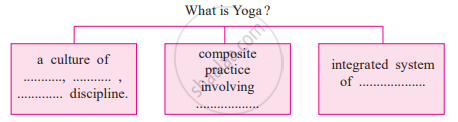
How long does the whole event described in this passage take? Work it out by reading the passage.
Read: ‘The Listeners’ and ‘Someone’ - poems by Walter de la Mare.
Present any one of these announcements yourself, orally.
Find out how the following game is played.
Badminton
What was the businessman looking for? Why?
Write what you can do to welcome birds in your surroundings.
Guess the meaning of weary.
What are the common Rangoli designs or motifs?
Why had Prospero raised a violent storm in the sea?
What was Mrs. Krishnan busy with?
When and where was the first ATM installed?
Read the data below and answer the following question.
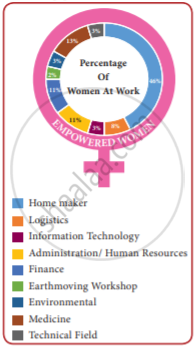
Choose the correct answer.
Percentage of women working in finance is the same as ______.
Read the letter again and write a few lines on each of the following.
- things that the coach taught….
- transformation in the child……..
- things that amazed the writer……..
Let no ______ tone be______.
- soft
- vain
- fear
- joy
- love
- heard
- toiled
- mild
- good
- sand
- life
- harsh
Who is Raj?
Find example of alliteration and write them in the blank.
to muddy roads
monsoons and mangoes
The ________ are trying to terraform Mars.
In the Earth, we get water from ______.
Where did Anitha go?
What day is it?
Where did we visit a mermaid?
Match the following.
| pale |  |
| tremble |  |
| fainted |  |
Try your own.
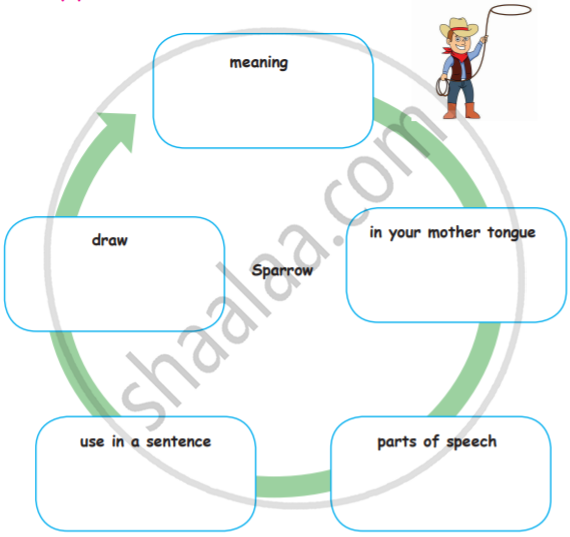
Find and write the clues.
Clue for the load on the camel ______
______always stays to the last in our needs.
Where do the moles save their food?
Why it is important for people to live without boundaries?
Kamali gave her savings to______.
Leaf cutter ants drink ______.
The child won’t ______ anything, if he closes his ears.
The garden Alice saw was
What is Gandhiji’s ideal?
