Advertisements
Advertisements
प्रश्न
HCl is added to a hydrocarbon ‘A’ \[\ce{(C4H8)}\] to give a compound ‘B’ which on hydrolysis with aqueous alkali forms tertiary alcohol ‘C’ \[\ce{(C4H10O)}\]. Identify ‘A’ ,‘B’ and ‘C’.
Advertisements
उत्तर
\[\begin{array}{cc}
\phantom{...}\ce{CH3}\phantom{..............................}\ce{CH3}\phantom{..............................}\ce{CH3}\\
|\phantom{..................................}|\phantom{.................................}|\\
\ce{\underset{(A)}{\underset{(C4H8)}{\underset{2-Methylprop-1-ene}{H3C - C = CH2 + HCl}}} ->[Markovnikov][rule] H3C - C - CH3 ->[KOH (aq_.)Hydrolysis][\Delta] H3C - C - CH3}\\
\phantom{...................................}|\phantom{.................................}|\\
\phantom{.....................................}\ce{\underset{(B)}{\underset{2-Chloro-2-methylpropane}{Cl}}\phantom{...............}\ce{\underset{(C)}{\underset{(C4H10O)}{\underset{2-Hydroxy-2-methylpropane}{OH}}}}}
\end{array}\]
APPEARS IN
संबंधित प्रश्न
from the following pair would undergo SN2 faster from the other?
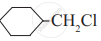

from the following pair would undergo SN2 faster from the other?
a. CH3CH2CH2I b. CH3CH2CH2Cl
Name the reagent used to bring about the following conversion.
Ethyl bromide to ethyl isocyanide
Distinguish between SN1 and SN2 mechanism of substitution reaction.
Complete the following reaction sequence by writing the structural formulae of the organic compound 'A', 'B' and 'C'.
\[\ce{2-Bromobutane->[Alc.KOH]A->[][Br2]B->[][NaNH2]C}\]
Complete the following reaction sequence by writing the structural formulae of the organic compound 'A', 'B' and 'C'.
\[\ce{Isopropyl alcohol ->[\triangle][PBr3] A ->[][NH3 excess] B}\]
Observe the following and answer the question given below.

Can it react by SN1 mechanism? Justify your answer.
Propane nitrile can be prepared by heating ____________
The following will react faster by SN1 mechanism
Nucleophilic substitution reaction of 2, 4-dinitrochlorobenzene is faster than p-nitrochlorobenzene. Give reason.
Explain primary benzylic halide shows higher reactivity by SN1 mechanism than other primary alkyl halide.
The least reactive towards nucleophilic addition reactions is ____________.
Which of the following is least reactive towards SN1 reactions?
Ethyl bromide undergoes the following reaction:
\[\ce{\underset{Ethyl bromide}{C2H5Br} + \underset{(aq.)}{KOH} ->[\Delta] \underset{Ethyl alcohol}{C2H5OH} + KBr}\]
Which of the following is a WRONG statement?
The SN2 reaction of a compound containing an asymmetric carbon atom always gives ____________.
With which halogen the reactions, of alkanes are explosive?
Complete the following reaction giving major products.
\[\begin{array}{cc}
\ce{CH3}\phantom{.......}\\
|\phantom{.........}\\
\ce{CH3 - c - CH2 - Cl ->[Na/dry ether]}\\
|\phantom{.........}\\
\ce{CH3}\phantom{.......}
\end{array}\]
Complete the following reactions giving a major product.
\[\begin{array}{cc}
\ce{CH3}\phantom{................}\\
|\phantom{..................}\\
\ce{CH3 - C - CH2 - Cl ->[Na/dry ether] A}\\
|\phantom{..................}\\
\ce{CH3}\phantom{................}
\end{array}\]
Complete the following reaction giving a major product.
\[\begin{array}{cc}
\ce{CH3}\phantom{.................}\\
|\phantom{...................}\\
\ce{CH3 - C - CH2 - Cl->[Na/dry ether]A}\\
|\phantom{..................}\\
\ce{CH3}\phantom{................}
\end{array}\]
Complete the following reaction sequences by writing the structural formulae of the organic compounds 'A', 'B' and 'C'.
\[\ce{2-Bromobutan ->[alc. KOH] A ->[][Br2] B ->[][NANH2] C}\]
What is the action of following on ethyl bromide?
alcoholic sodium hydroxide
Complete the following reaction giving major product.
\[\begin{array}{cc}
\ce{CH3}\phantom{...............}\\
|\phantom{..................}\\
\ce{CH3 - C - CH2 - Cl ->[Na/dry ether]A}\\
|\phantom{...................}\\
\ce{CH3}\phantom{.................}
\end{array}\]
Complete the following reaction giving major product.
\[\begin{array}{cc}
\ce{CH3}\phantom{................}\\
|\phantom{..................}\\
\ce{CH3 - C - CH2 - Cl ->[Na/dry ether]A}\\
|\phantom{..................}\\
\ce{CH3}\phantom{................}
\end{array}\]
Complete the following reaction giving major product.
\[\begin{array}{cc}
\ce{CH3}\phantom{.................}\\
|\phantom{...................}\\
\ce{CH3 - C - CH2 - Cl ->[Na/dry ether] A}\\
|\phantom{...................}\\
\ce{CH3}\phantom{.................}
\end{array}\]
Which of the following pair of compounds on heating gives butanenitrile?
Identify the substrate 'X' in the following reaction.
\[\ce{\underset{}{X + O2} ->[i) Co-naphtenate 423 K][ii) dil HClΔ] \underset{\underset{}{}}{Phenol + Acetone}}\]
Which of the following reagent is used for conversion of alkyl halide into nitrile?
