Advertisements
Advertisements
प्रश्न
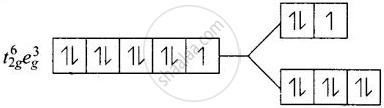
Give the electronic configuration of the following complexes on the basis of Crystal Field Splitting theory.
\[\ce{[CoF6]^{3-}, [Fe(CN)6]^{4-} and [Cu(NH3)6]^{2+}}\].
Advertisements
उत्तर
\[\ce{[CoF6]^{3-} : Co^{3+} (d^6)}\]
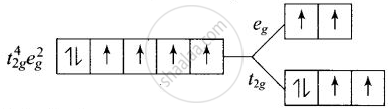
\[\ce{[Fe(CN)6]^{4-} : Fe^{2+} (d)^6}\]
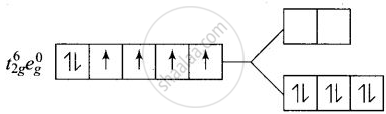
\[\ce{[Cu(NH3)6]^{2+} : Cu^{2+} (d^9)}\]
APPEARS IN
संबंधित प्रश्न
On the basis of crystal field theory, write the electronic configuration for d4 ion if ∆0 < P.
How does the magnitude of Δo decide the actual configuration of d orbitals in a coordination entity?
Why are low spin tetrahedral complexes rarely observed?
Atomic number of \[\ce{Mn}\], \[\ce{Fe}\] and \[\ce{Co}\] are 25, 26 and 27 respectively. Which of the following inner orbital octahedral complex ions are diamagnetic?
(i) \[\ce{[Co(NH3)6]^{3+}}\]
(ii) \[\ce{[Mn(CN)6]^{3-}}\]
(iii) \[\ce{[Fe(CN)6]^{4-}}\]
(iv) \[\ce{[Fe(CN)6]^{3-}}\]
Why are low spin tetrahedral complexes not formed?
Arrange following complex ions in increasing order of crystal field splitting energy (∆O):
\[\ce{[Cr(Cl)6]^{3-}, [Cr(CN)6]^{3-}, [Cr(NH3)6]^{3+}}\].
Using crystal field theory, draw energy level diagram, write electronic configuration of the central metal atom/ion and determine the magnetic moment value in the following:
\[\ce{[FeF6]^{3-}, [Fe(H2O)6]^{2+}, [Fe(CN)6]^{4-}}\]
Why are different colours observed in octahedral and tetrahedral complexes for the same metal and same ligands?
The CFSE for octahedral [CoCl6]−4 is 18,000 cm−1. What will be the CFSE for tetrahedral [CoCl3]−2?
[Ni(H2O)6]2+ (aq) is green in colour whereas [Ni(H2O)4 (en)]2+ (aq)is blue in colour, give reason in support of your answer.
The magnitude of CFSE depends upon ______
The CFSE of [CoCl6]3– is 18000 cm–1 the CFSE for [CoCl4]– will be ______.
Using crystal field theory, write the electronic configuration of d5 ion, if Δ0 > P.
The correct order of intensity of colors of the compounds is ______.
For octahedral Mn(II) and tetrahedral Ni(II) complexes, consider the following statements:
- Both the complexes can be high spin.
- Ni(II) complex can very rarely below spin.
- With strong field Ligands, Mn(II) complexes can be low spin.
- Aqueous solution of Mn (II) ions is yellow in colour.
The correct statements are:
On the basis of Crystal Field theory, write the electronic configuration for the d5 ion with a strong field ligand for which Δ0 > P.
On the basis of crystal field theory, write the electronic configuration for the d5 ion with a weak ligand for which Δ0 < P.
The value of the spin only magnetic moment for one of the following configurations is 2.84 BM. The correct one is:
The correct order of the wavelength of light absorbed by the following complexes is:
- [Co(NH3)6]3+
- [Co(CN)6]3−
- [Cu(H2O)4]2+
- [Ti(H2O)6]3+
Choose the correct answer from the options given below:
