Advertisements
Advertisements
प्रश्न
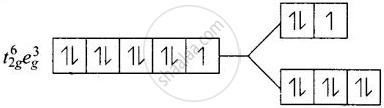
Give the electronic configuration of the following complexes on the basis of Crystal Field Splitting theory.
\[\ce{[CoF6]^{3-}, [Fe(CN)6]^{4-} and [Cu(NH3)6]^{2+}}\].
Advertisements
उत्तर
\[\ce{[CoF6]^{3-} : Co^{3+} (d^6)}\]
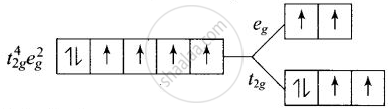
\[\ce{[Fe(CN)6]^{4-} : Fe^{2+} (d)^6}\]
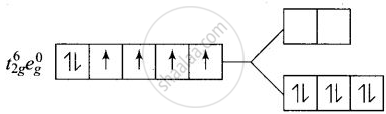
\[\ce{[Cu(NH3)6]^{2+} : Cu^{2+} (d^9)}\]
APPEARS IN
संबंधित प्रश्न
On the basis of crystal field theory, write the electronic configuration for d4 ion if ∆0 < P.
The hexaquo manganese(II) ion contains five unpaired electrons, while the hexacyanoion contains only one unpaired electron. Explain using Crystal Field Theory.
How does the magnitude of Δo decide the actual configuration of d orbitals in a coordination entity?
State the superiority of crystal field theory over valence bond theory.
Write the electronic configuration of Fe(III) on the basis of crystal field theory when it forms an octahedral complex in the presence of (i) strong field, and (ii) weak field ligand. (Atomic no.of Fe=26)
Why are low spin tetrahedral complexes not formed?
\[\ce{CuSO4 . 5H2O}\] is blue in colour while \[\ce{CuSO4}\] is colourless. Why?
Match the complex ions given in Column I with the hybridisation and number of unpaired electrons given in Column II and assign the correct code:
| Column I (Complex ion) | Column II (Hybridisation, number of unpaired electrons) |
| A. \[\ce{[Cr(H2O)6]^{3+}}\] | 1. dsp2, 1 |
| B. \[\ce{[Co(CN)4]^{2-}}\] | 2. sp3d2, 5 |
| C. \[\ce{[Ni(NH3)6]^{2+}}\] | 3. d2sp3, 3 |
| D. \[\ce{[MnF6]^{4-}}\] | 4. sp3, 4 |
| 5. sp3d2, 2 |
Why are different colours observed in octahedral and tetrahedral complexes for the same metal and same ligands?
Considering crystal field theory, strong-field ligands such as CN–:
The correct order of increasing crystal field strength in following series:
The magnitude of CFSE depends upon ______
What is crystal field splitting energy?
The correct order of intensity of colors of the compounds is ______.
For octahedral Mn(II) and tetrahedral Ni(II) complexes, consider the following statements:
- Both the complexes can be high spin.
- Ni(II) complex can very rarely below spin.
- With strong field Ligands, Mn(II) complexes can be low spin.
- Aqueous solution of Mn (II) ions is yellow in colour.
The correct statements are:
Consider that d6 metal ion (M2+) forms a complex with aqua ligands and the spin only magnetic moment of the complex is 4.90 BM. The geometry and the crystal field stabilization energy of the complex are ______.
On the basis of crystal field theory, write the electronic configuration for the d5 ion with a weak ligand for which Δ0 < P.
