Advertisements
Advertisements
प्रश्न
Fill the blank in the following so that the following statement is true.
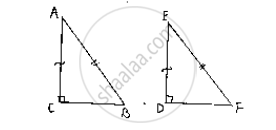
In right triangles ABC and DEF, if hypotenuse AB = EF and side AC = DE, then ΔABC ≅ Δ ……
Advertisements
उत्तर
In right triangles ABC and DEF, if hypotenuse AB = EF and side AC = DE, then.
ΔABC ≅ ΔEFD
Reason: From RHS congruence criterion we have ΔABC ≅ ΔEFD
APPEARS IN
संबंधित प्रश्न
In ΔABC, AD is the perpendicular bisector of BC (see the given figure). Show that ΔABC is an isosceles triangle in which AB = AC.

ΔABC is an isosceles triangle in which AB = AC. Side BA is produced to D such that AD = AB (see the given figure). Show that ∠BCD is a right angle.

Show that the angles of an equilateral triangle are 60° each.
The vertical angle of an isosceles triangle is 100°. Find its base angles.
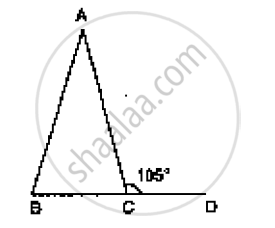
In Figure 10.24, AB = AC and ∠ACD =105°, find ∠BAC.
Which of the following statements are true (T) and which are false (F):
Angles opposite to equal sides of a triangle are equal
Which of the following statements are true (T) and which are false (F):
The bisectors of two equal angles of a triangle are equal
Is it possible to draw a triangle with sides of length 2 cm, 3 cm and 7 cm?
Prove that the perimeter of a triangle is greater than the sum of its altitudes.
Which of the following statements are true (T) and which are false (F)?
Difference of any two sides of a triangle is equal to the third side.
If the angles of a triangle are in the ratio 2 : 1 : 3, then find the measure of smallest angle.
In the given figure, if EC || AB, ∠ECD = 70° and ∠BDO = 20°, then ∠OBD is
In the given figure, for which value of x is l1 || l2?
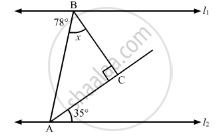
In the given figure, what is the value of x?
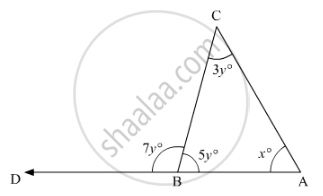
The base BC of triangle ABC is produced both ways and the measure of exterior angles formed are 94° and 126°. Then, ∠BAC =
The angles of a right angled triangle are
Which of the following correctly describes the given triangle?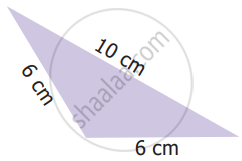
In triangles ABC and PQR, AB = AC, ∠C = ∠P and ∠B = ∠Q. The two triangles are ______.
If ∆PQR ≅ ∆EDF, then is it true to say that PR = EF? Give reason for your answer
Show that in a quadrilateral ABCD, AB + BC + CD + DA < 2(BD + AC)
