Advertisements
Advertisements
प्रश्न
Draw a neat and labelled diagram of a vernier callipers. Name its main parts and state their functions.
Advertisements
उत्तर
Diagram of vernier callipers:

Main parts and their functions:
Main scale: It is used to measure length correct up to 1 mm.
Vernier scale: It helps to measure length correct up to 0.1 mm.
Outside jaws: It helps to measure length of a rod, diameter of a sphere, external diameter of a hollow cylinder.
Inside jaws: It helps to measure the internal diameter of a hollow cylinder or pipe.
Strip: It helps to measure the depth of a beaker or a bottle.
APPEARS IN
संबंधित प्रश्न
Describe in steps, how would you use a vernier callipers to measure the length of a small rod?
State the formula for calculating length if:
Number of vernier scale division coinciding with the main scale and number of division of main scale on the left-hand side of zero of vernier scale is known.
What do you understand by the term zero error?
State the correction if the negative error is 7 divisions when the least count is 0.01 cm.
The circular scale of a screw gauge has 100 divisions. Its spindle moves forward by 2.5 mm when given five complete turns. Calculate
- pitch
- least count of the screw gauge
What do you understand by the following term as applied to screw gauge?
Negative zero error
State whether the following statement is true or false by writing T/F against it.
The least count of a screw gauge can be lowered by increasing the number of divisions on its thimble.
What is the least count in the case of the following instrument?
Stopwatch
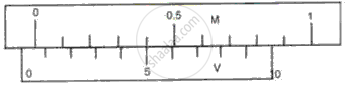
Consider the following case where the zero of vernier scale and the zero of the main scale are clearly seen. If L.C. of the vernier calipers is 0.01 cm, write the zero error and zero correction of the following.
In a vernier calipers, (N + 1) divisions of vernier scale coincide with N divisions of main scale. If 1 MSD represents 0.1 mm, the vernier constant (in cm) is ______.
