Advertisements
Advertisements
प्रश्न
State three uses of the vernier callipers.
Advertisements
उत्तर
Three uses of vernier callipers are
(a) Measuring the internal diameter of a tube or a cylinder.
(b) Measuring the length of an object.
(c) Measuring the depth of a beaker or a bottle.
APPEARS IN
संबंधित प्रश्न
State one use of a screw gauge.
Describe the procedure to measure the diameter of a wire with the help of a screw gauge.
Figure shows the position of vernier scale while measuring the external length of a wooden cylinder.
- What is the length recorded by the main scale?
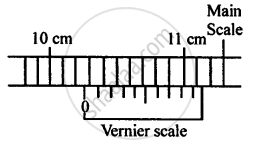
- Which reading of vernier scale coincides with the main scale?
- Calculate the length.
State the formula for calculating length if:
The reading of the main scale is known and the number of vernier scale divisions coinciding with the main scale is known.
What do you understand by the following term as applied to micrometre screw gauge?
Thimble
State whether the following statement is true or false by writing T/F against it.
The diameter of a wire can be measured more accurately by using vernier calipers than by a screw gauge.
Consider the following case where the zero of vernier scale and the zero of the main scale are clearly seen. If L.C. of the vernier calipers is 0.01 cm, write the zero error and zero correction of the following.
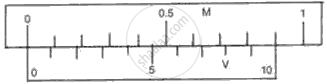
Least count of a vernier caliper is ______ cm.
