Advertisements
Advertisements
प्रश्न
Describe briefly the following term:
minority carrier injection in forward biasing.
Advertisements
उत्तर
Due to the applied voltage, electrons from the n-side cross the depletion region and reach the p-side (where they are minority carriers). Similarly, holes from the p-side cross this junction and reach the n-side (where they are minority carriers). This process under forward bias is known as minority carrier injection.
APPEARS IN
संबंधित प्रश्न
What happens when a forward bias is applied to a p-n junction?
The dynamic plate resistance of a triode value is 10 kΩ. Find the change in the plate current if the plate voltage is changed from 200 V to 220 V.
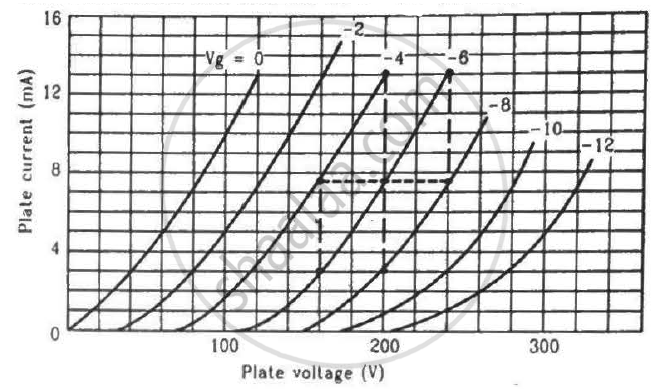
Find the values of rp, µ and gm of a triode operating at plate voltage 200 V and grid voltage −6. The plate characteristics are shown in the figure.
The gain factor of an amplifier in increased from 10 to 12 as the load resistance is changed from 4 kΩ to 8 kΩ. Calculate (a) the amplification factor and (b) the plate resistance.
We use alloys for making standard resistors because they have ____________.
Avalanche breakdown is due to ______.
In the depletion region of a diode ______.
- there are no mobile charges.
- equal number of holes and electrons exist, making the region neutral.
- recombination of holes and electrons has taken place.
- immobile charged ions exist.
Can the potential barrier across a p-n junction be measured by simply connecting a voltmeter across the junction?
 (a) |
 (b) |
- Name the type of a diode whose characteristics are shown in figure (A) and figure (B).
- What does the point P in figure (A) represent?
- What does the points P and Q in figure (B) represent?
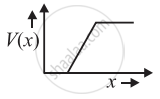
The graph of potential barrier versus width of depletion region for an unbiased diode is shown in graph A. In comparison to A, graphs B and C are obtained after biasing the diode in different ways. Identify the type of biasing in B and C and justify your answer
| ‘A’ | ‘B’ | ‘C’ |
 |
 |
 |
