Advertisements
Advertisements
प्रश्न
Three cells, each of emf E but internal resistances 2r, 3r and 6r are connected in parallel across a resistor R.
Obtain expressions for (i) current flowing in the circuit, and (ii) the terminal potential differences across the equivalent cell.
Advertisements
उत्तर

`R_{AB}` = ?
`1/(R_{AB}) = 1/(2r) + 1/(3r) + 1/(6r)`
`1/R_{AB} = 1/r[(3 + 2 + 1)/6]`
`1/R_{AB} = 1/r`
`R_{AB} = r` ⇒ equivalent internal resistant
Equivalent emf of cells in parallel,
`E_{eq} = (E_1/r_1 + E_2/r_2 + E_3/r_3)/(1/r_1 + 1/r_2 + 1/r_3)`
= `(E/(2r) + E/(3r) + E/(6r))/(1/(2r) + 1/(3r) + 1/(6r))`
`E_{eq} = E[(1/(2r) + 1/(3r) + 1/(6r))/(1/(2r) + 1/(3r) + 1/(6r))]`
Eeq = E
Current flowing in the circuit,
I = `E_{eq}/(R + R_{AB})`
I = `E/(R + r)`
Potential drop across E,
V = IReq
V = `(rE)/(R + r)`
APPEARS IN
संबंधित प्रश्न
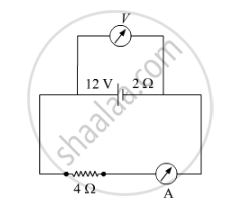
A battery of emf 12 V and internal resistance 2 Ω is connected to a 4 Ω resistor as shown in the figure.
(a) Show that a voltmeter when placed across the cell and across the resistor, in turn, gives the same reading.
(b) To record the voltage and the current in the circuit, why is voltmeter placed in parallel and ammeter in series in the circuit?
A long straight current carrying wire passes normally through the centre of circular loop. If the current through the wire increases, will there be an induced emf in the loop? Justify.
In a potentiometer arrangement for determining the emf of a cell, the balance point of the cell in open circuit is 350 cm. When a resistance of 9 Ω is used in the external circuit of the cell, the balance point shifts to 300 cm. Determine the internal resistance of the cell.
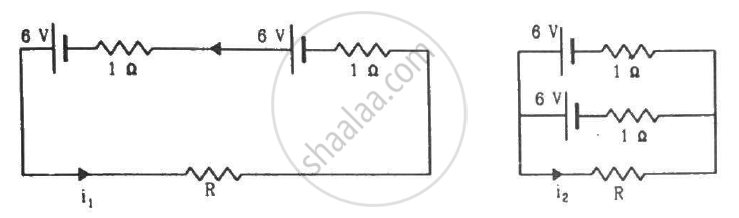
Find the value of i1/i2 in the following figure if (a) R = 0.1 Ω (b) R = 1 Ω and (c) R = 10 Ω. Note from your answers that in order to get more current from a combination of two batteries, they should be joined in parallel if the external resistance is small and in series if the external resistance is large, compared to the internal resistance.
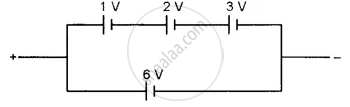
Find the emf of the battery shown in the figure:
Answer the following question.
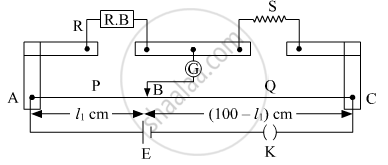
What is the end error in a meter bridge? How is it overcome? The resistances in the two arms of the metre bridge are R = Ω and S respectively. When the resistance S is shunted with equal resistance, the new balance length found to be 1.5 l1, where l2 is the initial balancing length. calculate the value of s.
Five cells each of emf E and internal resistance r send the same amount of current through an external resistance R whether the cells are connected in parallel or in series. Then the ratio `("R"/"r")` is:
Two batteries of emf ε1 and ε2 (ε2 > ε1) and internal resistances r1 and r2 respectively are connected in parallel as shown in figure.

A block of metal is heated directly by dissipating power in the internal resistance of block. Because of temperature rise, the resistance increases exponentially with time and is given by R(t) = 0.5 e2t, where t is in second. The block is connected across a 110 V source and dissipates 7644 J heat energy over a certain period of time. This period of time is ______ × 10-1 sec (take ln 0.367 = -1).
The emf of a cell is defined as the work done in carrying a unit positive charge through which part of the circuit?
