Advertisements
Advertisements
प्रश्न
Based on the information on your completed scorecard, write a short report for the Danapur local newspaper about the Annual Athletic Meet of the school. Remember 'CODER'. Some further advice ...
• Give an interesting heading
• By line (who has written the report)
• Answer the 'WH' questions - Who? Why? When? Where?
• Overall result
• Aim of the Meet
Advertisements
उत्तर
Do it yourself.
APPEARS IN
संबंधित प्रश्न
Now that you have enjoyed reading the story, answer the following question by choosing the correct option.
The grandmother could relate to the central character of the story 'Kashi Yatre' as __________.
Private Quelch knew ‘too much’. Give reasons to prove that he was unable to win the admiration of his superior officers or his colleagues in about 100 words.
Answer the following questions:
How does the brook ‘sparkle’?
In the sixth line of the first stanza, we read:
"... and sings a melancholy strain,..."
This "s" sound at the beginning of sings and strain has been repeated. Poets often do
this. Do you know why? Do you know what this "poetic repetition" is called? Can you
find other instances of this, in The Solitary Reaper?
Answer the following question.
The Poem invokes beautiful imagery which is built around 'sigh of the sea', 'laughter of
the field' and 'tears of heaven'. Explain the three expressions in the context of rain.
What according to you are the stages of a person's life? What characteristics
would you associate with each stage? (e.g., childhood: innocence, joy
On the basis of your understanding of the poem, answer the following question
by ticking the correct choice.
The title 'Oh, I wish I'd looked after me teeth' expresses __________.
Answer the following question briefly.
Juliette says "................... now I have only one thought that is to get the wretched place
off my hands. I would sacrifice it at any price", Does she stick to her words? Why / Why
not?
Discuss in groups
What would you do in the following situations? Give reasons for your answer
If you were travelling by bus and you saw someone pick another passenger's
pocket.
- If you found a wallet on the road.
- If you were in a shop and you saw a well-dressed lady shoplifting.
- If your best friend is getting involved with an undesirable set of friends.
- If you were in school and you saw one of your class-mates steal another child's
pen.
Simple Past and Past Continuous
There was a burglary in your neighbourhood. You saw something suspicious.
Tell the police officer all about it by filling in the blanks choosing the correct
forms of the words from the options given below.
It (a) was raining last night. I (b) _________ TV. I (c) _________ a little restless. I (d) _________ to the window and was looking out when I (e) _________ that Mr Sharma, my neighbour (f) _________ near the door. I thought he had gone to shut it. I also (g) _________ Mrs Sharma walking up and down in her garden. Then I heard Mr Sharma calling his wife to come in. I (h) _________ back to my table and opened my book. I (i) _________ when I heard a thud and a scream. I (j) _________ out of the house and saw a man in a black coat and hat running towards the gate. Mr and Mrs Sharma (k) _________ in the street. I saw a car speeding away with the burglar.
(a) (i) raining (ii) was raining (iii) were raining (iv) rained
(b) (i) were watching (ii) watched (iii) was watching (iv) watching
(c) (i) has felt (ii) felt (iii) was feeling (iv) feel
(d) (i) had gone (ii) went (iii) was going (iv) gone
(e) (i) noticing (ii) was noticing (iii) were noticing (iv) noticed
(f) (i) stood (ii) were standing (iii) was standing (iv) were stood
(g) (i) seeing (ii) saw (iii) was seeing (iv) seen
(h) (i) had come (ii) was coming (iii) came (iv) were came
(i) (i) hadread (ii) was reading (iii) were reading (iv) read
m (i) rushed (ii) was rushing (iii) were rushed (iv) rushing
(k) (i) had screamed (ii) was screaming (iii) screamed (iv) were screaming
Suppose you are on a ship, far out into sea. Something happens, and you find yourself in the water. The ship continues on its journey. Discuss the following with your partner and share your views with the class
• How long do you think you can stay alive in the water?
• How will you know which way to swim?
• What dangers will you face?
Study the given notes and complete the paragraph that follows by filling in the blanks.
Mobile phones — emit electromagneticfield — prolonged exposure — researchneeded — brain illness — cancer memoryloss — evidence — likely to cause — healthscares — press reports — people worryneedlessly.
Think about it. Every time you use a mobile phone, (a)_____________ head to electromagnetic emission. Manufacturers (b)___________to prove there is no risk (c)_____________ . Some evidence, so far suggests that mobile phone emissions (d)_________ . These health scares (e)______ . So, people worry needlessly.
(a) (i) he exposes his
(ii) one exposes his
(iii) one exposes one’s
(b) (i) needed
(ii) are needed
(iii) have needed
(iv) need
(c) (i) in brain cancer or memory loss
(ii) from brain cancer or memory loss
(iii) with brain cancer or memory loss
(iv) of brain cancer or memory loss
(d) (i) are likely to cause illness
(ii) are likely for causing illness
(iii) is likely in causing illness
(v) is likely to cause illness
(e) (i) is base on press reports
(ii) have been based on press reports
(iii) are based on press reports
(iv) are being based on press reports
As a Conservationist, write a report to the World Wildlife Federation, based on 5. Remember 'CODER'
| From: (your name), Conservationist. To: The Chairman WWF (Date) (Suitable Heading) (Suitable introduction) e.g. You recently asked me to submit a report on my study of YAK - in particular, their future. The following are my findings and recommendations. 1. The current problem. 2. Reasons why this problem has arisen. 3. Effects of the problem 4. Recommendation 5. Conclusion (Suitable ending, including other ideas for increasing YAK population) Your name (Conservationist) |
After the role play, the Chairman will put forward the final decision with reasons.
Listen to the following conversation adapted from 'Harry Potter and the Philosopher's Stone' by J. K. Rowling.
While your teacher reads the excerpt, complete the following statements.
Aunt Petunia : Wizard, indeed!
Hany Potter : You knew? You knew I'm a - a wizard?
Aunt Petunia : (shouting angrily) Knew! Knew! Of course we knew! How cold you not be, my dratted sister being what she was? Oh, she got a letter just like that and disappeared off to that - that school - and came home every holiday with her pockets full of frog-spawn, turning teacups into rats. I was the only one who saw her for what she was - a freak! But for my mother and father, oh no, it was Lily this and Lily that, they were proud of having a witch in the family! (Drawing a deep breath) Then she met that Potter at school and they left and got married and had you, and of course I knew you'd be just the same, just as strange, just as - as - abnormal - and then, if you please, she went and got herself blown up and we got landed with you!'
Harry Potter : (Listens in shocked silence). Blown up? You told me they died in a car crash!'
Hagrid : (Angrily) CAR CRASH! (Jumping to his feet) How could a car crash kill Lily an' James Potter? It's an outrage! A scandal! Harry Potter not knowin' his own story when every kid in our world knows his name!'
Harry Potter : But why? What happened?
Hagrid : (Anxiously) I never expected this. I had no idea, when Dumbledore told me there might be trouble gettin' hold of yeh, how much yeh didn't know. Ah, Hany, I don' know if I'm the right person to tell yeh - but someone's gotta -yeh can't go off to Hogwarts not knowin'. Well, it's best yeh know as much as I can tell yeh - mind, I can't tell yeh everthin', It's a great mystry, parts of it ... ' (Hagrid pauses for a moment. Sound of chair being dragged). It begins, I suppose, with - with a person called - but it's incredible yeh don't know his name, everyone in our world knows-'
Harry Potter : Who ?
Hagrid : Well - I don't like sayin' the name if I Can help it . No one does .
Harry Potter : Why not ?
Hagrid : Gulpin' gargoyles, Harry, people are still scared. Blimey, this is difficult. See, there was this wizard who went ... bad. As bad as you could go. Worse than worse. His name was .... (Hagrid gulps but no word comes out).
Harry Potter : Could you write it down ?
Hagrid : (in a whisper) Nah - can't spell it. All right - Voldemort. (shudders) Don't make me say it again. Anyway, this - this wizard, about twenty years ago now, started lookin' fer followers. Got 'em, too - some were afraid, some
just wanted a bit o' his power, "cause he was gettin' himself power, all right. Dark days, Harry. Didn't know who to trust, didn't dare get friendly with strange wizards or witches .. Terrible things happened. He was takin' over.' Course, some stood up to him - an' he killed" em. Horribly. One o' the only safe places left was Hogwarts. Reckon Dumbledore's the only one You-Know-Who was afraid of. Didn't dare try takin' the school, not jus' then, anyway. Now, yer mum an' dad were as good a witch an' wizard as I ever knew. Head Boy an' Girl at Hogwarts in their day! Suppose the myst'ry is why You-Know-Who never tried to get 'em on his side before ... probably knew they were too close to Dumbledore to want anythin' to do with the Dark Side. Maybe thought he could persuade 'em .. maybe he just wanted 'em outta the way. All anyone knows is, he turned up in the village where you was all living, on Hallowe'en ten years ago. You was just a year old. He came toyer house an' - an'-' (Blows nose with a sound like a foghorn). Soriy. But it's that sad - knew yer mum an' dad, an' nicer people yeh couldn't find - anyway"You-Know-Who" killed 'em. An' then - an' this is the real myst'ry of the thing - he tried to kill you, too. Wanted to make a clean job of it, I suppose, or maybe he just liked killin' by then. But he couldn't do it. Never wondered how you got that mark on yer forehead? That was no ordinary cut. That's what yeh get when a powerful, evil curse touches yeh - took care of yer mum an' dad an' yer house, even - but it didn't work on you, an' that's why yer famous, Harry. No one ever lived after he decided to kill' em, no one except you, an' he'd killed some o' the best witches an' wizards of the age - the McKinnons, the Bones, the Prewetts an' your parents Harry.
1. Aunt Petunia did not like her sister and brother-in-law as ____________
2. Harry's mother had met his father at _______________
3. Harry had been told that his parents had ___________This was not the truth as ____________
4. The name of the Wizard who killed Harry Potter's parents was __________
5. Hagrid was reluctant to name _______ and called him _______
6. Harry got the scar on his forehead when _________
Film/Book Review
The aim of writing a film review is to judge a film or a book and inform the viewer / reader about it. The reviewer talks about the subject of the film / book being reviewed and how the film maker or director / author has handled the subject. At times the reviewer's aim is to arouse the interest of the viewer/ reader so that she / he wishes to see the film / read the book. Sometimes, the reviewer warns the viewer/ reader why she / he should not see or read a particular film / book.
Write a review of a Harry Potter film / book or an episode of Malgudi Days that you have seen.
You must include :
• the name of the film / book
• the cast / director/ writer
• the important characters
• a very brief outline of the film / book
• why the film/ book was worth seeing or reading / not worth seeing or reading.
Sources
1) //en.wikipedia.org/wiki/Bermuda-Triangle//
2) /www.bermuda-triangle.org/
3) /www.bermudatrianglemystery.net./
Present perfect passive
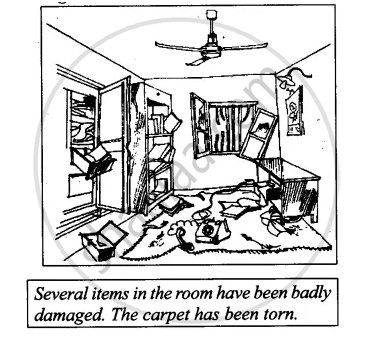
Inspector Narayan has been called to investigate a burglary. When he arrives, there is total chaos in the room. He makes notes about what has been damaged. You are Inspector Narayan. Look at the picture and complete the description, using the Present Perfect Passive.
Maintaining a Point of view
(a) Read the following passage. Underline the verbs in the active voice and put circles around verbs in the passive voice. The first two have been completed.
Dr. Godbole arrived at the station at 6.30 pm and (was met) by Professor Salisbury of the Institute of Environmental Studies. After being driven to the Conference Centre for a brief meeting, the Indian forestry expert was taken to his hotel. The following morning, he presented his paper entitled “Save the trees — Save the world” which was greeted with prolonged applause. After his brief visit, Dr. Godbole is reported to have said he was very pleased with its outcome.
(b) From whose perspective or point of view is this description given? How does the use of the passive voice help maintain this?
Copy the worksheet in your notebooks and work in pairs to complete the worksheet to know all about yourself. This will enable you to discover your hidden strengths, work on your weaknesses, and develop your personality.
Johari Window Work Sheet
| A | B | C |
| How I describe myself? | How I describe my friend ? | How my friend describes me? (Fill this part from what the friend says about you) |
|
|
____________ ____________ _____________ ___________ _____________ ______________ ______________ ______________ |
Either in groups or individually, make a power-point presentation on either of the two games. Incorporate points from the table above and any other interesting information I detail.
