Advertisements
Advertisements
प्रश्न
Film/Book Review
The aim of writing a film review is to judge a film or a book and inform the viewer / reader about it. The reviewer talks about the subject of the film / book being reviewed and how the film maker or director / author has handled the subject. At times the reviewer's aim is to arouse the interest of the viewer/ reader so that she / he wishes to see the film / read the book. Sometimes, the reviewer warns the viewer/ reader why she / he should not see or read a particular film / book.
Write a review of a Harry Potter film / book or an episode of Malgudi Days that you have seen.
You must include :
• the name of the film / book
• the cast / director/ writer
• the important characters
• a very brief outline of the film / book
• why the film/ book was worth seeing or reading / not worth seeing or reading.
Sources
1) //en.wikipedia.org/wiki/Bermuda-Triangle//
2) /www.bermuda-triangle.org/
3) /www.bermudatrianglemystery.net./
Advertisements
उत्तर
For Self-Attempt
APPEARS IN
संबंधित प्रश्न
Following dates were important in Charles Hooper’s life in some way. Complete the table by relating the description with the correct dates:

| Date | Description |
| News spread that Hooper and Duke had made it to an intersection | |
| Hooper walked independently from the clinic to the branch office | |
| Hooper planned to start a full day’s work at office | |
| Duke met with a fatal accident |
Answer the following question briefly:
Do you think Private Quelch learnt a lesson when he was chosen for cookhouse duties?
Based on your reading of the story, answer the following question by choosing
the correct option.
The narrator says that John was "______ of the suff that heroes are not often lucky
enough to be made of." His tone is sarcastic because __________
Answer the following questions:
How many hills and bridges does the brook pass during its journey?
Answer the following question briefly.
Which road would you choose? Why?
Answer the following question.
Explain the ending of the song.
Work individually, and rank the seven stages in order of attractiveness. If you
think being a schoolboy is most attractive stage, you could rank it number 1.
Then, work in groups of four and compare your individual rankings.
Toothache
Doki : Oh! I'm in agony. I didn't sleep a wink last night!
Moki : Why don't you go to a dentist?
Doki : Even thinking about the dentist's waiting room gives me the willies.
Moki : It's because you haven't been to a dentist for ages.
Doki: What a reassuring person you are!
Moki : I'm now going to get Mom. She'll only crack the whip and make you go to the
dentist.
Doki: No, No! I'd better go with you. At least you'd save me from going into the surgery.
Moki : I can only take the horse to the water but I can't make it drink! I'm sure, you're going
to turn tail and go home.
Doki: Don't worry, I shall be led quietly into the dentist like a lamb because my tooth is so
sore.
Moki : If that happens, I would believe that wonders will never cease!
Doki: I wish I had taken proper care of my teeth!
Moki : I wish you had paid attention to the discipline that Mom had laid for all of us!
Doki: Yeah! But past can't be undone. I have to reap what I had sown.
Your teacher will read out the conversation between Doki and his
sister, Moki. As you listen complete the idioms and expressions listed below.(GIVEN ABOVE)
1. sleep…...….............………….
2. ………....……….me the willies
3. crack the…………..............….
4. take the……………….to water
5. …………...................…….tail.
6. wonders will……….........…….
7. ……………….can't be undone.
8. reap what I …………………….
Idioms are metaphorical expressions rather than literal. For example 'give someone
the willies' does not simply mean 'to handover something called willies to someone',
but 'to make someone feel nervous'. It is important for learners of English to
understand them and be able to use them.
Answer the following question briefly.
The convict says, "I am too old a bird to be caught with chaff." What does he mean
by this statement?
Read the following extract and answer the questions that follow by choosing the
correct options.
I offered to take her in here for a day or two, but she seemed to think it might distress
you.
(a) The Bishop wanted to take Mere Grngoire in because _________.
(i) she was sick.
(ii) she had no money.
(iii) she was unable to pay the rent of her house.
(iv) she was a close friend of Persome.
(b) Persome would be distressed on Mere Gringoire's being taken in because
________
(i) she did not want to help anyone.
(ii) she felt that Mere Gringoire was taking undue advantage of the Bishop.
(iii) she was a self-centred person.
(iv) she would be put to a great deal of inconvenience.
The Convict goes to Paris, sells the silver candlesticks and starts a business. The
business prospers and he starts a reformatory for ex-convicts. He writes a letter to the
Bishop telling him of this reformatory and seeks his blessings.
As the convict, Jean Valjean, write the letter to the Bishop.
(a) Answer the following questions:
- Where were the characters at the time of narration?
- Who was travelling with the aunt?
- How did the children pass their time?
- How long would they take to reach Templecombe?
- How does the aunt respond to the children’s antics? Why do you say so?
(b) You must have used a variety of articles in your answer. Why did you use them? Discuss the reasons with your teacher.
Study the following pair of sentences from the description. Notice the use of
articles-a, an or the or no article (X).
e.g. The next stop was at X Templecombe.
An aunt belonging to the children sat in one corner.
In the corner sat a stranger.
Hence we conclude
1. No article is used before a proper noun.
2. 'The' is used to refer to a specific place/person/ object.
3. 'A' is used when the person/place is referred to for the first time.
4. 'An' is used before a vowel sound.
Look at the numbers on the map, and match them with the names given in the box below.
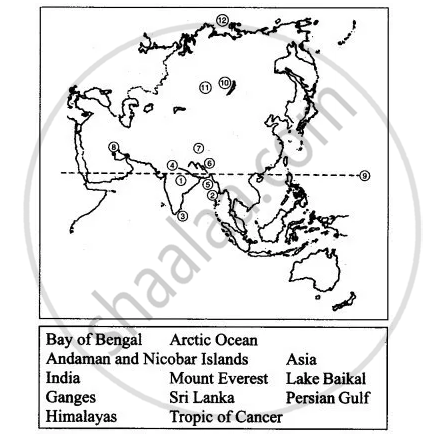
Read through the poem and quickly make a note of any thoughts that come to you, while you are reading it.
Dispute
A man and a tiger once had a dispute,
Which was reckoned greater, the man or the brute.
The tiger discoursed on his side at some length,
And greatly enlarged on his courage and strength,
Said the man, 'Don't be prating; look yonder, I pray,
At that sculpture of marble: now what will you say?
The tiger is vanquished; but as for the man,
He is striding upon him: deny if you can.'
'But pray,' said the tiger, 'Who sculptured that stone?
'One of us,' said the man. 'I must candidly own.'
'But when we are sculptors,' the other replied,
'You will then on the man see the tiger astride.'
Anonymous
Massive poaching in the past two years has wiped out the entire tiger population at one of the tiger reserves in India,' claims an investigation report.
Study the information in 7 and 8 and notice how the number of tigers are falling. Using the information, write a paragraph in about 150 words on Project Tiger.
After reading the information given in Question 8, complete the table given below by filling in the blank spaces.
| Sub species | Countries | Estimated Population | |
| Minimum | Maximum | ||
| P .t. altaica Amur | (a)…………………………………………….. | (b)……… | (c)……… |
| Royal Bengal Tiger | India | (d)……… | (e)……… |
| P. t. corbetti (IndoChinese tiger) |
China | (f)………… | 40 |
| P. t. sumatrae (Sumatran Tiger) |
(g)…………………………………. | 400 | (h)………… |
Write what each symbol means using can, can’t, must, mustn’t.

Past passive –
“Where was it made?”
Look at what your partner is wearing. Imagine where the various items of clothing were (or might have been) made, and tell your partner. Use your imagination!
e.g. A : Was your shirt made in France ?
B : No, actually it was made in Brazil.
When both students have completed their half of the table above, exchange information, by asking and answering questions e.g.
1. What's the weight of the football?
2. When do you get a penalty in hockey?
As you receive information from your partner, write it down in the other half of the table above. (Do not let your partner look at your table!)
Look at the map below.
You have invited three friends to a party at your house. Write three separate notes, giving them directions from 1, 2 and 3 to your house. You may use the words in the box.

The directions from (1) are given here as an example
Go down Diwan Marg and turn right down Antonio Avenue. Walk as far as the traffic lights then turn right into Mount Road. Turn first left into The Crescent and my house is on the left.
________________________________
