Advertisements
Advertisements
Question
Film/Book Review
The aim of writing a film review is to judge a film or a book and inform the viewer / reader about it. The reviewer talks about the subject of the film / book being reviewed and how the film maker or director / author has handled the subject. At times the reviewer's aim is to arouse the interest of the viewer/ reader so that she / he wishes to see the film / read the book. Sometimes, the reviewer warns the viewer/ reader why she / he should not see or read a particular film / book.
Write a review of a Harry Potter film / book or an episode of Malgudi Days that you have seen.
You must include :
• the name of the film / book
• the cast / director/ writer
• the important characters
• a very brief outline of the film / book
• why the film/ book was worth seeing or reading / not worth seeing or reading.
Sources
1) //en.wikipedia.org/wiki/Bermuda-Triangle//
2) /www.bermuda-triangle.org/
3) /www.bermudatrianglemystery.net./
Advertisements
Solution
For Self-Attempt
APPEARS IN
RELATED QUESTIONS
Have you ever been on a trip to any place in India, where you didn’t know the language spoken locally? How did you feel? How did you manage to communicate?
Answer the following question briefly
Which of the following traits are relevant to the character of the narrator's grandmother?
(i) determined
(ii) selfish
(iii) emotional
(iv)mean
Give reasons for your choice.
Here are some direct quotations from the story. Identify the speaker and write what each quotation suggests about the speaker. You can use the adjectives given in the box and may also add your own.
| amiable, tender, gentle, sympathetic, understanding, determined, diligent, kind, concerned, systematic, wise, helpful, enthusiastic, selfish, cruel, humble, religious, prudent |
| Speaker | Quotation | Quality Highlighted | |
|
a. |
'Avva, is everything all right? Are you O.K.?' |
||
| b. | 'At times, I used to regret not going to school, so I made sure that my children and grandchildren studied well.' |
||
| c. | 'Avva, don't cry. What is the matter? Can I help you in anyway?' |
||
| d. | 'We are well-off, but what use is money when I cannot be independent.' | ||
| e. | 'I will keep Saraswati Pooja day during Dassara as the deadline.' | ||
| f. | 'For a good cause if you are determined you can overcome any obstacle.' | ||
| g. | I am touching the feet of a teacher not my granddaughter.' |
Answer the following questions briefly:
(a) In 1953, Hooper was a favoured young man. Explain.
(b) They said that they would create a desk job for Hooper at headquarters.
- Who are ‘they’?
- Why did they decide to do this?
(c) Duke was an extraordinary dog. What special qualities did he exhibit to justify this? Discuss.
(d) What problems did Chuck present when he returned to the company headquarters?
(e) Why do you think Charles Hooper’s appointment as Assistant National Sales Manager is considered to be a tribute to Duke?
Answer the following question briefly.
Describe the two roads that the poet comes across.
Answer the following question briefly.
Does the speaker seem happy about his decision?
On the basis of your understanding of the poem, answer the following question
by ticking the correct choice.
The speaker says that she has paved the way for cavities and decay by __________.
Answer the following question briefly.
Why is Gaston not interested in buying the villa in the beginning?
Answer the following question briefly.
Who is better business person - Juliette or Gaston? substantiate your view with
examples from the text.
Answer the following question briefly.
Why does Persome feel that the people pretended to be sick?
The term irony refers to a discrepancy, or disagreement, of some sort. The
discrepancy can be between what someone says and what he or she really
means. on verbal irony. The discrepancy can be between a situation that one
would logically anticipate or that would seem appropriate and the situation that
actually develops or situational irony. The discrepancy can even be between the
facts known to a character and the facts known to us, the readers or audience or
dramatic irony.
Working in groups of four complete the following table. Find instances of irony from the play
and justify them.
| Extract | Justification |
| I believe you want to convert me; save my soul, don’t you call it? Well, it’s no good………. see? I don’t want any damned religion. ● ________________________________ ●_________________________________ |
Later, the convict says, “its a queer thing to ask, but-could you, would you bless me before I go.” ●______________________________ ●______________________________ |
| ● Why the devil do you leave the window unshuttered and the door unbarred so that anyone can come in? ’ ●__________________________________ ●__________________________________ |
If the door had been barred the convict couldn’t have entered the house. ______________________________ ●______________________________ |
| ● My mother gave them to me on………………………. on her death bed just after you were bom, and…………….. and she asked me to keep them in remembrance of her, so I would like to keep them. ● _______________________________ ● _______________________________ |
Later he hands the convict the candlesticks and tells him to start a new life. ● _________________________ ● __________________________ |
You are a member or 'Explorer', an adventure club. Write a paragraph about one of your experiences or adventure activity.
Here are some words and phrases you can use
| Curious | thrilled | terrified | relieved |
| felt euphoric | agonizing moments | insecurity | grateful |
| uncertainty | overwhelming experience | extraordinary | courage |
In pairs, match A and B to produce likely phrases.
| A | B |
| A(n)
Some A pair of A piece of |
horse |
There is sometimes more than one sensible combination as in the example.

Working in groups of four, write a dialogue between
• A tiger behind bars and a man
• A man in a cage and a tiger.
The Environment in Danger
What do you think will happen to the following?
Choose four, and write one sentence about each using the modals below and/ or expressions from 10.
(a) The ozone layer
(b) The Taj Mahal
(c) The Maldives
(d) The rainforests
(e) Weather patterns
(f) Fossil fuels
(g) The Ganges delta
e.g. In my opinion, the hole in the ozone layer will grow bigger and more people will get skin cancer.
Simple passive
Present Passive: “Where are they made?”
Match the words from columns A, B, C, and D to produce factually correct sentences. Write your answer in full sentences. (Remember to make your subject and verb “agree”.)
e.g. Coffee is grown in Brazil.
| A | B | C | D |
| Oranges | produced in | Brazil. | |
| Wine | worn in | Switzerland. | |
| Maruti cars | are | eaten in | Malaysia. |
| Coffee | manufactured in | France. | |
| The most expensive watches | is | grown in | India. |
| Uranium | mined in | the Middle East. | |
| Satay | South Africa. | ||
| Deshdashes | Morocco. |
The Passive in Tentative Statements
The passive is often used in tentative statements where the writer tries to be as neutral as possible.
| considered | to | be… | ||
| It | is | said | ||
| known | to | have been… | ||
| They | are | acknowledged believed regarded as… |
8.1
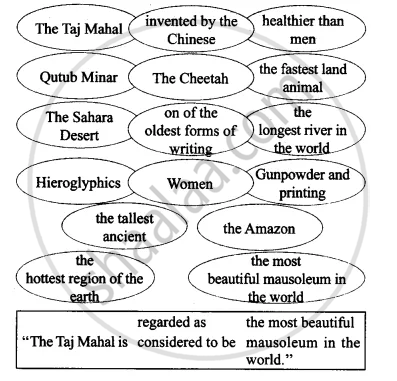
Look at the box below. Write tentative statements following the pattern in the table above.
Complete the table for the story you have read. By asking and answering questions, exchange information with your partner (for the story you have not read) and complete the other half of the table.
| Name | Shravan | Narendra |
| Age | ||
| Parents | ||
| How he spends a typical day | ||
| Recreation / hobbies | ||
| Hopes / dreams / ambitions |
Listen to the song and check whether you have guessed right in Question 1. Listen again until you are ready to sing along with it.
As children of the world, you have a role in helping to solve the problems prevalent in society. In groups or four, prepare a short skit on any one problem and present it in front of the class.
