English

The Passive in Tentative Statements the Passive is Often Used in Tentative Statements Where the Writer Tries to Be as Neutral as Possible. - English - Communicative

Advertisements
Advertisements

Question

The Passive in Tentative Statements
The passive is often used in tentative statements where the writer tries to be as neutral as possible.

    considered to be…
It is said    
    known to have been…
They are acknowledged
believed
regarded as…

 8.1
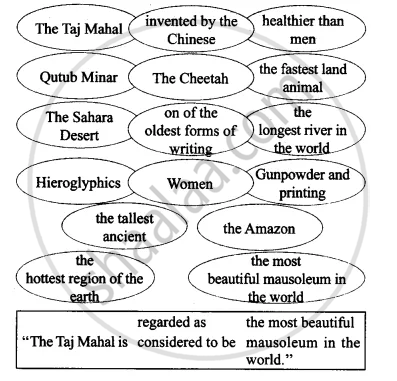
Look at the box below. Write tentative statements following the pattern in the table above.
Answer in Brief
Advertisements

Solution

  1. Qutab Minar is regarded as the tallest aneient minaret.
  2. The Sahara Desert is considered to be the hottest region of the earth.
  3. Hieroglyphics is acknowledged to be one of the oldest forms of writing.
  4. The Amazon is believed to be the longest river in the world.
  5. Gun powder and printing are known to have been invented by the Chinese.
  6. Women are considered/said to be healthier than men.
  7. The Cheetah is known to be the fastest land animal.
shaalaa.com
Writing and Grammar
  Is there an error in this question or solution?
Chapter 6.1: The Passive - Exercises [Page 79]

APPEARS IN

CBSE English Communicative Workbook Interact in English [English] Class 9
Chapter 6.1 The Passive
Exercises | Q 8.1 | Page 79

RELATED QUESTIONS

Here are some direct quotations from the story. Identify the speaker and write what each quotation suggests about the speaker. You can use the adjectives given in the box and may also add your own.

amiable, tender, gentle, sympathetic, understanding, determined, diligent, kind, concerned, systematic, wise, helpful, enthusiastic, selfish, cruel, humble, religious, prudent
  Speaker Quotation  Quality Highlighted

a.

  'Avva, is everything all right?
Are you O.K.?'
 
b.   'At times, I used to regret not going to school, so I made sure that my children and grandchildren
studied well.'
 
c.   'Avva, don't cry. What is the matter? Can I help you in
anyway?'
 
d.   'We are well-off, but what use is money when I cannot be independent.'  
e.   'I will keep Saraswati Pooja day during Dassara as the deadline.'  
f.   'For a good cause if you are determined you can overcome any obstacle.'  
g.   I am touching the feet of a teacher not my granddaughter.'


Answer the following question:

How did Harold come to know that his father was a boxer?


Here is a list of a few things. Can you tell how long each of them can live /exist?
(a) a dog
(b) an elephant
(c) a tree
(d) a human being
(e) a star
(f) a mountain
(g) a river


Answer the following question.

 In this universe, rain performs many functions. What are those?


'Ode to Autumn' is a beautiful poem written by the famous poet John Keats.
 Your teacher will read an excerpt from the poem. Pick phrases
which personify autumn.
Phrases
________________________ ______________________________
________________________ ______________________________
________________________ ______________________________
________________________ ______________________________

Ode to Autumn
John Keats
Season of mists and mellow fruitfulness!
Close bosom-friend of the maturing sun;
Conspiring with him how to load and bless
With fruit the vines that round the thatch-eaves run;
To bend with apples the mossed cottage-trees,
And fill all fruit with ripeness to the core;
To swell the gourd, and plump the hazel shells
With a sweet kernel; to set budding more,
And still more, later flowers for the bees,
Until they think warm days will never cease,
For Summer has o'erbrimmed their clammy cells.
Who hath not seen thee oft amid thy store?
Sometimes whoever seeks abroad may find
Thee sitting careless on a granary floor,
Thy hair soft-lifted by the winnowing wind;
Or on a half-reaped furrow sound asleep,
Drowsed with the fume of poppies, while thy hook
Spares the next swath and all its twined flowers;

And sometimes like a gleaner thou dost keep


Rain in the hills and rain in the desert present entirely different scenario. In the
hills it revitalises the greenery and freshens the vegetation; it waters the parched
land and relieves the thirsty and panting souls in the desert.
(i) This has been a year of scanty rains. Imagine how the rain would be welcomed
when it pours in the hills and in the desert after a long dry spell. Choose one such
place and describe
(a) What are you likely to see?
(b) What would happen to the rain water?
(c) What would be the scene before and after the rain?
(ii) How would you express rain as


In this poem, life is being compared to a play. Just as in a play, a man acts many
parts, so also in life, a man plays many roles. Can you think of some other
comparison for life? (For example, life could be compared with the seasons in
nature, the days of the week, the lessons in a school day.) Select one of these
comparisons (or choose one of your own), and write about the similarities that
life has with it. (80-100 words)


On the basis of your understanding of the poem, answer the following question
by ticking the correct choice.

The conscience of the speaker pricks her as she has__________.


Read the following extract and answer the questions that follow by choosing the
correct options.

She sent little Jean to Monseigneur to ask for help.

(a) Who sent little Jean to the Bishop?
(i) Mere Gringoire
(ii) Marie
(iii) Persome
(iv) Marie's mother


(b) Why did she send Jean to the Bishop?
(i) so that he could pray for her.
(ii) as she knew that he was a generous person.
(iii) as she was a greedy woman.
(iv) as she was a poor woman.


Choose three ‘since’ expressions and three ‘for’ expressions from the table above. Then write six sentences using the pattern in the box below.

I haven’t seen him since the day before yesterday.
I have not seen him for ages.


Listen carefully to 'Meet the personality of the month programme' read out by teacher/ student from the page no 167 and as you are listening fill in the details. 
ENVIRONMENTALIST: Mr Manu Srivastava 
Causes of pollution 
1. Atmosphere 

a__________________
___________________

2. water

a___________________
____________________
b__________________
___________________

3. Effects of pollution

a________________
_________________
b________________
________________

Human Rights activist- Ms.Shraddha Shankar 
Reasons for working in the factory 

a. ____________________________________________________
______________________________________________________

Effects

a________________
_________________
b________________
_________________
c________________
_________________

Steps which can be taken 

a________________
_________________
b________________
_________________
c________________
_________________

Read through the poem and quickly make a note of any thoughts that come to you, while you are reading it.

Dispute 
A man and a tiger once had a dispute, 
Which was reckoned greater, the man or the brute. 
The tiger discoursed on his side at some length, 
And greatly enlarged on his courage and strength, 
Said the man, 'Don't be prating; look yonder, I pray, 
At that sculpture of marble: now what will you say? 
The tiger is vanquished; but as for the man, 
He is striding upon him: deny if you can.' 
'But pray,' said the tiger, 'Who sculptured that stone? 
'One of us,' said the man. 'I must candidly own.' 
'But when we are sculptors,' the other replied, 
'You will then on the man see the tiger astride.' 
                                              Anonymous 


Fill in the blanks :

1. The next generation is not likely to see the tiger because of _________________________
2. ________________ laws against poachers must be enforced. 
3. The responsibility of protection of the tiger lies with the ___________________
4. One of the reasons for Tiger becoming extinct is _______________
5. Destroying nature means ________________
6. ___________________ , ________________ ,and _______________ are different types of tigers. 
7. ______________ is a wild life conservation project. 
8. Tigers are found in the evergreen and monsoon forests of the ______________
9. Though tigers are mostly nocturnal, __________ species may also be active during the day. 
10. The body length of the tiger is _______________ cm. 


Simple passive

Present Passive: “Where are they made?”

Match the words from columns A, B, C, and D to produce factually correct sentences. Write your answer in full sentences. (Remember to make your subject and verb “agree”.)

e.g. Coffee is grown in Brazil.

A B C D
Oranges   produced in Brazil.
Wine   worn in Switzerland.
Maruti cars are eaten in Malaysia.
Coffee   manufactured in France.
The most ex­pensive watches is grown in India.
Uranium   mined in the Middle East.
Satay     South Africa.
Deshdashes     Morocco.

Here are the stories of the two boys. One student reads the story of Shravan Kumar and the second student reads the story of Narendra Kumar. After reading the story, each student completes bis or her half of the table in Question 3. 

SHRAVAN KUMAR 

His day begins when most other people's day ends. Thirteen-year old Shravan Kumar works in a tea shop on Delhi's Bahadur Shah Zafar Marg, where several newspaper offices are situated. His work begins around seven in the evening when he starts preparing samosas, coffee and tea. He carries them to several offices, does the dishes, and goes around collecting his money well into the night. Around six in the morning, when all the newspapers are despatched for distribution and the press employees return home, he prepares his food, takes a bath and goes to bed.

Shravan is an orphan who crune to Delhi from his village in search of work. His father kept a shop, but was tricked out of it by a deceitful uncle. Despair drove him to alcohol and grunbling, and he died of a stroke soon after. 

Shravan worked in a tea shop in his village for a while. "When I first began washing other people's cups and glasses", he recalls, "I used to feel very bad, I would cry." 
Shravan moved to the more lucrative environs of Delhi, where his elder brother Shatrughan had preceded him. Ajob in a shop selling ice was his first taste of big city life. His mother crune to visit him in Delhi, but she fell ill and died soon after. "That was two or three years ago. I don't remember exactly when," the little boy says. Soon, Shravan lost his first job. His employer still owes him Rs 500. 

Following a brief spell of unemployment and a short spell as an assistant at a car park, he joined the tea shop where he is presently employed. The ruthlessness and loneliness of the world has left him shattered. "I think I run all alone in this world," he says despondently. 

Of the Rs 300 that he earns every month, he deposits Rs 200 in the bank. His bank balance stands at Rs 2000, he says proudly. Survival is his immediate aim but there is a larger objective towards which Shravan is working. He intends to retrieve the land that was mortgaged by his father. Already Shravan and Shatrughan have paid back the loan of Rs 8000 - only the interest remains to be paid. 

Shravan was a dedicated lotte:ry buyer at one time; until he realized that it was adding nothing to his income. The cinema remains a favourite form of entertainment - he even wakes up early to see the noon show. "I have no friends here. Who keeps awake late at night and sleeps during the day? I miss my village. There, I used to play gully danda and marbles and I had a lot of friends. When I went to the village last year, I met them. They are still studying and playing games. I want to join them, but it is a question of survival for me." 

Sharvan's mother wanted him to own a big shop - "like the one his father had owned," he says wistfully. He dreams of fulfilling her wish. He dreams of getting back their mortgaged land, and returning to the village for good, "I like being in my village. I like the films and the glitter of Delhi, but I prefer the greene:ry, the trees, and the fields of my village." Maybe the grit and intelligence he has shown, alone and friendless, in facing a hostile world, will also win for him his heart's desire. 

NARENDRA KUMAR 

Narendra Kumar, a thirteen year old Kendriya Vidyalaya student, was interviewed by The Illustrated Weekly of India. Read what he says about himself. 

Interviewer : Hello, Narendra! 
Narendra : Hello! 
Interviewer : Congratulations! Narendra. I saw your photograph in the newspaper last week, when you won the Soviet Land Nehru Award for drawing and painting. Our readers are anxious to know more about you. 
Narendra : Thank you, Sir. I think I was just lucky to get the award. The competition is held every year in my school and a large number of students take part in it. 
Interviewer : That's good, very good. It's evident that your school encourages students to take part in various activities. 
Narendra : Oh yes. Our teachers -especially my Art teacher, Mr. V. Sinha - gives us a lot of encouragement. My parents have encouraged me a lot, too. 
Interviewer : When did you start painting? 
Narendra : When I was three, I was attending the Shishu Vihar Nursery School. My teacher gave me a picture of a big kite one day. The picture was beautiful and that very day I asked my father to buy me some crayons and drawing paper... Soon my room was full of crayons and paper! I kept drawing whenever I found time. I now have a mini art room of my own at home! 
Interviewer : That's great, really great! Do you want to become an artist when you grow up? 
Narendra : No. Drawing and painting are just hobbies, which give me a great deal of pleasure. I want to become a police officer when I grow up. That's the only thing I've ever wanted to be. 
Interviewer : Is that because your father is a police officer? 
Narendra : Yes, maybe. I've been watching my father and other policemen for a very long time. I suppose I want to be like him! 
Interviewer : Do you feel you have the qualities that a good police officer needs? 
Narendra : Yes, I think so. A good police officer needs to be physically fit and mentally alert. I'm trying my best to grow into a healthy young man. I'm a member of the local sports club. I play tennis in the evenings and I also swim regularly. 
Interviewer : How do you find time for all these activities? 
Narendra : Well, I suppose I'm busy the whole day. Immediately after school I like to paint or play. I study before dinner and usually get to bed at about 10 o'clock. 
Interviewer : Thank you, Narendra. It's been good talking to you. We wish you success. 
Narendra : It's been a pleasure


Report the following questions. (Use if/whether or why, as appropriate.)

  1. Have you met my sister?
    She asked _________________ (use you and her)
  2. Do you want a drink?
    He asked _________________ (use you)
  3. Why didn’t you study for the Unit test?
    She asked _________________ (use he)
  4. Can you help me with my homework this evening?
    He asked _________________ (use she)
  5. Have you had lunch yet?
    They asked _________________ (use he)

Ravi has a problem, so he asks his friends for advice. Read the conversation below and underline the expressions that are used for giving advice. (This could be done as role-play) 

Ravi : My neighbours play very loud music, which disturbs me when I'm studying. 
Mohan: Why don't you try persuading them to turn down the volume? 
Shiela: If that doesn't work you could think of changing your study time. 
Rahim: Why should Ravi have to do that? He really ought to report such antisocial behaviour to the police. 
Shiela: Before taking drastic action like that, I would advise you to sort it out amicably with your neighbours. 
Rahim: If l were you, I would play my music even louder! 
Mohan: That won't solve his problem. Ravi, I think you should ask your father to take it up with your neighours. 


Adjectives and Prepositions
Look at the table below. Decide which of the adjectives in Column A commonly go with which preposition. Tick the table as shown. (There may be more then one tick for each adjective).

A at to about for
worried    
good        
bad        
surprised        
happy        
sensitive        
puzzled        
married        
clever        
suitable        
curious        
due        
qualified        
famous        

Share
Notifications

Englishहिंदीमराठी


      Forgot password?
Use app×