मराठी

The Passive in Tentative Statements the Passive is Often Used in Tentative Statements Where the Writer Tries to Be as Neutral as Possible.

Advertisements
Advertisements

प्रश्न

The Passive in Tentative Statements
The passive is often used in tentative statements where the writer tries to be as neutral as possible.

    considered to be…
It is said    
    known to have been…
They are acknowledged
believed
regarded as…

 8.1
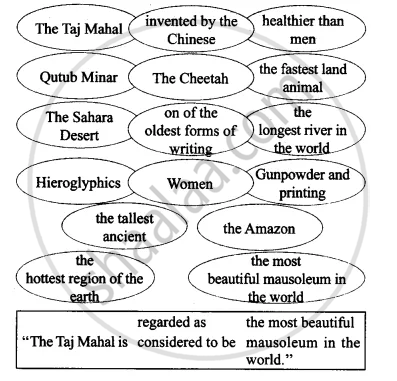
Look at the box below. Write tentative statements following the pattern in the table above.
थोडक्यात उत्तर
Advertisements

उत्तर

  1. Qutab Minar is regarded as the tallest aneient minaret.
  2. The Sahara Desert is considered to be the hottest region of the earth.
  3. Hieroglyphics is acknowledged to be one of the oldest forms of writing.
  4. The Amazon is believed to be the longest river in the world.
  5. Gun powder and printing are known to have been invented by the Chinese.
  6. Women are considered/said to be healthier than men.
  7. The Cheetah is known to be the fastest land animal.
shaalaa.com
Writing and Grammar
  या प्रश्नात किंवा उत्तरात काही त्रुटी आहे का?
पाठ 6.1: The Passive - Exercises [पृष्ठ ७९]

APPEARS IN

सीबीएसई English Workbook [English] Class 9
पाठ 6.1 The Passive
Exercises | Q 8 | पृष्ठ ७९
सीबीएसई English Workbook [English] Class 9
पाठ 6.1 The Passive
Exercises | Q 8.1 | पृष्ठ ७९

संबंधित प्रश्‍न

Answer the following question briefly
Which of the following traits are relevant to the character of the narrator's grandmother?
(i) determined
(ii) selfish
(iii) emotional
(iv)mean
Give reasons for your choice.


Here is a story about Swami and his grandmother. After reading the excerpt, change it into a conversation between Swami and his Grandmother.
After the night meal with his head on his granny’s lap, nestling close to her, Swaminathan felt very snug and safe in the faint atmosphere of cardamom and cloves. ‘Oh, Granny !’ he cried ecstatically. ‘You don’t know what a great fellow Rajam is.’ He told her the story of the first enmity between Rajam and Mani and the subsequent friendship.

‘You know, he has a real police dress,’ said Swaminathan. ‘Is it? What does he want a police dress for?’ asked Granny.

‘His father is the Police Superintendent. He is the master of every policeman here.’ Granny was impressed. She said that it must be a tremendous office indeed. She then recounted the days when her husband, Swaminathan’s grandfather, was a powerful sub-magistrate, in which office he made the police force tremble before him and the fiercest dacoits of the place flee. Swaminathan waited impatiently for her to finish the story. But she went on, rambled, confused, mixed up various incidents that took place at different times. ‘That will do, Granny,’ he said ungraciously. ‘Let me tell you something about Rajam. Do you know how many marks he gets in arithmetic?’

‘He gets all the marks, does he, child?’ asked Granny.
‘No silly. He gets ninety marks out of one hundred.’
‘Good. But you must also try and get marks like him…. You know, Swami, your grandfather used to frighten the examiners with his answers sometimes. When he answered a question, he did it in a tenth of the time that others took to do it. And then, his answers would be so powerful that his teachers would give him two hundred marks sometimes.

‘Oh, enough, Granny ! You go on bothering about old unnecessary stories. Won’t you listen to Rajam?’
‘Yes, dear, yes.’
‘Granny, when Rajam was a small boy, he killed a tiger.’
Swaminathan started the story enthusiastically : Rajam’s father was camping in a forest. He had his son with him. Two tigers came upon them suddenly, one knocking down the father from behind. The other began chasing Rajam, who took shelter behind a bush and shot it dead with his gun.

‘Granny, are you asleep?’ Swaminathan asked at the end of the story.
Now read the dialogue and complete the conversation:
Swarni:
 You don’t know what a great fellow Raj am is! In the beginning I could not get along with him but now he is my good friend. And you know, he has a real police dress.
Grandmother: Is it? What does he want a police dress for?
Swarni: His father is the Police Super­intendent. He is the master of every policeman here.
Grandmother: I think, it must be a tremendous office. Do you know, your grandfather was a powerful sub­magistrate and the Police Force trembled before him? Even the fiercest dacoits of the place fled.
Swarni: That will do, Granny. It’s so boring. Let me tell you something about Raj am. Do you know how many marks he gets in arithmetic?
Grandmother: He gets all the marks, doesn’t he, child?


Answer the following question briefly:

 Private Quelch looked like a ‘Professor’ when the author first met him at the training depot. Why?


Answer the following question:

How did Harold come to know that his father was a boxer?


Based on your reading of the story, answer the following question by choosing
the correct option.
 The narrator says that John was "______ of the suff that heroes are not often lucky
enough to be made of." His tone is sarcastic because __________


Here is a list of a few things. Can you tell how long each of them can live /exist?
(a) a dog
(b) an elephant
(c) a tree
(d) a human being
(e) a star
(f) a mountain
(g) a river


Answer the following question briefly.

The poet says “I took the one less travelled by, And that has made all the difference.” What is ‘the difference’ that the poet mentions?


In this poem, life is being compared to a play. Just as in a play, a man acts many
parts, so also in life, a man plays many roles. Can you think of some other
comparison for life? (For example, life could be compared with the seasons in
nature, the days of the week, the lessons in a school day.) Select one of these
comparisons (or choose one of your own), and write about the similarities that
life has with it. (80-100 words)


Answer the following question briefly.

Why does Jeanne want to buy a villa?


Simple Past and Past Continuous
There was a burglary in your neighbourhood. You saw something suspicious.
Tell the police officer all about it by filling in the blanks choosing the correct
forms of the words from the options given below.

It (a) was raining last night. I (b) _________ TV. I (c) _________ a little restless. I (d) _________ to the window and was looking out when I (e) _________ that Mr Sharma, my neighbour (f) _________ near the door. I thought he had gone to shut it. I also (g) _________ Mrs Sharma walking up and down in her garden. Then I heard Mr Sharma calling his wife to come in. I (h) _________ back to my table and opened my book. I (i) _________ when I heard a thud and a scream. I (j) _________ out of the house and saw a man in a black coat and hat running towards the gate. Mr and Mrs Sharma (k) _________ in the street. I saw a car speeding away with the burglar.

(a) (i) raining                  (ii) was raining                          (iii) were raining                      (iv) rained
(b) (i) were watching      (ii) watched                               (iii) was watching                    (iv) watching
(c) (i) has felt                  (ii) felt                                       (iii) was feeling                        (iv) feel
(d) (i) had gone              (ii) went                                    (iii) was going                          (iv) gone
(e) (i) noticing                (ii) was noticing                        (iii) were noticing                     (iv) noticed
(f) (i) stood                     (ii) were standing                      (iii) was standing                     (iv) were stood
(g) (i) seeing                   (ii) saw                                       (iii) was seeing                         (iv) seen
(h) (i) had come             (ii) was coming                          (iii) came                                  (iv) were came
(i) (i) hadread                 (ii) was reading                         (iii) were reading                       (iv) read
m (i) rushed                   (ii) was rushing                         (iii) were rushed                         (iv) rushing
(k) (i) had screamed      (ii) was screaming                     (iii) screamed                              (iv) were screaming


Now that you have seen some techniques for creating vivid images with language, try to compose a poem or write a short descriptive paragraph using similes and colourful expressions. Work in pairs if you prefer. Then read it out to the class. 
Choose one of these themes: waves, stars and moon, rocks, sunset or sunrise. 
Consider the following for your chosen theme: 
• What does it look like? 
• What does it feel like? 
• What does it sound like? 
• How does it move? 
• Where do we see it? 
• When do we see it? 


The teacher/ student will read out the Radio programme again. Fill in as much information as you can in the following table. Then exchange information with your partner to complete the table. 
                             RADIO SHOW 

Content of programme  Details 
1. School News  .
  .
  .
  .
2. Jokes  .
3. 'Meet the Teacher'  .
  .
  .
4. Advert Time  .
  .
  .
5. Safety at School  .
  .

Look at the notes below. Then use the information to complete the paragraph by choosing a suitable word or phrase in each space. Do not add any new information. The first one has been done for you as an example.

Galapagos Islands

Visitors to these Pacific Islands – leave – unstamped – mail them – return home – picture post-cards – show up – since 1960s – self perpetuating post office probably set up – to get news from their family, friends – tradition persisted – post office – establish – 1950s – barrel – replace – many times – weather worn plaques remain.

Tradition has it that visitors to these Pacific Islands (a) leave unstamped, addressed postcards and letters in a barrel at Post Office Bay, to await pick up by other tourists who affix postage and (b) __________ when they return home. Picture post-cards (c) __________ in the barrel since the late 1960s, when tourists began visiting the Galapagos Islands. The self- perpetuating post office (d) __________by whalers in the late 1790s as a way to get news to and from friends and family. The tradition persisted even after a post office (e) __________on the island of Floreana in the 1950s. The barrel (f) __________ many times, but weather worn plaques, where sailors long ago and from far away carved their names, remain.

(a) (i) leaving stamped
(ii) leaves unstamped
(iii) leave unstamped
(iv) left unstamped
(b) (i) mail them
(ii) mails them
(iii) mailed this
(iv) mailing these
(c) (i) show up
(ii) shown up
(iii) are show up
(iv) have show up
(d) (i) is setting up
(ii) was set up
(iii) is set up
(iv) has been set up
(e) (i) is established
(ii) is being established
(iii) was established
(iv) has been established
(f) (i) replacing
(ii) has been replaced
(iii) is replaced
(iv) was replaced

Passives in Headlines and Notices
Headlines.
Newspaper headlines are short and crisp. They often use the passive as it may
not be necessary to focus on the doer.

             Sales Tax Increased

Expand the following headlines using passives as shown.
a) Oscar award for A.R. Rahman's Jai Ho
A.R. Rahman was awarded the Oscar for his song Jai Ho in the movie Slumdog
Millionaire.

(b) Son of business tycoon kidnapped
_____________________________________________
(c) Explosive found near Regal Cinema
_____________________________________________


Given alongside are the pictures of two boys - Shravan Kumar and Narendra Kumar. (They are not related.) Working with a partner, look at their pictures and predict how each boys lives. Write your answer in points .

Shravan Kumar  Narendra Kumar 


Choose the right word from the options given below and fill in the blanks.

(а) The weekly forecast says that I _________ an old friend this week.
(b) I have to catch the 5.00 am train tomorrow. So, I _________ go to bed late tonight.
(c) The casualties _________ to a nearby hospital.
(d) The majority of the news _________ about violence.

(a) (i) will meet
(ii) meet
(iii) am meeting
(iv) ought to meet
(b) (i) have to
(ii) needn’t
(iii) may
(iv) mustn’t
(c) (i) was taken
(ii) were taken
(iii) taken
(iv) took
(d) (i) are
(ii) is
(iii) has
(iv) have

1 Read the conversation between a young boy and his mother. The boy is determined to go to camp, despite his mother's refusal to let him (from George Layfon's short story "The Holiday").
It wasn't fair. Tony and Barry were going. In fact, nearly all of them in Class
Three and Four were going, except me. It wasn't fair. Why wouldn't my mum let
me go?
(a) "I'vetoldyou. Youarenotgoingcamping. You're far too young."
Huh! She said thatlastyear.
"You said that last year."
"You can go next year when you're a bit older."
She said that last year, too.
"You said that last year and all."
"Do you want a clout?"
"Well you did, Mum, didn't you?"
(b) "Go and wash your hands for tea."
(c) "Aw, Mum, everybody else is going to school camp. Why can't I?"
(d) "Because you're going to Bridlington with me and your aunt Doreen, like you do
every year!"
Ohl Every year my mum, me and Aunt Doreen stay at Mrs. Sharkey's boarding
house. I suppose we'll have that same room again.
"Don't be cheeky! Mrs. Sharkey saves the room for me every year. It's the best
room in the house facing the sea."
"Aw, Mum, I never get any sleep - the sea splashing on one side."
My mum gave me a clout right across my head.
"Well, you've done it now. You've dislocated my jaw- owl"
She clouted me again, right in the same place.

"It's not fair. Tony's mum and dad are letting him go to school camp, and
Barry's going too. Why don'tyou let me go?"
She suddenly bent down and put her face right next to mine, right close. She
made me jump.
(e) "Now listen to me, my lad. What Tony's mum and dad do, and what Barry's
mum and dad do, is their look out. You will come with me and your Auntie
Doreen to Bridlington and enjoy yourself, like you do every year!"

1.1 Suppose Tony overheard this conversation, and wrote a letter to Barry.
Write and complete Tony's letter for him.

Dear Barry,
It's just two weeks more for our school camp! I can't wait to have a great time with
our class mates. I was hoping you, George and I get to share a tent together! But I
was at George's place and got to hear what his mother felt about our trip.
To start with his mother said he wasn't going camping. adding that he was far
too young for it. George reminded his Mum that she had said that the previous
year.
She felt that (a)____________________________________________________________________ older. He protested that she had said the previous year, too. To this, she simply ordered (b)_______________________________________________________________________ for tea. He wanted to know why (c) _________________________________________________________ when every body else, was going. She reasoned with him saying (d)_______________ George objected to being disturbed by the splashing sea, waves. But, his mother clouted him twice and in a threatening manner, told him (e)______________________ _________________ so, that's it. Probably, George won't be with us
Affectionately
Tony.


Study the following graph and the accompanying report. 

Our study of the time spent by students at the computer and studying at home in three countries has revealed some interesting facts. 

First, the majority of boys and girls in the age groups of 14-16 in these countries spend more time at the computer than studying at home. Children in these countries spend an average of20-30 hours per week in comparison to 10-15 hours of studying at home. The only exception is Burland where girls spend more time studying at home than at the computer. 

Secondly it is evident that in all three countries, time spent at the computer is having a serious impact on the number of hours spent studying at home. In fact, the greater the number of hours spent at the computer, the fewer number of hours are being spent studying. For example, boys in Burland spend an average of 32 hours at the computer while they spend about 8 hours studying at home. 


You will now hold an actual class debate on the topic 'Computers and Children: A Boon or a Bane'. 

In groups of four decide whether your group is FOR or AGAINST the motion. Then draft your debate. Each member of the group must participate in the written as well as the spoken matter. The spoken matter can be divided thus 
• One introduces the topic 
• One discusses points favouring the motion 
• One argues the opponent's points 
• One concludes 


Several youngsters have problems in dealing with their parents. With your partner, discuss the difference ln views and complete the table below. Sometimes there may be no contradiction between the two views. 

Features  As we see ourselves  As our parents see us 
How tidy we are     
The types of clothes we wear     
How courteous we are     
How much we study     
How independently are we allowed to express our opinions     

Share
Notifications

Englishहिंदीमराठी


      Forgot password?
Use app×