Advertisements
Advertisements
प्रश्न
The Passive in Tentative Statements
The passive is often used in tentative statements where the writer tries to be as neutral as possible.
| considered | to | be… | ||
| It | is | said | ||
| known | to | have been… | ||
| They | are | acknowledged believed regarded as… |
8.1
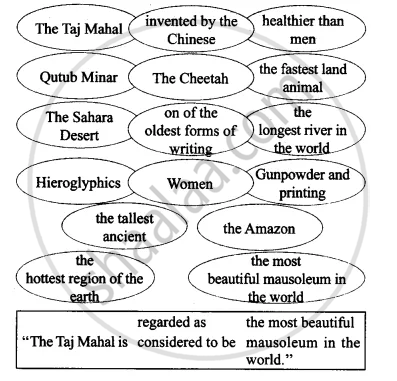
Look at the box below. Write tentative statements following the pattern in the table above.
Advertisements
उत्तर
- Qutab Minar is regarded as the tallest aneient minaret.
- The Sahara Desert is considered to be the hottest region of the earth.
- Hieroglyphics is acknowledged to be one of the oldest forms of writing.
- The Amazon is believed to be the longest river in the world.
- Gun powder and printing are known to have been invented by the Chinese.
- Women are considered/said to be healthier than men.
- The Cheetah is known to be the fastest land animal.
संबंधित प्रश्न
Following dates were important in Charles Hooper’s life in some way. Complete the table by relating the description with the correct dates:

| Date | Description |
| News spread that Hooper and Duke had made it to an intersection | |
| Hooper walked independently from the clinic to the branch office | |
| Hooper planned to start a full day’s work at office | |
| Duke met with a fatal accident |
Identify the rhyme scheme of the poem.
On the basis of your understanding of the poem, answer the following question
by ticking the correct choice.
All 'have their exits and their entrances'. Exits and entrances refer to __________.
Read the following extracts and answer the questions that follow by choosing the correct options.
But the sign has been hanging on the gate for over a month now and I am beginning to
be afraid that the day I bought it was when I was the real fool.
a) Why is Juliette disappointed?
(i) she is unable to get a role of cook in the films.
(ii) her maid is leaving as she has got a role in the films.
(iii) she is unable to find a suitable buyer for her villa.
(iv) Gaston is offering a very low price for the villa.
b) Why does she call herself a fool?
(i) she has decided to sell her villa.
(ii) there are no buyers for the villa.
(iii) she had bought the villa for more than it was worth.
(iv) the villa was too close to the film studios.
Discuss in groups
What would you do in the following situations? Give reasons for your answer
If you were travelling by bus and you saw someone pick another passenger's
pocket.
- If you found a wallet on the road.
- If you were in a shop and you saw a well-dressed lady shoplifting.
- If your best friend is getting involved with an undesirable set of friends.
- If you were in school and you saw one of your class-mates steal another child's
pen.
The Convict goes to Paris, sells the silver candlesticks and starts a business. The
business prospers and he starts a reformatory for ex-convicts. He writes a letter to the
Bishop telling him of this reformatory and seeks his blessings.
As the convict, Jean Valjean, write the letter to the Bishop.
Study the given notes and complete the paragraph that follows by filling in the blanks.
Mobile phones — emit electromagneticfield — prolonged exposure — researchneeded — brain illness — cancer memoryloss — evidence — likely to cause — healthscares — press reports — people worryneedlessly.
Think about it. Every time you use a mobile phone, (a)_____________ head to electromagnetic emission. Manufacturers (b)___________to prove there is no risk (c)_____________ . Some evidence, so far suggests that mobile phone emissions (d)_________ . These health scares (e)______ . So, people worry needlessly.
(a) (i) he exposes his
(ii) one exposes his
(iii) one exposes one’s
(b) (i) needed
(ii) are needed
(iii) have needed
(iv) need
(c) (i) in brain cancer or memory loss
(ii) from brain cancer or memory loss
(iii) with brain cancer or memory loss
(iv) of brain cancer or memory loss
(d) (i) are likely to cause illness
(ii) are likely for causing illness
(iii) is likely in causing illness
(v) is likely to cause illness
(e) (i) is base on press reports
(ii) have been based on press reports
(iii) are based on press reports
(iv) are being based on press reports
As a Conservationist, write a report to the World Wildlife Federation, based on 5. Remember 'CODER'
| From: (your name), Conservationist. To: The Chairman WWF (Date) (Suitable Heading) (Suitable introduction) e.g. You recently asked me to submit a report on my study of YAK - in particular, their future. The following are my findings and recommendations. 1. The current problem. 2. Reasons why this problem has arisen. 3. Effects of the problem 4. Recommendation 5. Conclusion (Suitable ending, including other ideas for increasing YAK population) Your name (Conservationist) |
Complete the introduction given below to the story The Story Teller by Saki (H.H. Munro), by using ‘a’ ‘art’ or ‘the’’:
The afternoon was hot, and so was (a)______ railway carriage. (b)_______ next stop was at Templecombe, nearly (c)______ hour ahead. In the carriage were a small girl, (d)______ smaller girl, and a small boy. (e)________ aunt belonging to (f)______ children sat in (g)_________ comer seat, and in (h)_______ further comer seat on (i)______ opposite side, was a man who was a stranger to them, but (j)_____ small girls and the small boys were (k)_________ ones who filled the compartment. The children chatted on and on to their aunt, like (l)____ housefly that refuses to be put off. Most of the aunt’s remarks seemed to begin with “Don’t”, and nearly all of (m)______ children’s remarks began with “Why?”
Do you see any difference in the following sentences?
(a) You can use a ruler to dig holes.
(b) You can use my ruler to dig holes.
(c) You can find a ruler in the study room.
Can is used to express permission, ability, and possibility in these sentences.
In sentence (a) can is used to express ________.
In sentence (b) can is used to express ________ and,
in sentence (c) can is used to express ________.
Can, could, may, might, will, would, must, ought to, shall, should are called Modal verbs.
Work in pain and complete the table of the supernatural theories and logical explanations as presented in 'The Mystery of Bermuda Triangle'.

Saving the World.
What do you think ought to be done about these problems?
should
e.g. I think the Government should ban all sprays which destroy the ozone
layer.
List some phrases and words that come to your mind, when you look at the picture given below

Look at the following pair of sentences. Underline the modals and discuss why each one is used in that sentence.
e.g.
I must not take those pills. (I’m not allowed.)
I need not take those pills. (It is not compulsory but I may if I wish.)
(b) I needn’t go to the meeting if I don’t wish to.
2. (a) I can swim a length of the pool.
(b) I can swim in the pool on Saturdays.
3. (a) You ought to get a nice present for her.
(b) You have to get a nice present for her.
4. (a) Can I go to the toilet?
(b) May I be excused?
5. (a) I may come tomorrow if I have the time.
(b) I might come tomorrow but it’s going to be difficult.
Did you know?
Modals are a small group of verbs that are used to express possibility,
probability, capability, capacity, ability, obligation and predictions.
Some of the modals you learnt in this unit are
can
may
shall
could
might
should
Need, dare, had better are also modals.
Understanding Modals:
Modal Auxiliaries
A modal verb or auxiliary verb is a verb, which modifies another verb, so that
the modified verb has more intention in its expression. In essence the modal
verb expresses modality, the way in which something is being said.
The main modals are
Can: could; may: might; shall: should; will: would: must; ought to; need to;
have to.
The negative modals are
Couldn't; wouldn't; shouldn't; mustn't; needn't; oughtn't/ ought not to
| Modal | Examples | Uses |
| Can/ can't |
She can read and write It can rain today Can I borrow your pen? Can you lend me your notes? Can I carry your books? |
ability possibility /probability seeking permission request offer |
| Could/ couldn't |
Could I borrow your book? Could you please help me with this sum? We could go for a picnic on Sunday I think you could come first this time There was a time when I could work round the clock. |
seeking permission request suggestion possibility/ probability past ability |
| May |
May I have some water? May I help you? May I shut the door? India may become a super power by 2020. May God bless you |
request offer permission possibility/ probability wish/ desire |
| Might | They might sell their house as they need the money. | future possibility/ probability |
| Will /Won't |
It is very cold so I will stay at home. I will help you if you wish. Will you look after my dog for a day? It will rain tonight. I will get you a shawl from Srinagar. |
intention offer request prediction promise |
| Would/Wouldn't |
Would you mind if I come over tonight? Would five o'clock suit you? Yes it would. Would you pass the salt? Would you come to my party? Would you prefer tea or coffee? |
permission making arrangements request invitation preference
|
| Shall |
Shall I help you? Shall we meet at 3.00 pm outside Bakshi Stadium? |
offer making arrangements |
| Should |
We should check the timings of the train. You should listen to the advice of your elders. |
recommended action advice |
| Ought to |
You ought to do your duty. The bus ought to be here any minute |
advice probability |
| Must/mustn't |
We must make a move now. You mustn't tell lies. |
obligation necessity |
| Need |
He need not go to the market. You need to lose weight. I need to get the groceries. |
necessity compulsion insistence |
Prevention is better than cure.
Swine flu has been declared (as) a pandemic.
In groups of four discuss the following.
(a) What has been done by the authorities to cope with the problem?
(b) What are the consequences of such a major world-wide infection?
Write out the answer to the questions as a flowchart using the passive form of the verb.
Several youngsters have problems in dealing with their parents. With your partner, discuss the difference ln views and complete the table below. Sometimes there may be no contradiction between the two views.
| Features | As we see ourselves | As our parents see us |
| How tidy we are | ||
| The types of clothes we wear | ||
| How courteous we are | ||
| How much we study | ||
| How independently are we allowed to express our opinions |
As children of the world, you have a role in helping to solve the problems prevalent in society. In groups or four, prepare a short skit on any one problem and present it in front of the class.
Read the following sentences. Each sentence has four words underlined. Select one underlined word that is incorrect and write it in the space provided. The first one has been done as an example:
1. The statue of liberty is designed by Fedreric Auguste Barthold.
| is |
2. Is was completely in france in july 1884.
3. The statue was shipped to New York with 350 pieces.
4. She arrieved there on 17 june 1885.
5. The pieces were put together but the opening ceremony took place on 28 Oct 1886.
Use the adjectives and prepositions from the box above to fill in the gaps below. Add eight sentences of your own.
- Mary is bad ________ Maths.
- Fruit is good ________ you.
- Ram was married ________ Beena for 10 years. They were very happy.
- This tool is more ________ planing wood.
- What good news! I’m so ________ you.
- He’s ________ her; she looks ill.
- She’s ashamed ________ her bad behaviour.
- They are fond ________ dancing.
- He was absent ________ the Science Club yesterday.
- He is sensitive ________ criticism.
Rearrange the following words and phrases to form meaningful sentences. The first one has been done for you as an example.
was/ about twenty / childhood / delight / years ago.
Childhood was a delight about twenty years ago.
(a) the leisure hours/of a child/ of the TV / today / are spent / in front
________________________________________________
(b) of most / now – a – days / the attitude / parents is / different
________________________________________________
(c) work and play / different things / they see / as / two
________________________________________________
(d) playing / feel / is a / waste of / they / time / that
________________________________________________
