हिंदी

Inspector Narayan Has Been Called to Investigate a Burglary. When He Arrives, There is Total Chaos in the Room.

Advertisements
Advertisements

प्रश्न

Present perfect passive

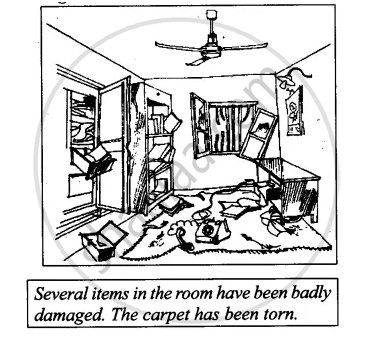
Inspector Narayan has been called to investigate a burglary. When he arrives, there is total chaos in the room. He makes notes about what has been damaged. You are Inspector Narayan. Look at the picture and complete the description, using the Present Perfect Passive.
संक्षेप में उत्तर
Advertisements

उत्तर

Several items in the room have been badly damaged. The carpet has been torn and spoiled. Books have been thrown here and there. The window has been smashed and its bars broken and twisted. The almirah has been broken into and searched. The telephone has been broken and its cable cut. A table has been broken. Drawers (of the table) have been pulled out and searched. Some money has been stolen.

shaalaa.com
Writing and Grammar
  क्या इस प्रश्न या उत्तर में कोई त्रुटि है?
अध्याय 6.1: The Passive - Exercises [पृष्ठ ८३]

APPEARS IN

सीबीएसई English Workbook [English] Class 9
अध्याय 6.1 The Passive
Exercises | Q 11 | पृष्ठ ८३

संबंधित प्रश्न

Listen to a speech by the honourable former President of India, Dr APJ Abdul Kalam, on his 'Vision for India'. While listening, fill up the following details. 

a . The following countries captured our lands and conquered our minds. 

-----------------------------------------------------------------------------------------------------------------------

b . His first vision had been that of ---------------

c . His second vision was -----------------------

d . The three scientists who worked with him at ISRO were -------------------------------------------

e . India leads in --------------------------- and is the second largest producer of ----------------------


Answer the following question briefly.

Describe the two roads that the poet comes across.


Answer the following question briefly.

 Does the speaker seem happy about his decision?


What according to you are the stages of a person's life? What characteristics
would you associate with each stage? (e.g., childhood: innocence, joy


Answer the following question.

Why did the poet go to the dentist? How could she have avoided it?


Read the following extract and answer the questions that follow by choosing the
correct options.

Monseigneur, the Bishop is a ... a-hem!


(a) Why does Persome not complete the sentence?
(i) she used to stammer while speaking.
(ii) she was about to praise the Bishop.
(iii) she did not wish to criticise the Bishop in front of Marie.
(iv) she had a habit of passing such remarks.


(b) Why is she angry with the Bishop?
(i) the Bishop has sold the salt-cellars.
(ii) the Bishop has gone to visit Mere Gringoire.
(iii) he showed extra concern for Marie.
(iv) she disliked the Bishop.


Read the following extract and answer the questions that follow by choosing the
correct options.

I offered to take her in here for a day or two, but she seemed to think it might distress
you.
(a) The Bishop wanted to take Mere Grngoire in because _________.
(i) she was sick.
(ii) she had no money.
(iii) she was unable to pay the rent of her house.
(iv) she was a close friend of Persome.

(b) Persome would be distressed on Mere Gringoire's being taken in because
________
(i) she did not want to help anyone.
(ii) she felt that Mere Gringoire was taking undue advantage of the Bishop.
(iii) she was a self-centred person.
(iv) she would be put to a great deal of inconvenience.


The Convict goes to Paris, sells the silver candlesticks and starts a business. The
business prospers and he starts a reformatory for ex-convicts. He writes a letter to the
Bishop telling him of this reformatory and seeks his blessings.
As the convict, Jean Valjean, write the letter to the Bishop.


Imagine that you are one of the boys, and that the map on the next page is of the island on which you have landed. Your most urgent task is to decide where to live. Work in groups of four; decide where to set up camp, and the materials you will use. Be prepared to justify your choices to the rest of the class. 


Answer the following question by ticking the correct option :
What was the tiger's counter-argument? 


Look at sentences in Column A. Match them with the appropriate explanation in Column B.

A B
1. Next Friday is the
29th of May.
a. emphasizing that something
will happen very soon
2. I’ll have left by the
time you get here.
b. making a promise
3. I’m visiting my
uncle on Sunday.
c. predicting that some­thing
will be true at a given time in the future
4. I’ll send the photo­graphs
as soon as I can.
d. stating something
which is a certainty
5. The lesson is about
to start… hurry!
e. reporting a decision
made earlier
6. The population of
our country will increase
in the next ten years.
f. making a prediction
about future events

Future Perfect and Future Continuous

Look at the following sentences.

Match words from the different columns to make reasonable predictions. Then write them down in the space below. One has been done as an example.


Is there enough variety of content?


Look at the following pair of sentences. Underline the modals and discuss why each one is used in that sentence.

e.g.
I must not take those pills. (I’m not allowed.)
I need not take those pills. (It is not compulsory but I may if I wish.)

1. (a) I can’t go to the meeting because I’m not a member.
(b) I needn’t go to the meeting if I don’t wish to.

2. (a) I can swim a length of the pool.
(b) I can swim in the pool on Saturdays.

3. (a) You ought to get a nice present for her.
(b) You have to get a nice present for her.

4. (a) Can I go to the toilet?
(b) May I be excused?

5. (a) I may come tomorrow if I have the time.
(b) I might come tomorrow but it’s going to be difficult.

Did you know?
Modals are a small group of verbs that are used to express possibility,
probability, capability, capacity, ability, obligation and predictions.
Some of the modals you learnt in this unit are
can
may
shall
could
might
should
Need, dare, had better are also modals.

Understanding Modals:
Modal Auxiliaries
A modal verb or auxiliary verb is a verb, which modifies another verb, so that
the modified verb has more intention in its expression. In essence the modal
verb expresses modality, the way in which something is being said.
The main modals are
Can: could; may: might; shall: should; will: would: must; ought to; need to;
have to.
The negative modals are
Couldn't; wouldn't; shouldn't; mustn't; needn't; oughtn't/ ought not to

Modal Examples Uses
Can/ can't

She can read and write

It can rain today

Can I borrow your pen?

Can you lend me your notes?

Can I carry your books?

ability

possibility /probability

seeking permission

request

offer

Could/ couldn't

Could I borrow your book?

Could you please help me with  this sum?

We could go for a picnic on Sunday

I think you could come first this time 

There was a time when I could  work round the clock.

seeking permission

request

suggestion

possibility/ probability

past ability

May

May I have some water?

May I help you?

May I shut the door?

India may become a super power by 2020.

May God bless you

request

offer

permission

possibility/ probability

wish/ desire

Might They might sell their house as they need the money. future possibility/ probability
Will /Won't

It is very cold so I will stay at home.

I will help you if you wish.

Will you look after my dog for a day?

It will rain tonight.

I will get you a shawl from Srinagar.

intention

offer

request

prediction

promise

Would/Wouldn't

Would you mind if I come over tonight?

Would five o'clock suit you?

Yes it would.

Would you pass the salt?

Would you come to my party?

Would you prefer tea or coffee?

permission

making arrangements

request

invitation

preference


Shall

Shall I help you?

Shall we meet at 3.00 pm outside Bakshi Stadium?

offer

making arrangements

Should

We should check the timings of the train.

You should listen to the advice of your elders.

recommended action

advice

Ought to

You ought to do your duty.

The bus ought to be here any minute

advice

probability

Must/mustn't

We must make a move now.

You mustn't tell lies.

obligation

necessity

Need

He need not go to the market.

You need to lose weight.

I need to get the groceries.

necessity

compulsion

insistence


Answer the following question by ticking the correct option. 

The Manor House stood out because of its _______________


Answer the following question by ticking the correct option. 

John Douglas had won quite a reputation for himself in Birlstone because of his __________________


At a party, Gautam met a friend (Ravi) who talked about his experiences in staging a play.

Read the dialogue.

Gautam : It’s quite some time since we met. I guess it’s because you’ve been busy as usual.
Ravi : Yes, I’ve been directing a play – Tagore’s Chandalika. Did you hear about it?
Gautam : Yes, I heard it was a great hit. In fact, I was planning to get in touch with you to ask for your help, to put on a play for our Annual Open Day. How did you go about staging your play?
Ravi : Well …. First, we chose three possible plays, and divided ourselves into reading groups. Then we exchanged views and arrived at a decision.
Gautam : What was your next step?
Ravi : Casting, of course. Once we’d got the script ready, we selected the cast.
Gautam : And then?
Ravi : We held auditions for the main parts and then made a preliminary selection. Eventually we were able to make a final choice and assign the roles.
Gautam : How did you plan your rehearsals?
Ravi : We met for a couple of hours every evening. As the play took shape, we held longer and more intensive rehearsals.
Gautam : Who else was involved in the production?
Ravi : The stage crew and the technicians. But they didn’t come in until we were out of the initial phase.


(The conversation continues.)
Gautam decides to make a written record of how Ravi produced a play in order to try it too.

Write this record, using the passive where appropriate. The first few words have been provided for you.

Three possible plays were selected and Ravi’s friends were divided ………..
________________________________________________

Class discussion 
• Is a biography written in a particular order of events? 
• Which is the most common tense? 


Use the adjectives and prepositions from the box above to fill in the gaps below. Add eight sentences of your own.

  1. Mary is bad ________ Maths.
  2. Fruit is good ________ you.
  3. Ram was married ________ Beena for 10 years. They were very happy.
  4. This tool is more ________ planing wood.
  5. What good news! I’m so ________ you.
  6. He’s ________ her; she looks ill.
  7. She’s ashamed ________ her bad behaviour.
  8. They are fond ________ dancing.
  9. He was absent ________ the Science Club yesterday.
  10. He is sensitive ________ criticism.

Share
Notifications

Englishहिंदीमराठी


      Forgot password?
Use app×