Advertisements
Advertisements
प्रश्न
A steam engine delivers 5.4×10⁸ J of work per minute and services 3.6 × 10⁹ J of heat per minute from its boiler. What is the efficiency of the engine? How much heat is wasted per minute?
Advertisements
उत्तर १
Work done perminute, output =` 5.4 xx 10^8 J`
Heat absorbed per minute, input = `3.6 xx 10^9 J`
Efficiency, = eta = "output"/"input" = (5.4 xx 10^8)/(3.6 xx 10^9) = 0.15
`%eta = 0.15 xx 100 = 15`
Heat energy wasted /minute
= Heat energy absorbed / minute - Useful work done / minute
`= 3.6 xx 10^9 - 5.4 xx 10^8`
`= (3.6 - 0.54) xx 10^9 = 3.06 xx10^9 J`
उत्तर २
Work done by the steam engine per minute, W = 5.4 × 10⁸ J
Heat supplied from the boiler, H = 3.6 × 10⁹ J
Efficiency of the engine = `"Output energy"/"Inut energy"`
`:.eta = W/H = (5.4 xx 10^8)/(3.6 xx 10^9) = 0.15`
Hence, the percentage efficiency of the engine is 15 %.
Amount of heat wasted = 3.6 × 10⁹ – 5.4 × 108
= 30.6 × 108 = 3.06 × 10⁹ J
Therefore, the amount of heat wasted per minute is 3.06 × 10⁹ J.
APPEARS IN
संबंधित प्रश्न
Explain why Two bodies at different temperatures T1 and T2, if brought in thermal contact, do not necessarily settle to the mean temperature (T1 + T2)/2.
Explain why Air pressure in a car tyre increases during driving.
In changing the state of a gas adiabatically from an equilibrium state A to another equilibrium state B, an amount of work equal to 22.3 J is done on the system. If the gas is taken from state A to B via a process in which the net heat absorbed by the system is 9.35 cal, how much is the net work done by the system in the latter case? (Take 1 cal = 4.19 J)
A force F is applied on a block of mass M. The block is displaced through a distance d in the direction of the force. What is the work done by the force on the block? Does the internal energy change because of this work?
The outer surface of a cylinder containing a gas is rubbed vigorously by a polishing machine. The cylinder and its gas become warm. Is the energy transferred to the gas heat or work?
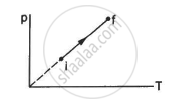
An ideal gas goes from the state i to the state f as shown in figure. The work done by the gas during the process ______________ .
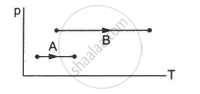
Consider two processes on a system as shown in figure.
The volumes in the initial states are the same in the two processes and the volumes in the final states are also the same. Let ∆W1 and ∆W2 be the work done by the system in the processes A and B respectively.
A gas is contained in a metallic cylinder fitted with a piston. The piston is suddenly moved in to compress the gas and is maintained at this position. As time passes the pressure of the gas in the cylinder ______________ .
A mixture of fuel and oxygen is burned in a constant-volume chamber surrounded by a water bath. It was noticed that the temperature of water is increased during the process. Treating the mixture of fuel and oxygen as the system,
- Has heat been transferred?
- Has work been done?
- What is the sign of ∆U?
What is the internal energy of the system, when the amount of heat Q is added to the system and the system does not do any work during the process?
Explain given cases related to energy transfer between the system and surrounding –
- energy transferred (Q) > 0
- energy transferred (Q) < 0
- energy transferred (Q) = 0
When 1 g of water at 0° C and 1 x 10⁵ N/m2 pressure is converted into ice of volume 1.082 cm3, the external work done will be ____________.
Two cylinders A and B of equal capacity are connected to each other via a stopcock. A contains a gas at standard temperature and pressure. B is completely evacuated. The entire system is thermally insulated. The stopcock is suddenly opened. Answer the following:
What is the change in internal energy of the gas?
In thermodynamics, heat and work are ______.
The internal energy of one mole of argon is ______.
The internal energy of one mole of argon at 300 K is ______. (R = 8.314 J/mol.K)
What is heat?
Explain the change in internal energy of a thermodynamic system (the gas) by heating it.
