Advertisements
Advertisements
प्रश्न
A gas is initially at a pressure of 100 kPa and its volume is 2.0 m3. Its pressure is kept constant and the volume is changed from 2.0 m3 to 2.5 m3. Its Volume is now kept constant and the pressure is increased from 100 kPa to 200 kPa. The gas is brought back to its initial state, the pressure varying linearly with its volume. (a) Whether the heat is supplied to or extracted from the gas in the complete cycle? (b) How much heat was supplied or extracted?
Advertisements
उत्तर
(a) Given:-
P1 = 100 kPa,
V1 = 2 m3
V2 = 2.5 m3
∆V = 0.5 m3
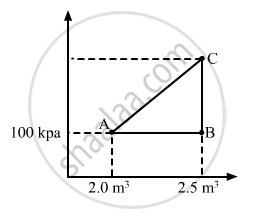
Work done, W = P∆V
\[W = 100 \times {10}^3 \times 0 . 5\]
\[W = 5 \times {10}^4 J\]
WAB = Area under line AB = 5 × 10⁴ J
If volume is kept constant for line BC, then ∆V = 0.
WBC = P∆V = 0
Work done while going from point B to C = 0
When the system comes back to the initial point A from C, work done is equal to area under line AC.
WCA = Area of triangle ABC + Area of rectangle under line AB
Total work done, W = Area enclosed by the ABCA
W = WAC - WAB
From the graph, we see that the area under AC is greater than the area under AB. We also see that heat is extracted from the system as change in the internal energy is zero.
(b) Amount of heat extracted = Area enclosed under ABCA
\[= \frac{1}{2} \times 0 . 5 \times 100 \times {10}^3 = 25000 J\]
APPEARS IN
संबंधित प्रश्न
In changing the state of a gas adiabatically from an equilibrium state A to another equilibrium state B, an amount of work equal to 22.3 J is done on the system. If the gas is taken from state A to B via a process in which the net heat absorbed by the system is 9.35 cal, how much is the net work done by the system in the latter case? (Take 1 cal = 4.19 J)
A cylinder containing a gas is lifted from the first floor to the second floor. What is the amount of work done on the gas? What is the amount of work done by the gas? Is the internal energy of the gas increased? Is the temperature of the gas increased?
The final volume of a system is equal to the initial volume in a certain process. Is the work done by the system necessarily zero? Is it necessarily nonzero?
Consider the following two statements.
(A) If heat is added to a system, its temperature must increase.
(B) If positive work is done by a system in a thermodynamic process, its volume must increase.
The pressure p and volume V of an ideal gas both increase in a process.
(a) Such a process is not possible.
(b) The work done by the system is positive.
(c) The temperature of the system must increase.
(d) Heat supplied to the gas is equal to the change in internal energy.
Figure shows three paths through which a gas can be taken from the state A to the state B. Calculate the work done by the gas in each of the three paths.
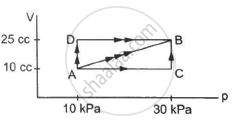
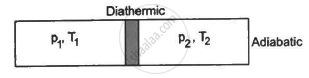
Figure shows a cylindrical tube of volume V with adiabatic walls containing an ideal gas. The internal energy of this ideal gas is given by 1.5 nRT. The tube is divided into two equal parts by a fixed diathermic wall. Initially, the pressure and the temperature are p1, T1 on the left and p2, T2 on the right. The system is left for sufficient time so that the temperature becomes equal on the two sides. (a) How much work has been done by the gas on the left part? (b) Find the final pressures on the two sides. (c) Find the final equilibrium temperature. (d) How much heat has flown from the gas on the right to the gas on the left?
A system releases 130 kJ of heat while 109 kJ of work is done on the system. Calculate the change in internal energy.
Which of the following is correct, when the energy is transferred to a system from its environment?
A system releases 100 kJ of heat while 80 kJ of work is done on the system. Calculate the change in internal energy.
An ideal gas is compressed at a constant temperature. Its internal energy will ____________.
8 m3 of a gas is heated at the pressure 105 N/m2 until its volume increases by 10%. Then, the external work done by the gas is ____________.
When 1 g of water at 0° C and 1 x 10⁵ N/m2 pressure is converted into ice of volume 1.082 cm3, the external work done will be ____________.
Two samples A and B, of a gas at the same initial temperature and pressure are compressed from volume V to V/2; A isothermally and B adiabatically. The final pressure of A will be ______.
If a gas is compressed adiabatically:
The internal energy of one mole of argon is ______.
A steam engine delivers 4.8 x 10⁸ Jof work per minute and services 1.2 x 10⁹ J of heat per minute from its boiler. What is the percentage efficiency of the engine?
