Advertisements
Advertisements
प्रश्न
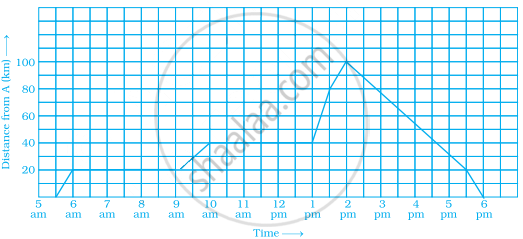
A man started his journey on his car from location A and came back. The given graph shows his position at different times during the whole journey.
- At what time did he start and end his journey?
- What was the total duration of journey?
- Which journey, forward or return, was of longer duration?
- For how many hours did he not move?
- At what time did he have the fastest speed?
Advertisements
उत्तर
Analysing the graph carefully, we observe that
- He started his journey at 5:30 AM and end at 6 PM.
- Total duration of journey was 12:30 h.
- His forward journey is of duration 8:30 h and return journey is of duration 4 h. Forward journey was of longer duration.
- He did not move from 6:30 AM to 9:30 AM and 10 AM to 1 PM. So, he did not move for 6 h.
- He have the fastest speed at 1 PM.
APPEARS IN
संबंधित प्रश्न
Locate the points:
(2, 1), (2, 2), (2, 3), (2, 4)
Decide which of the following statements is true and which is false. Give reasons for your answer.
A point whose y-coordinate is zero, will lie on x-axis.
Decide which of the following statements is true and which is false. Give reasons for your answer.
Points whose x and y coordinates are equal, lie on a line passing through the origin.
The point (3, 4) is at a distance of ______.
A point in which the x-coordinate is zero and y-coordinate is non-zero will lie on the ______.
The points (3, 5) and (5, 3) represent the same point.
Plot the given points on a graph sheet and check if the points lie on a straight line. If not, name the shape they form when joined in the given order.
(1, 2), (2, 4), (3, 6), (4, 8)
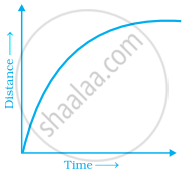
Explain the situations represented by the following distance-time graph.
The following is the time-distance graph of Sneha’s walking.
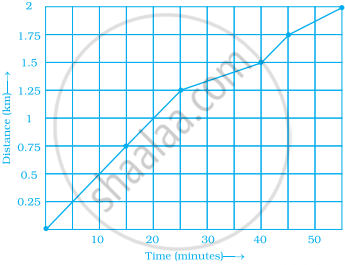
- When does Sneha make the least progress? Explain your reasoning.
- Find her average speed in km/hour.
The two graphs below compare Car A and Car B. The left graph shows the relationship between age and value. The right graph shows the relationship between size and maximum speed.
 |
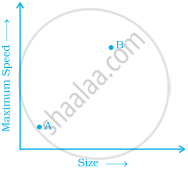 |
Use the graphs to determine whether each statement is true or false, and explain your answer.
- The older car is less valuable.
- The faster car is larger.
- The larger car is older.
- The faster car is older.
- The more valuable car is slower.
