Advertisements
Advertisements
प्रश्न
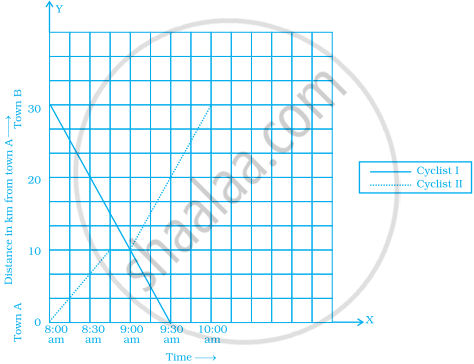
The following graph shows the journey made by two cyclists, one from town A to B and the other from town B to A.
- At what time did cyclist II rest? How long did the cyclist rest?
- Was cyclist II cycling faster or slower after the rest?
- At what time did the two cyclists meet?
- How far had cyclist II travelled when he met cyclist I?
- When cyclist II reached town A, how far was cyclist I from town B?
Advertisements
उत्तर
- On the basis of given graph, the cyclist II rest at 8:45 am for 15 min.
- Cyclist II is cycling faster after rest as he has covered a distance of 20 km in 1 h.
- Both cyclists meet at 9:00 am.
- The cyclist II had travelled 20 km, when he met cyclist I.
- When cyclist II reached town A, the cyclist I was 10 km for from town B.
APPEARS IN
संबंधित प्रश्न
State whether True or False. Correct those are false.
A point whose x coordinate is zero and y-coordinate is non-zero will lie on the y-axis.
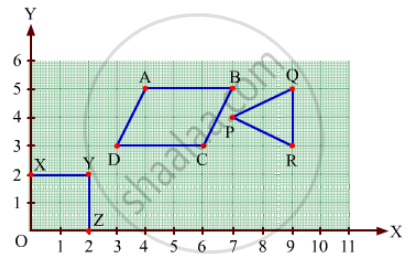
Write the coordinates of each of the vertices of each polygon in Fig. 27.9.
Decide which of the following statements is true and which is false. Give reasons for your answer.
A point whose y-coordinate is zero, will lie on x-axis.
Decide which of the following statements is true and which is false. Give reasons for your answer.
Points whose x and y coordinates are equal, lie on a line passing through the origin.
All points with y-coordinate as zero lie on the ______.
The x-coordinate of any point lying on the y-axis will be ______.
If y-coordinate is 3 times x-coordinate, form a table for it and draw a graph.
Explain the situations represented by the following distance-time graph.

The following table gives the growth chart of a child.
| Height (in cm) | 75 | 90 | 110 | 120 | 130 |
| Age (in years) | 2 | 4 | 6 | 8 | 10 |
Draw a line graph for the table and answer the questions that follow.
- What is the height at the age of 5 years?
- How much taller was the child at the age of 10 than at the age of 6?
- Between which two consecutive periods did the child grow more faster?
Observe the toothpick pattern given below:
(a) Imagine that this pattern continues. Complete the table to show the number of toothpicks in the first six terms.
| Pattern | 1 | 2 | 3 | 4 | 5 | 6 |
| Toothpicks | 4 | 13 |
(b) Make a graph by taking the pattern numbers on the horizontal axis and the number of toothpicks on the vertical axis. Make the horizontal axis from 0 to 10 and the vertical axis from 0 to 30.
(c) Use your graph to predict the number of toothpicks in patterns 7 and 8. Check your answers by actually drawing them.
(d) Would it make sense to join the points on this graph? Explain.
