Advertisements
Advertisements
प्रश्न
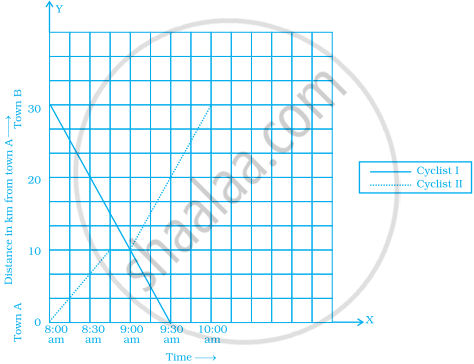
The following graph shows the journey made by two cyclists, one from town A to B and the other from town B to A.
- At what time did cyclist II rest? How long did the cyclist rest?
- Was cyclist II cycling faster or slower after the rest?
- At what time did the two cyclists meet?
- How far had cyclist II travelled when he met cyclist I?
- When cyclist II reached town A, how far was cyclist I from town B?
Advertisements
उत्तर
- On the basis of given graph, the cyclist II rest at 8:45 am for 15 min.
- Cyclist II is cycling faster after rest as he has covered a distance of 20 km in 1 h.
- Both cyclists meet at 9:00 am.
- The cyclist II had travelled 20 km, when he met cyclist I.
- When cyclist II reached town A, the cyclist I was 10 km for from town B.
APPEARS IN
संबंधित प्रश्न
Locate the points:
(2, 1), (2, 2), (2, 3), (2, 4)
Locate the points:
(1, 3), (2, 3), (3, 3), (4, 3)
The following table shows the amount of rice grown by a farmer in different years:
| Years: | 2000 | 2001 | 2002 | 2003 | 2004 | 2005 | 2006 |
| Rice grown (in quintals): | 200 | 180 | 240 | 260 | 250 | 200 | 270 |
Plot a graph to illustrate this information.
In the point (4, 7), 4 denotes the ______.
The y-coordinate of any point lying on the x-axis will be zero.
Write the x-coordinate (abscissa) of the given point.
(0, 5)
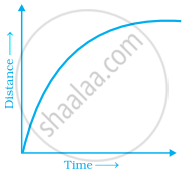
Explain the situations represented by the following distance-time graph.
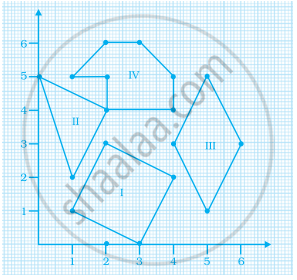
Find the coordinates of the vertices of the given figures.
Locate the points A(1, 2), B(4, 2) and C(1, 4) on a graph sheet taking suitable axes. Write the coordinates of the fourth point D to complete the rectangle ABCD.
The graph given below compares the price (in Rs) and weight of 6 bags (in kg) of sugar of different brands A, B, C, D, E, F.
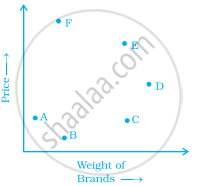
- Which brand(s) costs/cost more than Brand D?
- Bag of which brand of sugar is the heaviest?
- Which brands weigh the same?
- Which brands are heavier than brand B?
- Which bag is the lightest?
- Which bags are of the same price?
