Advertisements
Advertisements
प्रश्न
A point which lies on both the axis is ______.
पर्याय
(0, 0)
(0, 1)
(1, 0)
(1, 1)
Advertisements
उत्तर
A point which lies on both the axis is (0, 0).
Explanation:
We know that, the axes are two mutually perpendicular lines intersecting each other at the point (0, 0) also known as the origin.
Hence, the point which lies on both the axes is (0, 0).
APPEARS IN
संबंधित प्रश्न
Draw the line passing through (2, 3) and (3, 2). Find the coordinates of the points at which this line meets the x-axis and y-axis.
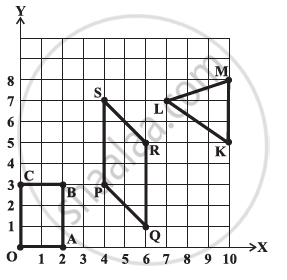
Write the coordinates of the vertices of each of these adjoining figures.
Decide which of the following statements is true and which is false. Give reasons for your answer.
Points whose x and y coordinates are equal, lie on a line passing through the origin.
The coordinates of a point at a distance of 3 units from the x axis and 6 units from the y axis is ______.
______ displays data that changes continuously over periods of time.
All points with y-coordinate as zero lie on the ______.
The coordinates of the origin are (0, 0).
The following is the time-distance graph of Sneha’s walking.
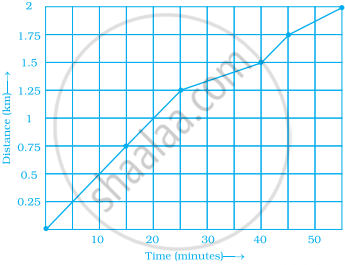
- When does Sneha make the least progress? Explain your reasoning.
- Find her average speed in km/hour.
The points on the graph below represent the height and weight of the donkey, dog, crocodile, and ostrich shown in the drawing.
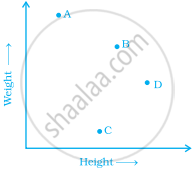
- What are the two variables represented in the graph?
- Which point represents each animals? Explain.
