Topics
Sets and Relations
- Concept of Relations
- Representation of a Set
- Intervals
- Classification of Sets
- Relations of Sets
Functions
- Concept of Function
- Types of Functions
- Representation of Function
- Representation of Function
- Fundamental Functions
- Algebra of Functions
- Composite Function
- Inverse Functions
- Some Special Functions
Complex Numbers 33
- Introduction of Complex Number
- Imaginary Number
- Concept of Complex Numbers
- Conjugate of a Complex Number
- Algebraic Operations of Complex Numbers
- Square Root of a Complex Number
- Solution of a Quadratic Equation in Complex Number System
- Cube Root of Unity
Sequences and Series
- Sequence, Series, and Progression
- Geometric Progression (G. P.)
- General Term Or the nth Term of a G.P.
- Sum to' n' Terms of a Geometric Progression
- Sum to' n' Terms of a Geometric Progression
- Recurring Decimals
- Harmonic Progression (H. P.)
- Types of Means
- Special Series (Sigma Notation)
Locus and Straight Line
- Locus
- Line
- Equations of Lines in Different Forms
- Equations of Line in Different Forms
Determinants
- Concept of Determinant
- Properties of Determinants
- Application of Determinants to Coordinate Geometry
- Methods of Solving Linear Equations in Two Variables > Determinant method (Cramer’s Rule)
- Consistency of Three Linear Equations in Two Variables
- Application of Determinants to Coordinate Geometry
- Collinearity of Three Points
Limits
- Definition of Limit of a Function
- Algebra of Limits
- Evaluation of Limits
- Direct Method
- Methods to Find Limit of Rational Function>Factorization Method
- Methods to Find Limit of Rational Function> Rationalization Method
- Limits of Exponential and Logarithmic Functions
Continuity
- Continuous and Discontinuous Functions
- Examples of Continuous Functions Whereever They Are Defined
Differentiation
- The Meaning of Rate of Change
- Concept of Differentiability
- Derivative by the Method of First Principle
- Rules of Differentiation (Without Proof)
- Applications of Derivatives
Partition Values
- Partition Values
- Deciles
- Percentiles
- Relations Among Quartiles, Deciles and Percentiles
- Graphical Location of Partition Values
Measures of Dispersion
- Measures of Dispersion
- Quartiles and Range in Statistics
- Measures of Dispersion > Variance and Standard Deviation
- Standard Deviation for Combined Data
- Coefficient of Variation
Skewness
- Skewness
- Asymmetric Distribution (Positive Skewness)
- Asymmetric (Negative Skewness)
- Measures of Skewness
- Karl Pearson’S Coefficient of Skewness (Pearsonian Coefficient of Skewness)
- Features of Pearsonian Coefficient
- Bowley’s Coefficient of Skewness
Bivariate Frequency Distribution and Chi Square Statistic
- Bivariate Frequency Distribution
- Classification and Tabulation of Bivariate Data
- Marginal Frequency Distributions
- Conditional Frequency Distributions
- Categorical Variables
- Contingency Table
- Chi-Square Statistic ( χ2 )
Correlation
- Correlation
- Concept of Covariance
- Properties of Covariance
- Concept of Correlation Coefficient
- Scatter Diagram
- Interpretation of Value of Correlation Coefficient
Permutations and Combinations
- Fundamental Principles of Counting
- Concept of Addition Principle
- Concept of Multiplication Principle
- Concept of Factorial Function
- Permutations
- Circular Permutations
- Combination
Probability
Linear Inequations
Commercial Mathematics
- Percentage
- Profit and Loss
- Simple and Compound Interest (Entrance Exam)
- Concept of Depreciation
- Partnership
- Shares
Notes
We know that a line divides the Cartesian plane into two parts. Each part is known as a half plane. A vertical line will divide the plane in left and right half planes and a non-vertical line will divide the plane into lower and upper half planes Fig.
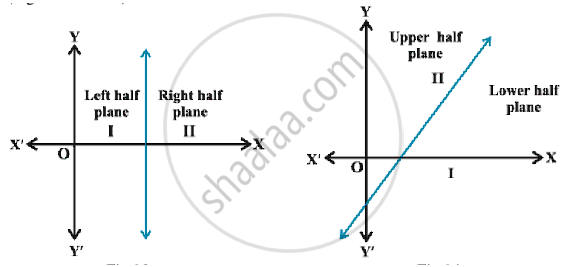
A point in the Cartesian plane will either lie on a line or will lie in either of the half planes I or II. We shall now examine the relationship, if any, of the points in the plane and the inequalities ax + by < c or ax + by > c.
Let us consider the line
ax + by = c, a ≠ 0, b ≠ 0 ... (1)
There are three possibilities namely:
(i) ax + by = c (ii) ax + by > c (iii) ax + by < c.
In case (i), clearly, all points (x, y) satisfying (i) lie on the line it represents and conversely. Consider case (ii), let us first assume that b > 0. Consider a point P (α,β) on the line ax + by = c, b > 0, so that aα + bβ = c.Take an arbitrary point Q (α , γ) in the half plane II . fig
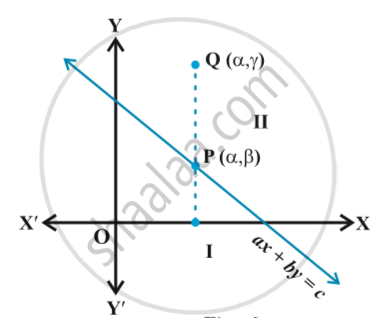
Now , we interpret, γ > β (Why?)
or bγ > bβ or aα + b γ > aα + bβ (Why?)
or aα + b γ > c i.e., Q(α,γ ) satisfies the inequality ax + by > c.
Thus, all the points lying in the half plane II above the line ax + by = c satisfies the inequality ax + by > c. Conversely, let (α, β) be a point on line ax + by = c and an arbitrary point Q(α, γ) satisfying
ax + by > c
so that aα + bγ > c
⇒ aα + b γ > aα + bβ (Why?)
⇒ γ > β (as b > 0)
This means that the point (α, γ) lies in the half plane II.
Thus, any point in the half plane II satisfies ax + by > c, and conversely any point satisfying the inequality ax + by > c lies in half plane II.
In case b < 0, we can similarly prove that any point satisfying ax + by > c lies in the half plane I, and conversely.
Hence, we deduce that all points satisfying ax + by > c lies in one of the half planes II or I according as b > 0 or b < 0, and conversely.
Thus, graph of the inequality ax + by > c will be one of the half plane (called solution region) and represented by shading in the corresponding half plane.