Topics
Number System
Integers
- Integers
- Multiplication and Division of Integers
- Properties of Operations on Integers
- Concept for Commutativity, Associativity, Existence of Identity
- Inverse and Distributivity
- Problem Solving Using Operations on Integers
- Statement Problems on Integers Using All Fundamental Operations.
Commercial Arithmetic
Rational Numbers
- Rational Numbers
- Word Problems on Rational Numbers (All Operations)
- Decimal Representation of Rational Numbers
- Concept for Problem Solving Using Operations on Rational Numbers
- The Decimal Number System
Algebra
Fractions (Including Problems)
Decimal Fractions (Decimals)
Geometry
Exponents (Including Laws of Exponents)
- Concept of Exponents
- Concept for Exponents Only Natural Numbers.
- Laws of Exponents (Through Observing Patterns to Arrive at Generalisation.)
- Concept for Application of Laws of Exponents in Simple Daily Life Problems
Data Handling (Statistics)
Set Concepts
Ratio and Proportion (Including Sharing in a Ratio)
Unitary Method (Including Time and Work)
Percent and Percentage
Profit, Loss and Discount
- Concept of Discount
- Concept for Application to Profit and Loss (Single Transaction Only)
Simple Interest
Speed, Distance and Time
Fundamental Concepts (Including Fundamental Operations)
- Fundamental Concepts
- Terms, Factors and Coefficients of Expression
- Algebraic Expressions
- Performs Operations (Addition and Subtraction) on Algebraic Expressions with Integral Coefficients Only.
Simple Linear Equations (Including Word Problems)
- Word Problems on Linear Equations
- Concept for Inequalities
- Concept for Solution of Simple Inequalities in One Variable
Inequalities
Lines and Angles (Including Construction of Angles)
- Introduction to Lines and Angles
- Concept of Pairs of Angles
- Parallel Lines
- Construction of a Line Parallel to a Given Line from a Point Outside It .
Triangles
- Basic Concepts of Triangles
- Concept for Angle Sum Property
- Concept for Exterior Angle Property
- Concept for Construction of Simple Triangles.
Pythagoras Theorem
Symmetry (Including Reflection and Rotation)
Recognition of Solids (Representing 3-d in 2-d)
- Concept of Recognition of Solids
- Faces, Edges and Vertices of Polyhedron
- Concept for Mapping the Space Around Approximately Through Visual Estimation.
Congruency: Congruent Triangles
- Congruence of Triangles
- Concept for Congruence Through Superimposition
- Extend Congruence to Simple Geometrical Shapes E.G. Triangles, Circles.
- Criteria for Congruence of Triangles
Constructions
Mensuration
- Basic Concepts in Mensuration
- Concept of Perimeter
- Circumference of a Circle
- Concept of Area
- Concept of Measurement Using a Basic Unit Area of a Square, Rectangle, Triangle, Parallelogram and Circle, Rings and Combined Figures.
Data Handling
Probability
- Concept of Probability
- Concept for Feel of Probability Using Data Through Experiments.
- Concept for Notion of Chance
- Concept for Tabulating and Counting Occurrences
- Comparing the Observation with that for a Coin. Observing Strings of Throws, Notion of Randomness.
Notes
Decimal Representation of Rational Numbers:
1) Write the rational number `7/4` in decimal form.
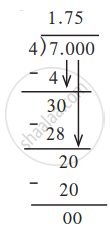
(1) 7 = 7.0 = 7.000 (Any number of zeros can be added after the fractional part.)
(2) 1 is the quotient and 3 the remainder after dividing 7 by 4. Now we place a decimal point after the integer 1. Writing the 0 from the dividend after the remainder 3, we divide 30 by 4. As the quotient, we get now is fractional, we write 7 after the decimal point. Again we bring down the next 0 from the dividend and complete the division.
2) Write `2 1/5` in decimal form.
We shall find the decimal form of `2 1/5 = 11/5` in three different ways.
Find the decimal form of `1/5`.
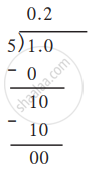
∴ `1/5` = 0.2
3) Write the number `2/11` in decimal form.
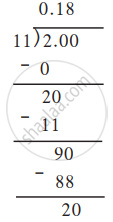
∴ `2/11` = 0.1818.......
`2/11 = 0.bar18`
4) Work out the decimal form of `5/6`.
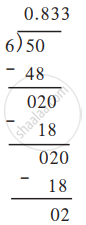
`5/6` = 0.833...
`∴ 5/6 = 0.8dot3`
Here, a single digit or a group of digits occurs repeatedly on the right of the decimal point. This type of decimal form of a rational number is called the recurring decimal form.
If in a decimal fraction, a single-digit occurs repeatedly on the right of the decimal the point, we put a point above it as shown here. `5/6 = 0.8dot3` and if a group of digits occurs repeatedly, we show it with a horizontal line above the digits. Thus, `2/11 = 0.bar18`.
