A cooperative society is a voluntary group of people with common needs who work together, much like a club, to support each other in buying, selling, or obtaining loans, with a focus on service rather than profit.
Topics
Introduction of Commerce and Business
Trade
- Concept of Trade
- Internal Trade
- Wholesale Trade
- Retail Trade
- Types of Retailers> Itinerant Retailers
- Types of Retailers> Fixed Shop Retailer
- Small Scale Fixed Retailer
- Large Scale Fixed Retailers
- Departmental Stores
- Super Market Shop
- Chain Stores or Multiple Shops
- One Price Shop
- Concept of Mall
- International Trade
- Export Trade
- Procedure of Export Trade
- Import Trade
- Procedure of Import Trade
- Entrepot Trade
- Comparison of Different Types of Retailers and Trade Practices
Small Scale Industry and Business
Forms of Business Organisation - 1
- Private Sector Organisations
- Sole Trading Concern
- Partnership Firm
- Types of Partners
- Types of Partnerships Firms
- Hindu Undivided Family Business Or Joint Hindu Family Business
- Co-operative Society
- Types of Cooperative Societies
- Joint Stock Company
- Amul: A Successful Co-operative Movement in India
- Private Limited Company
- Public Limited Company
- Comparison of Different Forms of Business Organization
Forms of Business Organisation - 2
Institutes Supporting Business
Business Environment
- Concept of Business Environment
- Importance of Business Environment
- Dimensions of Business Environment
- Internal Factors
- External Factors> Natural Environment
- External Factors> Social Environment
- External Factors> Political Environment
- External Factors> Economic Environment
- External Factors> Technological Environment
- External Factors> Legal Environment
- New Economic Policy and Business
- Liberalisation
- Privatisation
- Globalisation
- Impact of New Economic Policy on Business
Introduction to Management
- Introduction
- Definition: Co-operative Society
- Features
- Merits
- Demerits
- Real-Life Application
- Key Point Summary
Maharashtra State Board: Class 11
Introduction
Maharashtra State Board: Class 11
Definition: Co-operative Society
- According to The International Labour Organisation:
‘‘A cooperative organisation is an association of persons, usually of limited means, who have voluntarily joined together to achieve a common economic end through the formation of a democratically controlled organisation, making equitable distributions to the capital required and accepting a fair share of risk and benefits of the undertaking.’’ - According to the Indian Co-operative Society’s Act, 1912:
‘‘Co-operative Society is a society which has its objectives for the promotion of economic interest of its members in accordance with cooperative principles’’.
Maharashtra State Board: Class 11
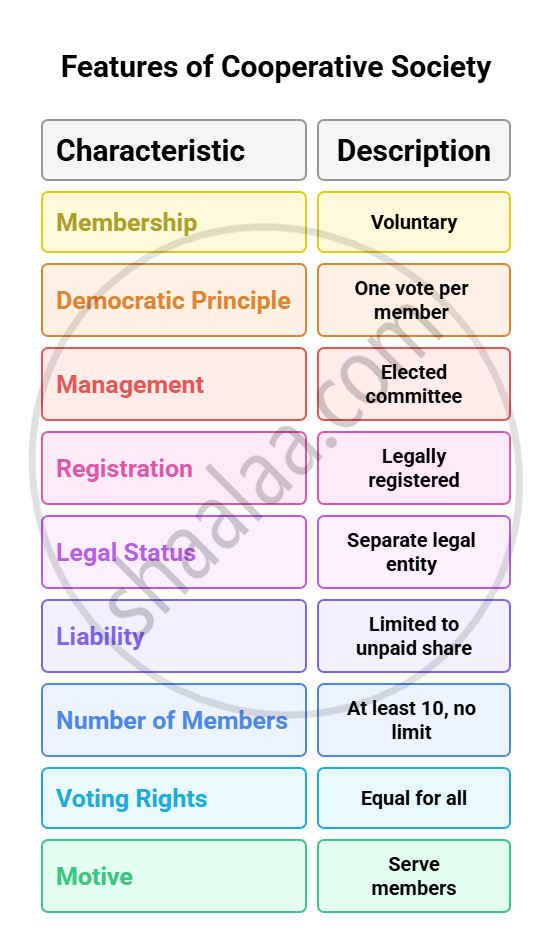
Features
Maharashtra State Board: Class 11
Merits
- Democratic Management: One member, one vote; managed by an elected committee.
- Open Membership: Open to all, with no restrictions.
- Low Expenses: No middlemen; minimal costs.
- Limited Liability: Risk limited to unpaid share value.
- Tax Benefits: Enjoys government tax concessions.
- Charity & Growth: Surplus used for development and charity.
Maharashtra State Board: Class 11
Demerits
Maharashtra State Board: Class 11
Real-Life Application
Case: Amul Dairy Cooperative
Farmers in Gujarat came together to form Amul, which collects milk from each member, processes it, and sells the product. This helps small producers earn more and have a say in the business.
Maharashtra State Board: Class 11
