In spherical mirrors, three primary distances are considered:
Topics
Measurements and Experimentation
- Measurements
- Physical Quantities
- Unit and Its Types
- Unit Systems
- The International System of Units (SI)
- Unit Prefixes
- Measurement of Length
- Measuring Smaller Distances
- Measuring Larger Distances
- Measurement of Time
- Rules and Conventions for Writing SI Units and Their Symbols
- Vernier Callipers
- Principle of Vernier
- Screw Gauge
- Principle of Screw Gauge
- Simple Pendulum
- A Time Period of Oscillation and Frequency
- Measurements Using Common Instruments
Motion in One Dimension
- Scalar and Vector Quantities
- Force and Motion
- Motion Along a Straight Line
- Distance and Displacement
- Speed
- Types of Speed
- Velocity
- Types of Velocity
- Distinguish Between Speed and Velocity
- Acceleration and Retardation
- Types of Acceleration
- Acceleration Due to Gravity (Earth’s Gravitational Acceleration)
- Graphical Representation of Motion
- Displacement - Time Graph Or Distance - Time Graph
- Velocity - Time Graphs
- Acceleration - Time Graph
- Motion Under Gravity
- Equations of Motion by Graphical Method
- Derivation of Velocity - Time Relation by Graphical Method
- Measuring the Rate of Motion - Speed with Direction
- Rate of Change of Velocity
Laws of Motion
- Effect of Force
- Types of Forces>Contact and Non-Contact Forces
- Newton's First Law of Motion
- Inertia and Mass
- Types of Inertia
- Linear Momentum
- Change in Momentum
- Rate of Change of Momentum
- Newton’s Second Law of Motion
- Newton's Third Law of Motion
- Force Due to Gravity
- Acceleration Due to Gravity (Earth’s Gravitational Acceleration)
- Free Fall
- Mass and Weight
- Gravitational Units of Force
- Newton's Universal Law of Gravitation
Fluids
Fluids
- Introduction of Fluid
- Variation of Pressure with Depth in a Fluid
- Thrust and Pressure
- Factors Affecting Pressure
- Pressure of liquid
- Pressure Exerted by a Liquid Column
- Law of Liquid Pressure
- Consequences of Liquid Pressure
- Pascal’s Law
- Application of Pascal’s Law
- Hydraulic Machines: Hydraulic Press (Or Bramah Press)
- Atmospheric Pressure
- Consequences of Atmospheric Pressure
- Measurement of Atmospheric Pressure
- Mercury Barometer (Simple Barometer)
- Fortin’s Barometer
- Aneroid Barometer
- Variation of Atmospheric Pressure with Altitude
- Weather Forecast by the Use of Arometer
- Altimeter
Buoyancy, Upthrust
- Buoyancy Force (Upthrust Force)
- Characteristic Properties of Upthrust
- Reason for Upthrust
- Upthrust is Equal to the Weight of Displaced Liquid (Mathematical Proof)
- Archimedes Principle
- Solid Bodies with density (ρ) greater than density of liquid (ρL) sink while with density (ρ) less than density of liquid (ρL) Float
- Density and It’s Unit
- Relative Density and Its Unit
- Relationship Between Density and Relative Density
- Determination of Relative Density of a Solid Substance by Archimedes’ Principle
- Determination of Relative Density of a Liquid by Archimedes’ Principle
- Principle of Floatation (Laws of Flotation)
- Relation Between Volume of Submerged Part of a Floating Body, the Densities of Liquid and the Body
- Application of the Principle of Floatation
Heat and Energy
- Heat
- The Temperature and a Thermometer
- Thermal Expansion
- Expansion of Solids
- Expansion of Liquids
- Expansion of Gases
- Anomalous Expansion of Water
- Consequences of Anomalous Expansion of Water
- Application of Laws of Thermodynamics in Energy Flow
- Sources of Energy
- Energy Resources > Conventional energy resources or non-renewable energy resources
- Electricity Generation using Solar Energy
- Solar Energy Devices
- Electricity Generation using Wind Energy
- Electricity Generation using Hydroelectric Energy
- Bio-energy
- Energy from the Sea
- Forms of Energy > Geo Thermal Energy
- Power Plants Based on Nuclear Energy
- Conservation of Coal, Petroleum, and Natural Resources
- Protecting our environment
- Energy Degradation
- Green House Effect
- Preventive Measures of Green House Effect
- Preventive Measures of Global Warming
- Future Predictions of Global Warming
Light
- Reflection of Light
- Terms Used in Reflection of Light
- Law of Reflection of Light
- Verification of the Law of Reflection of Light
- Formation of Image by Reflection: Real and Virtual Image
- Formation of Image of a Point Object by a Plane Mirror
- Image of an Extended Object Formed by a Plane Mirror
- Position of Image
- Lateral Inversion
- Plane Mirror
- Images Formed by a Plane Mirrors
- Images Formed in Two Inclined Mirrors
- Images Formed in a Pair of Mirrors Placed Parallel to Each Other
- Images Formed by Two Mirrors Placed Perpendicular to Each Other
- Spherical Mirrors
- Rules to Trace the Image Formed by Spherical Mirrors
- Factors Affecting Focal Length of a Lens
- Position and Nature of Image Formed by Spherical Mirrors
- Spherical Mirror > Concave Mirror
- Image Formation by Concave Mirror
- Spherical Mirror > Convex Mirror
- Image Formation by Convex Mirror
- Relationship Between the Focal Length and Radius of Curvature
- Sign Convention
- Mirror Equation/Formula
- Distinction Between a Plane Mirror, Concave Mirror and Convex Mirror
Sound
- Sound Waves
- Production of Sound
- Propagation of Sound
- Sound Need a Medium to Travel
- Characteristics of Sound
- Representation of a Wave
- Relationship Between the Wavelength, Wave Velocity and Frequency
- Speed of Sound (Velocity of Sound)
- Speed of Sound in Different Media
- Light Waves vs Sound Waves
- Factors Affecting Speed of Sound
- Factors Not Affecting Speed of Sound in a Gas
- Experimental Determination of Speed of Sound in Air
- Audibility and Range
- Ultrasonic Sound Or Ultrasound
Electricity and Magnetism
Electricity
- Electric cell
- Electric Current
- Symbols and Functions of Various Components of an Electric Circuits
- Electric Circuit
- Types of Circuits: Simple Circuit
- Electrical Conduction in Solids
- Flow of Charges (Electrons) Between Conductor
- Direction of the Electric Current - Conventional and Electronic Flow
- Electric Resistance
- Factors of Resistance
- Conservation of Electrical Energy
- Social Initiatives for Energy
Magnetism
- Magnet
- Magnetic and Non-magnetic Materials
- Induced Magnetism
- Properties of magnetic lines of force
- Concept of Magnetism
- Plotting of Uniform Magnetic Field Lines of Earth
- Plotting of Non Uniform Magnetic Field of a Strong Bar Magnet and Neutral Points
- Neutral Points in Magnetic Fields
- Electromagnet
- Making of an Electromagnet
- Permanent Magnet
- Uses of Electromagnet
- Introduction
- Stepwise Derivation of the Mirror Formula
Maharashtra State Board: Class 9
Introduction:
- Object Distance (u): The distance of the object from the pole of the mirror.
- Image Distance (v): The distance of the image from the pole of the mirror.
- Focal Length (f): The distance of the principal focus from the pole of the mirror.
These quantities are related by a mathematical expression known as the mirror formula:
`"1"/"v"`+`"1"/"u"`=`"1"/"f"`
Maharashtra State Board: Class 9
Stepwise Derivation of the Mirror Formula:
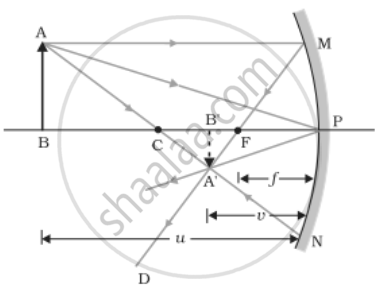
The triangles B′A′F and PMF are similar because they share common angles. Using the property of similar triangles:
`"B'A'"/"PM"`=`"B'F"/"FP"`
Substituting PM=AB into the equation:
`"B'A'"/"BA"`=`"B'F"/"FP"` .............(i)
∠APB = ∠A'PB
△A'B'P' ∼ △AB'P
`"B'A'"/"BA"` = `"B'P"/"BP"` ............(ii)
By comparing equation (i) and (ii), we get
`"B'F"/"FP"`= `"B'P-FP"/"FP"` = `"B'P"/"BP"`
B'P = -ν (image distance),
FP = -f (focal length),
BP = -u (object distance).
Substituting these values:
`"-ν+f"/"-f"` = `"-ν"/"-u"`
`"ν-f"/"f"` = `"ν"/"u"`
On further solving, we get
`"1"/"v"`+`"1"/"u"`=`"1"/"f"`
Related QuestionsVIEW ALL [8]
Match the following:
| Column I | Column II | ||
| 1. | plane mirror | a. | Focal length is positive. |
| 2. | concave | b. | The focal length is negative. |
| 3. | convex | c. | The focal length is infinity. |
| 4. | Real image | d. | Magnification if positive value. |
| 5. | Virtual image | e. | Magnification if negative value. |
Match the following:
| Column I | Column II | ||
| 1. | A plane mirror | a. | The image is erect & smaller in size than the object. |
| 2. | A concave mirror | b. | The image is erect & of the same size as the object. |
| 3. | A convex | c. | Used by dentists to see an enlarged image of teeth. |
| d. | Can form images of objects spread over a large area. |
